3 hrs
Milan
Milan Private Family Tour: Castle, Gelato & Dinosaurss
✓ Free cancellation Kids friendly
4.5(23 reviews)
From €247/ person
Book Now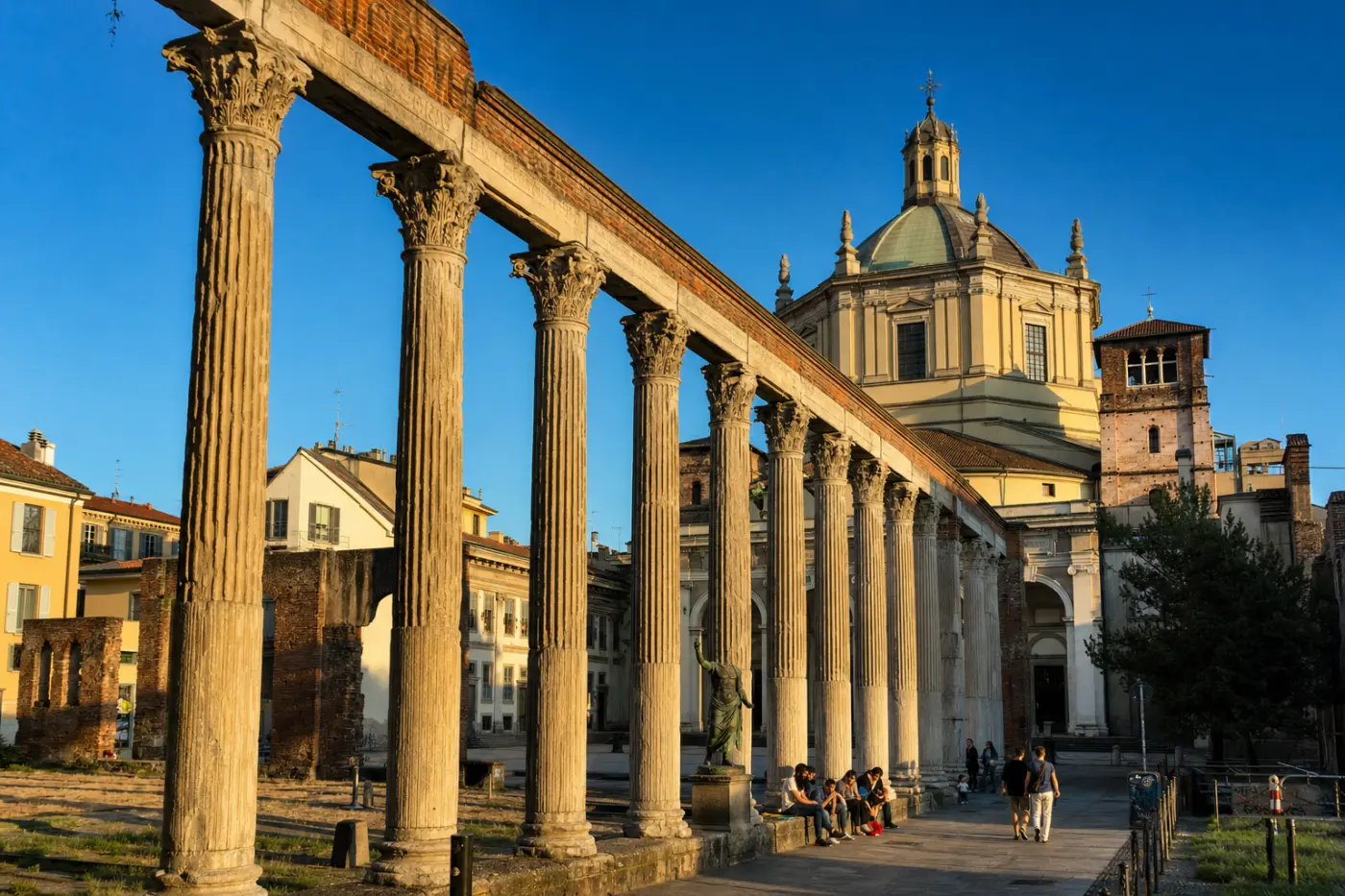
Tourist attraction
The Basilica di San Lorenzo Maggiore stands as one of the most significant early Christian monuments in northern Italy, and among the oldest surviving churches in Milan. Originally constructed in the late 4th century AD — most likely between 355 and 372 AD during the reign of Emperor Valentinian I — the basilica was built on the southwestern edge of the ancient Roman city of Mediolanum, which at that time served as the de facto capital of the Western Roman Empire. Its distinctive octagonal central plan, a rare architectural form in the Latin West, reflects the ambitions of an imperial building program that sought to rival the great ecclesiastical structures of Constantinople and Rome. The church was substantially rebuilt after a partial collapse in 1103 and again restructured in the 16th century under architect Martino Bassi, who restored the dome between 1573 and 1619, yet the essential early Christian spatial concept has endured across seventeen centuries.
Directly in front of the basilica's entrance stands one of Milan's most arresting open-air sights: sixteen granite Corinthian columns known as the Colonne di San Lorenzo. These columns were not built for the church; they originated as part of a 2nd-century Roman public building — most likely a portico attached to the imperial baths or a temple — and were relocated here in the 4th century to form a monumental forecourt. Standing roughly 8 metres tall and still crowned by a continuous entablature fragment, they constitute the most intact Roman colonnade surviving above ground in Milan. A bronze statue of Emperor Constantine I, erected in 1927, stands sentinel between the columns, commemorating the Edict of Milan of 313 AD, which was issued from this very city and granted religious tolerance throughout the Roman Empire.
Inside the basilica, the Chapel of Sant'Aquilino — a separate octagonal mausoleum annexed to the main structure and likely built around 400 AD — contains the church's most precious treasures. Its walls preserve extraordinary early Christian mosaics dating to the late 4th or early 5th century, depicting Christ among his Apostles in a composition that predates comparable Roman mosaics and offers a rare window into the visual theology of the earliest Christian communities. A surviving fragment of a gilded glass mosaic showing an enthroned Christ in a philosopher's pose is considered one of the finest examples of late antique art in Lombardy. Beneath the chapel, a Roman-era crypt contains fragmentary sarcophagi and architectural spolia.
Visitors approaching the basilica along Corso di Porta Ticinese encounter the Colonne di San Lorenzo as a living public space — the colonnade is a beloved gathering point for Milanese at aperitivo hour, lending the ancient stones an unexpectedly vivid social atmosphere. Entry to the main basilica is free, while a small admission fee is charged for the Chapel of Sant'Aquilino, which is essential not to miss. The church is located in the Navigli district, making it straightforward to combine with a walk along the historic canals. Arrive in the morning for quieter interior access and the best natural light filtering through the dome onto the early Christian floor plan below.
Private tours with a local guide, at your own pace.
Milan

Milan
Milan

Milan
Milan
Milan