7 hrs
Paris
Paris Private Full Day Tour: Montmartre, Sights & Eiffel Tower
✓ Free cancellation Kids friendly
4.6(109 reviews)
From €353/ person
Book Now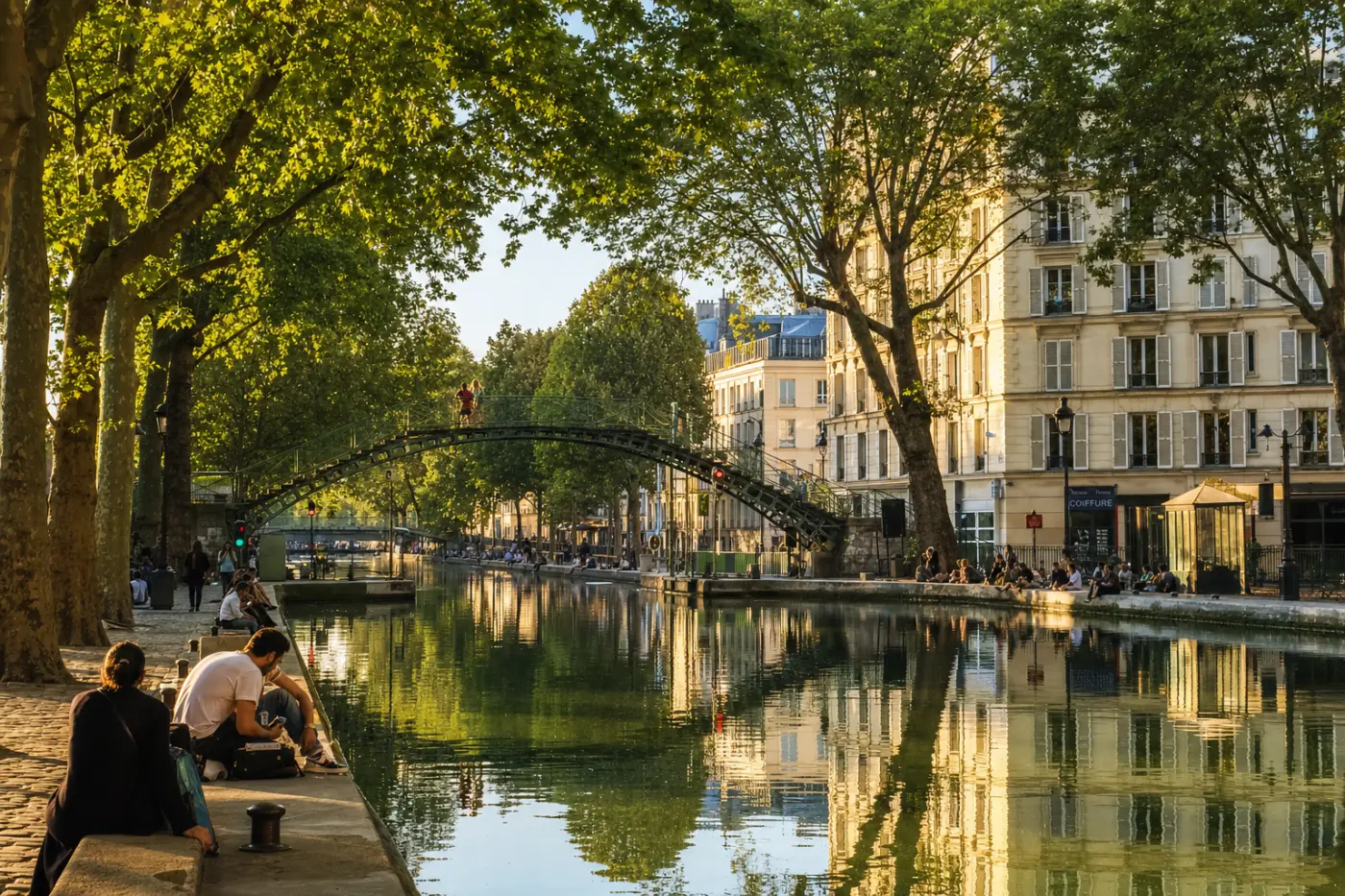
Tourist attraction
The Canal Saint-Martin is a 4.5-kilometre waterway in northeastern Paris, running on a north–south axis from the Bassin de la Villette and the Canal de l'Ourcq down to the Seine River, passing through the 10th arrondissement. Napoleon Bonaparte commissioned its construction in 1802, driven by a practical crisis: Paris's population was growing rapidly and the Seine, perpetually fouled by urban waste, could no longer reliably supply the city with safe drinking water. Construction began in 1805 and the canal opened in 1825, engineered with nine locks to manage a total elevation change of roughly 25 metres, two rotating swing bridges, and several elegant iron footbridges that arch over the water at regular intervals. The entire southern third of the canal — from the Place de la Bastille to the Rue du Faubourg-du-Temple — runs underground through a vaulted tunnel built under Baron Haussmann's Second Empire transformations of Paris in the 1860s, resurfacing into open air just in time for its most photographed stretch of tree-lined quays.
Through the 19th and early 20th centuries, the canal was a working industrial artery: barges loaded with grain, building stone, and wine moved through its locks, and the surrounding neighbourhood was defined by tanneries, workshops, and working-class tenements. The canal gained a lasting cultural imprint in 1938, when Marcel Carné filmed his landmark poetic-realist film Hôtel du Nord here, fixing the canal's melancholy iron bridges and stone quays permanently in the French cinematic imagination. A replica of the original Hôtel du Nord still stands at 102 Quai de Jemappes, now operating as a bar and restaurant. In the 1990s, the city seriously debated converting the canal into a motorway; instead, Paris chose preservation, and the canal corridor was gradually transformed into one of the capital's most desirable neighbourhoods.
Today, the Canal Saint-Martin is the social spine of a distinctly local Paris. On warm evenings and weekend afternoons, Parisians colonise the stone quays with bottles of wine, takeaway food from the surrounding bistros, and board games — an informal ritual that has no official name but feels like the city's most authentic leisure tradition. The canal's nine locks remain operational, and watching a barge slowly rise or descend through a lock chamber is one of the more hypnotic free spectacles the city offers. The surrounding streets — particularly Rue de Marseille, Rue Beaurepaire, and the Quai de Valmy — are dense with independent concept stores, vinyl shops, specialty coffee roasters, and restaurants that attract a young creative crowd without the self-consciousness of more overtly tourist-facing districts.
Boat cruises through the canal, operated by companies like Canauxrama, depart from the Port de l'Arsenal near the Bastille and offer a 2.5-hour passage through the underground tunnel, past the locks, and up to the Bassin de la Villette — a perspective on Paris that most visitors entirely miss. The best time to walk the canal is Sunday morning, when the quays are quiet and the light off the water is at its sharpest. The nearest Métro stations are Jacques Bonsergent (Line 5) for the southern quays and Goncourt or Jaurès (Lines 7bis and 2/5/7bis) for the northern end near the Bassin de la Villette.
Private tours with a local guide, at your own pace.
Paris
Paris
Paris
Paris
Paris
Paris
Paris
Paris
Paris