7 hrs
Paris
Paris Private Full Day Tour: Montmartre, Sights & Eiffel Tower
✓ Free cancellation Kids friendly
4.6(109 reviews)
From €353/ person
Book Now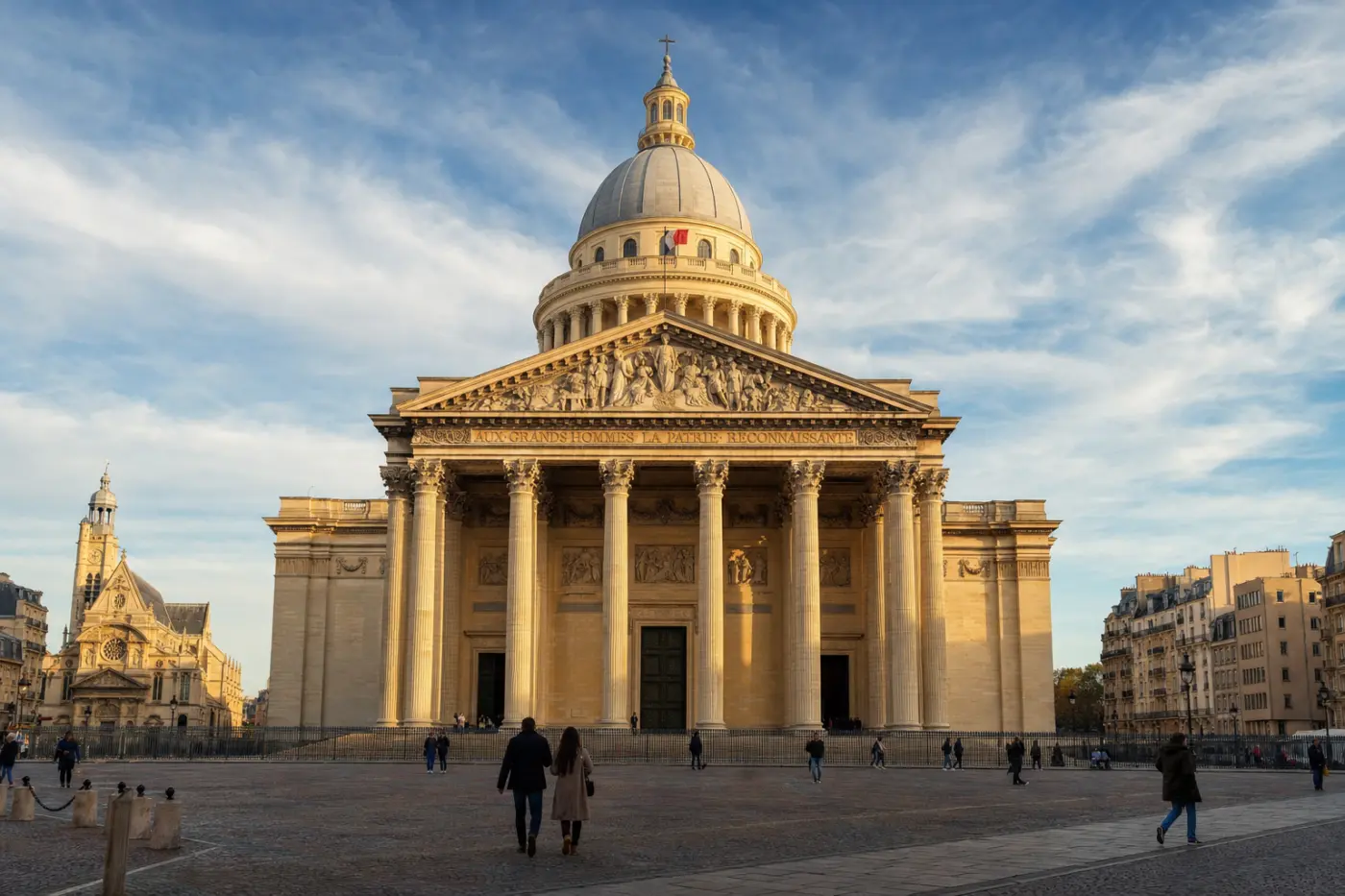
Tourist attraction
Rising 83 meters above the Latin Quarter's Montagne Sainte-Geneviève, the Panthéon is one of the most architecturally ambitious neoclassical buildings in the world. Construction began in 1757 under architect Jacques-Germain Soufflot, commissioned by King Louis XV as a grand church dedicated to Paris's patron saint, Sainte Geneviève. Soufflot's stated ambition was radical for the era: to fuse the soaring luminosity of Gothic cathedral design with the rational geometry of Greek and Roman classicism. The result — 110 meters long, 85 meters wide, and crowned by a dome whose triple-shell structure directly acknowledges Wren's St. Paul's in London and Bramante's Tempietto in Rome — stands as the first great monument of French neoclassicism. Soufflot died in 1780, before the building's completion in 1791, and his collaborator Guillaume Rondelet saw the project through to its consecration, though the full transparency of light Soufflot had envisioned was never achieved due to structural reinforcements that required many windows to be blocked.
The building's identity was transformed almost immediately after completion. In 1791, the Revolutionary National Constituent Assembly voted to secularize it, declaring it a mausoleum for distinguished French citizens under the motto "Aux grands hommes, la patrie reconnaissante" ("To great men, the grateful homeland"). Voltaire and Jean-Jacques Rousseau were among the first to be interred, their remains transferred to the crypt in a ceremony of enormous symbolic weight — two titans of the Enlightenment whose writings had intellectually underpinned the Revolution itself. The building oscillated between church and mausoleum several more times during the 19th century before being definitively secularized in 1885 upon the death of Victor Hugo, whose state funeral drew an estimated two million mourners to the streets of Paris. Today, the crypt holds the remains of over 80 individuals, including Émile Zola, Louis Braille, Jean Moulin (the Resistance hero), and Marie Curie — the first woman to be honoured here on the basis of her own achievements, panthéonized in 1995.
Visitors entering through the massive Corinthian-columned portico step into an interior of breathtaking scale and austere grandeur. The Greek-cross floor plan opens beneath the central dome, where an original replica of Léon Foucault's famous pendulum hangs — a direct reference to the physicist's 1851 experiment conducted in this very space, in which a 67-meter pendulum conclusively demonstrated the Earth's rotation to a Parisian public. The walls of the nave are lined with large-scale painted fresco cycles, most notably Puvis de Chavannes's monumental depictions of Sainte Geneviève's life, completed between 1874 and 1898, rendered in his signature pale, matte palette. A guided visit to the dome's colonnade rewards the climb with a panoramic view over the rooftops of the 5th arrondissement, the Luxembourg Gardens, and, on clear days, the full sweep of the Île de la Cité.
The Panthéon is located at Place du Panthéon in the 5th arrondissement and is managed by the Centre des Monuments Nationaux. It is open daily, with slightly reduced hours in winter. Admission is charged for adults; visitors under 26 from EU countries enter free. The nearest Métro stations are Cardinal Lemoine (line 10) and Luxembourg (RER B). Audio guides are available in multiple languages, and the crypt — where the actual tombs are located — is included in the standard ticket. Allow at least 90 minutes to do the monument justice, including time in the crypt and, if open that day, the dome climb.
Private tours with a local guide, at your own pace.
Paris

Paris
Paris
Paris
Paris
Paris
Paris
Paris
Paris
We use a single cookie, to remember this choice. We do not use analytics or advertising cookies. Read our cookie policy.