2 to 3 hrs
Milan
Milan's Gems & Secrets: Duomo, Castle & Gelato Private Walking Tour
✓ Free cancellation Kids friendly
4.9(49 reviews)
From €158/ person
Book Now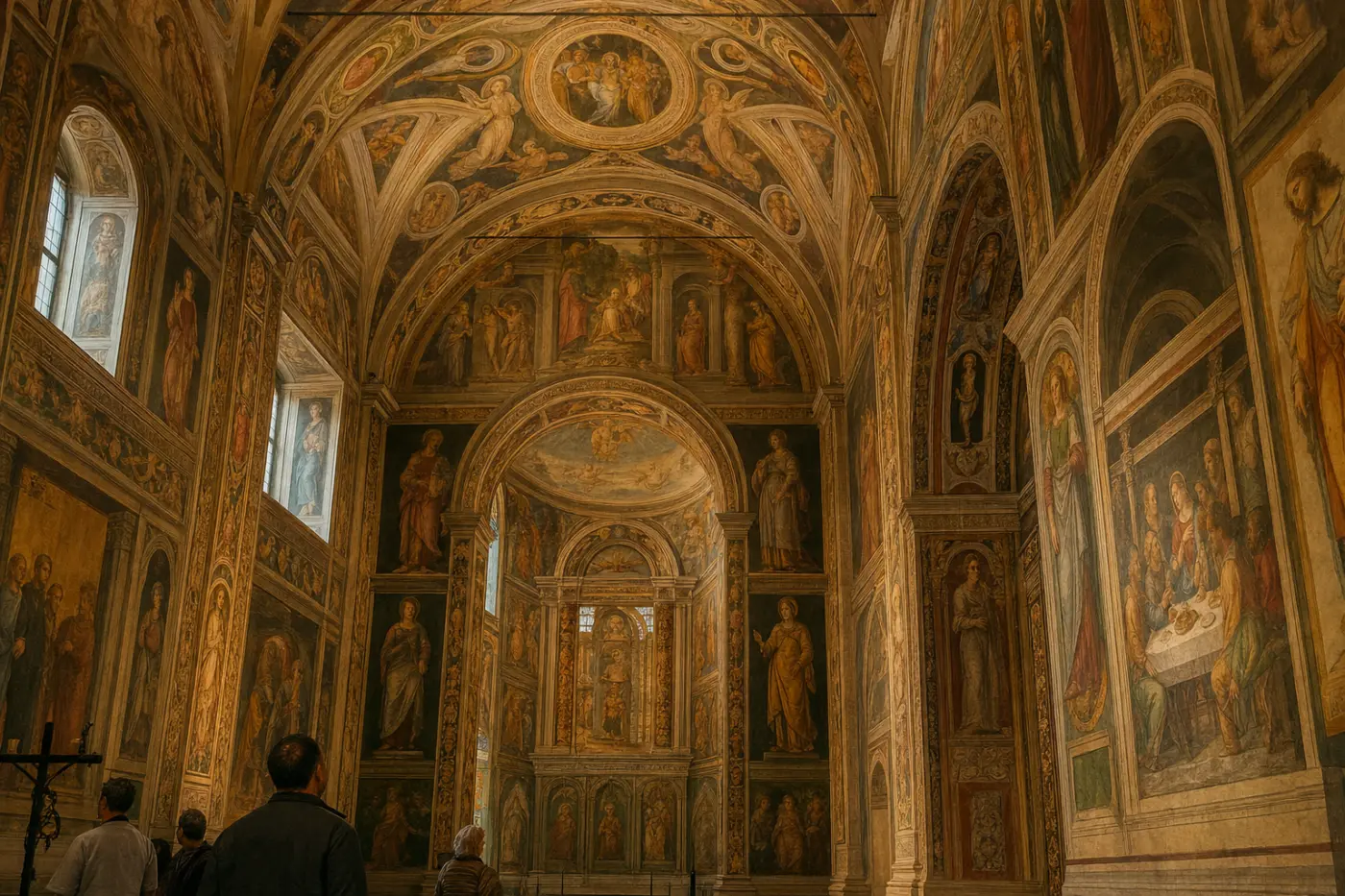
Tourist attraction
Chiesa di San Maurizio al Monastero Maggiore is a Renaissance church on Corso Magenta in central Milan, widely regarded as the most richly frescoed interior in the city. It was built in 1503 as the private chapel of the Benedictine convent known as the Monastero Maggiore — once the largest and most powerful female monastery in Milan, whose origins stretch back to late Roman times. The church is divided into two distinct halves by a tall partition wall: the public nave, where laypeople attended Mass, and the enclosed choir reserved exclusively for the cloistered nuns, who could observe the liturgy through small grilled windows without ever being seen.
The decoration of the interior was carried out primarily between the 1520s and 1550s, with Bernardino Luini — a leading pupil of Leonardo da Vinci — executing the most celebrated cycle of frescoes. Working from around 1522 to 1529, Luini covered the partition wall and the nave walls with scenes from the Life of Christ, the Life of Saint Catherine, and the Life of Saint Maurice, rendering figures with the soft sfumato modeling and serene facial expressions unmistakably influenced by Leonardo. His daughters and other members of his workshop continued the decorative program after his death in 1532. Additional contributions came from painters including Antonio Campi, Callisto Piazza, and Giovanni Antonio Boltraffio, making the church a gallery of the finest Lombard Renaissance painting under one roof. Every surface — arches, lunettes, pilasters, and ceilings — is covered with interlocking devotional scenes and ornamental grotesques, creating an immersive effect that consistently stuns first-time visitors.
The building stands directly adjacent to the Museo Archeologico di Milano, which occupies part of the former monastery complex. Excavations on the site have revealed remnants of Roman Milan (Mediolanum), including sections of the ancient city wall and two Roman towers dating to the 3rd century AD that are still visible in the museum's courtyard. The church itself was suppressed along with the monastery by Napoleonic decree in 1798, after which the convent was converted into the archaeological museum it remains today. San Maurizio was later deconsecrated and is now managed by the Civic Museums of Milan as a monumental space open to the public free of charge.
Visitors should allow at least 45 minutes to absorb the layered frescoes at close range; binoculars are genuinely useful for reading the upper register paintings in detail. The church is open Tuesday through Sunday and admission is free. Photography without flash is permitted. Because the space is relatively compact and acoustically intimate, mornings on weekdays offer the quietest experience. The church is a five-minute walk from the Cadorna Metro station (Lines M1 and M2) and sits on the same block as Santa Maria delle Grazie, home of Leonardo's Last Supper, making it a natural pairing for a single afternoon itinerary.
Private tours with a local guide, at your own pace.
Milan
Milan
Milan
Milan

Milan
Milan
We use a single cookie, to remember this choice. We do not use analytics or advertising cookies. Read our cookie policy.