3 hrs
Milan
Milan Private Family Tour: Castle, Gelato & Dinosaurss
✓ Free cancellation Kids friendly
4.5(23 reviews)
From €247/ person
Book Now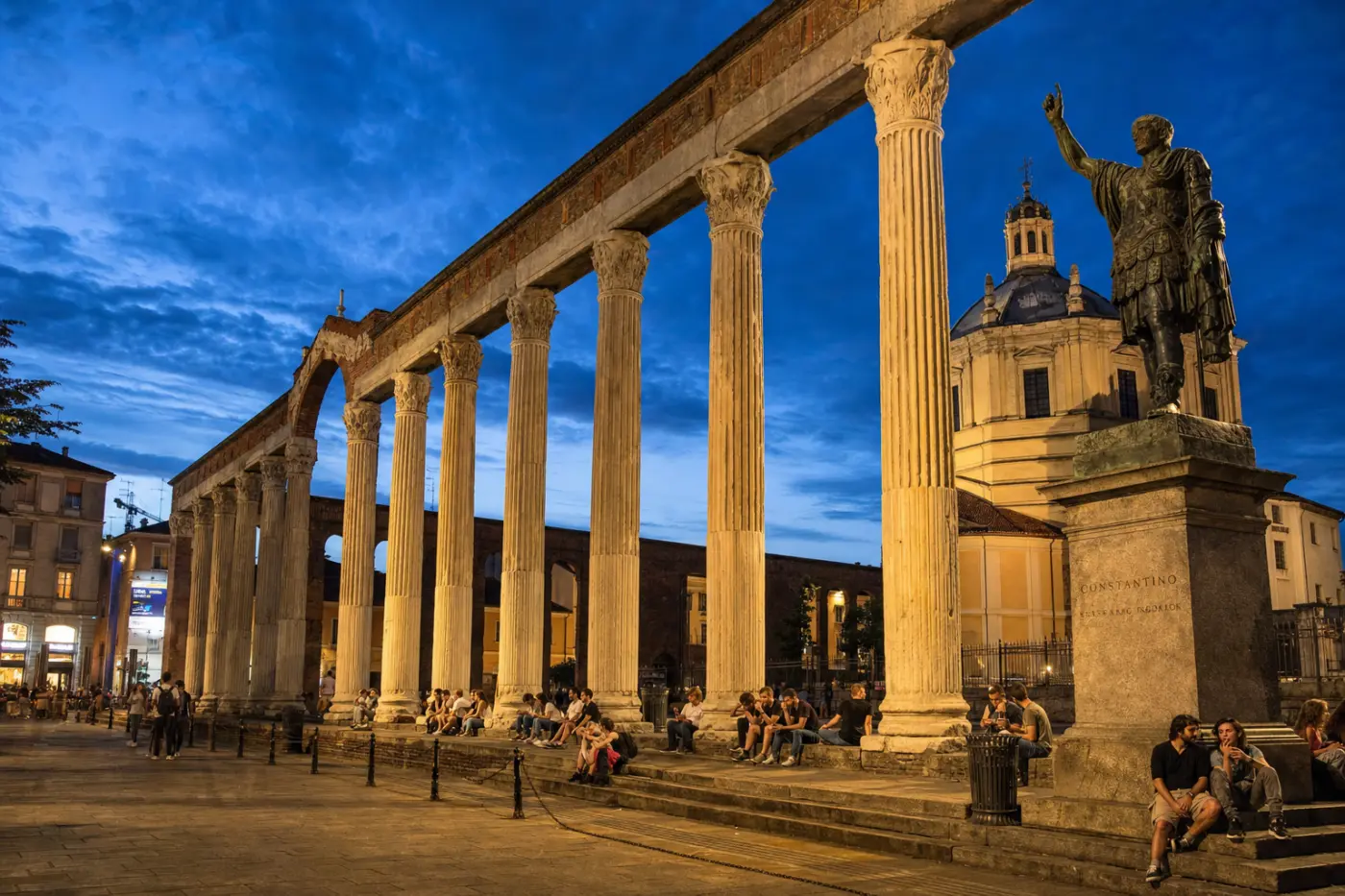
Tourist attraction
The Colonne di San Lorenzo is a colonnade of sixteen ancient Roman marble columns standing along Corso di Porta Ticinese, directly in front of the Basilica di San Lorenzo Maggiore. Quarried and carved between the 2nd and 3rd centuries AD, the columns are Corinthian in style and are believed to have originally belonged to a large Roman public structure — most likely a temple or the thermae (bath complex) of the imperial city of Mediolanum, as Milan was known under Roman rule. In the 4th century AD, during the city's transformation under Emperor Constantine and his successors, the columns were dismantled from their original location and re-erected at their current site to form an imposing entrance atrium to the early Christian basilica beside them. This act of architectural reuse — known as spolia — was common in Late Antiquity and makes the colonnade a living record of two civilizations layered on top of each other.
The Basilica di San Lorenzo Maggiore, which the columns precede, is itself one of the oldest churches in Milan, founded around 364–378 AD and considered a masterpiece of early Christian architecture. Together, the columns and the basilica form one of the most archaeologically significant ensembles in northern Italy. A bronze statue of Emperor Constantine — a copy of the original in Rome's Basilica of San Giovanni in Laterano — stands at the head of the colonnade, placed there in 1927, and references Milan's pivotal role as the western imperial capital from 286 to 402 AD, the period during which Constantine issued the Edict of Milan (313 AD) granting religious tolerance throughout the empire.
Visitors approaching the colonnade along Corso di Porta Ticinese encounter the columns rising nearly seven meters high, connected by fragments of an ancient entablature. The travertine and marble surfaces carry nearly two millennia of weathering, yet the proportions remain strikingly intact. The broad paved piazza in front of the columns has been a meeting point for Milanese since antiquity, and that social function has never ceased: today it is one of the liveliest aperitivo and evening gathering spots in the city, particularly among students and young locals, giving it a rare duality as both a serious archaeological site and an organic part of daily urban life.
Admission to the colonnade itself is free and the site is accessible at all hours. For the richest visual experience, visit at dusk when the columns are lit and the warm light brings out the depth of the marble. The nearby Basilica di San Lorenzo Maggiore — which also preserves a remarkable 4th-century chapel, the Cappella di Sant'Aquilino, with original Roman mosaic fragments — is open to visitors for a small fee. The area sits within the Ticinese neighbourhood, a ten-minute walk from the Navigli canal district, and is well served by tram lines 3 and 9 from the city centre.
Private tours with a local guide, at your own pace.
Milan

Milan
Milan

Milan
Milan
Milan