7 hrs
Paris
Paris Private Full Day Tour: Montmartre, Sights & Eiffel Tower
✓ Free cancellation Kids friendly
4.6(109 reviews)
From €353/ person
Book Now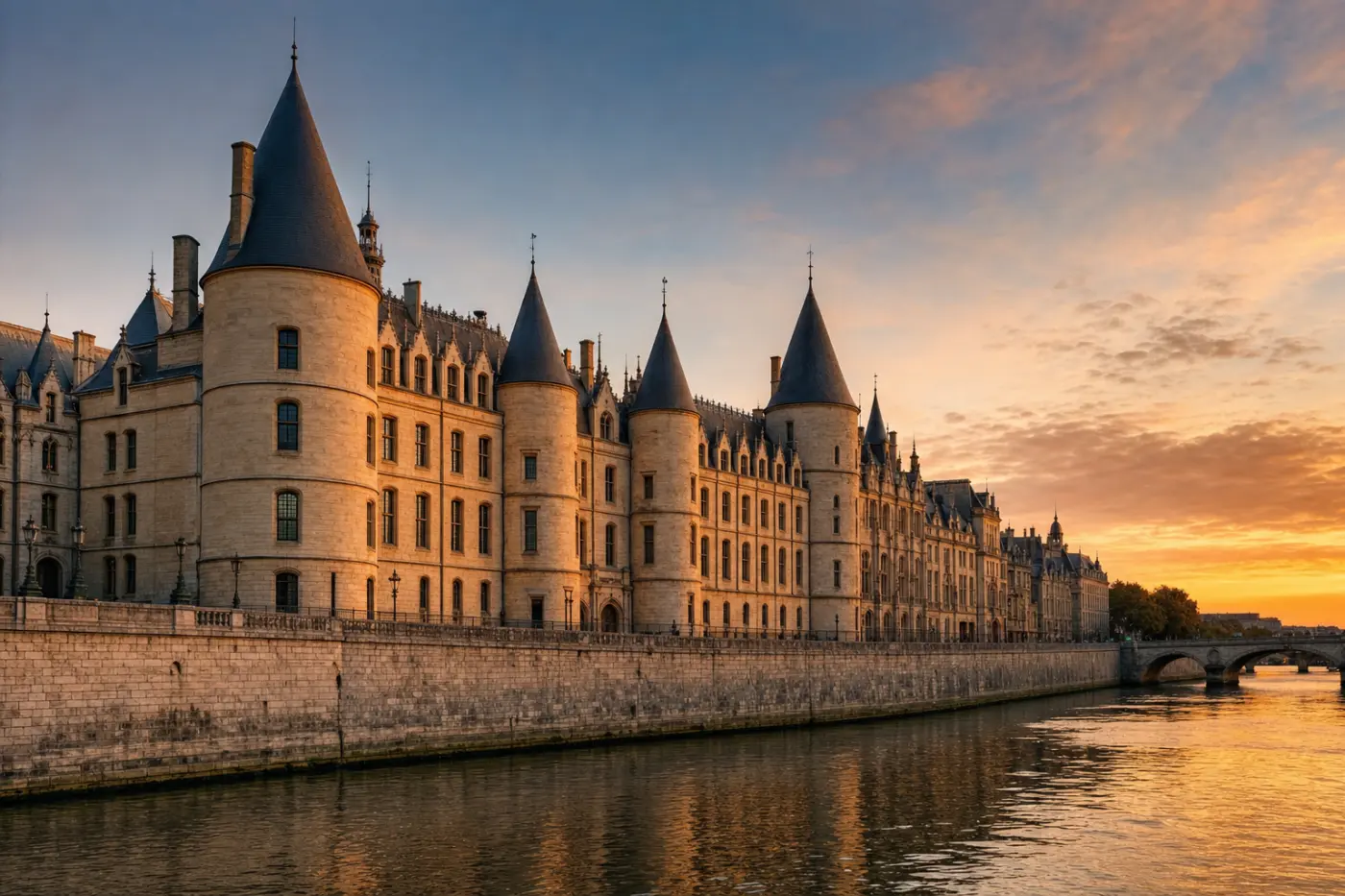
Tourist attraction
The Conciergerie occupies the western tip of the Île de la Cité, the island at the geographic and historic heart of Paris. Built as part of the Capetian royal palace complex beginning in the late 10th century, it reached its architectural peak under Philip IV ("Philip the Fair"), who commissioned the great Gothic halls between 1299 and 1313. The Salle des Gens d'Armes — the vast vaulted hall completed around 1302 — is one of the largest surviving Gothic civic interiors in Europe, stretching 64 metres in length and supported by four rows of slender columns. When the French royal court permanently relocated to the Louvre in 1358, the palace was repurposed as the seat of the Parlement de Paris, and the building's management was handed to a "concierge," a royal caretaker whose title gave the monument its enduring name. A prison wing was established at the same time, initially housing common criminals and debtors.
The Conciergerie's darkest chapter unfolded between 1793 and 1794, during the Reign of Terror that followed the French Revolution. The Revolutionary Tribunal, seated in the adjacent Palais de Justice, used the Conciergerie as its primary holding prison: an estimated 2,700 people passed through its gates during this period before being condemned and sent to the guillotine. The most famous prisoner was Marie Antoinette, who was held here from August 2, 1793, until her execution on October 16, 1793. Her cell — reconstructed and preserved — remains the emotional centrepiece of the monument. Other notable prisoners included the revolutionary leaders Georges Danton and Maximilien Robespierre himself, who was held briefly before his own execution in July 1794, marking the end of the Terror.
Today, visitors move through a layered sequence of spaces that span more than seven centuries of French history. The Salle des Gens d'Armes impresses immediately with its scale and the elegance of its Gothic vaulting, which once served as a communal dining hall for hundreds of royal servants. Beyond it, the prison quarter presents a meticulously documented record of life — and death — under the Revolutionary Tribunal: original cell arrangements, the "Rue de Paris" corridor where prisoners awaited their fate, and a chapel converted in the 19th century into a memorial for Marie Antoinette by Louis XVIII. Detailed interpretive displays cover the mechanics of the tribunal, the social hierarchy among prisoners (wealthy detainees could pay for private cells, while the poor slept communally on straw), and individual portraits of those who passed through.
The Conciergerie is located at 2 Boulevard du Palais, on the Île de la Cité, accessible by Métro lines 4 (Cité station) or RER B and C (Saint-Michel–Notre-Dame). It is managed by the Centre des Monuments Nationaux and is open daily. A combined ticket with the Sainte-Chapelle — located steps away within the same palace precinct — is available and strongly recommended, as the two monuments together represent the full scope of Capetian royal ambition on the island. Arrive early on weekdays to avoid queues, and allow at least 90 minutes to do the interior justice.
Private tours with a local guide, at your own pace.
Paris

Paris
Paris
Paris

Paris
Paris
Paris
Paris
Paris