4 hrs
Valencia
Highlights & Secrets of Valencia Half-Day Private Tour with Local Tasting
✓ Free cancellation Kids friendly
4.8(55 reviews)
From €163/ person
Book Now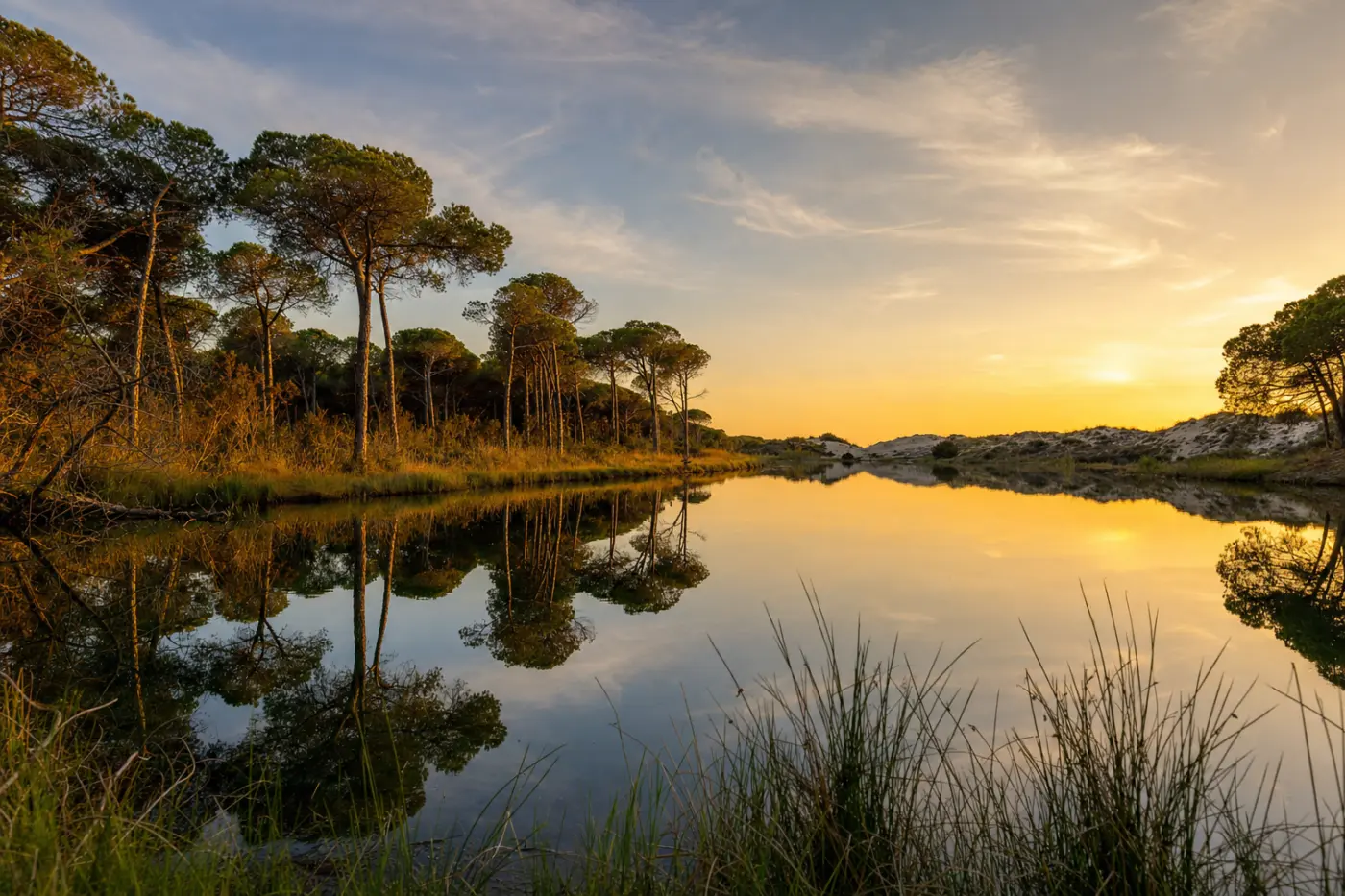
Tourist attraction
Estany del Pujol is an artificial lake nestled within the Devesa del Saler, the pine-forested sand barrier that separates the Albufera lagoon from the Mediterranean Sea, just 12 kilometres south of Valencia's city centre. Its origins are rooted in one of Spain's most controversial urban planning episodes: in 1962, Valencia's City Council launched an ambitious development scheme to convert the ecologically rich Devesa into a tourist and residential resort. Roads were bulldozed through the pine forest, residential towers began to rise, and an artificial lake was excavated from an ancient "mallada" — a Valencian term for the low-lying seasonal wetlands that form between the mobile coastal dunes and the fixed inner dune line — with the intention of turning it into a marina. The project was eventually halted, in large part due to sustained protests from local residents, environmental scientists, and the influential naturalist Félix Rodríguez de la Fuente, whose public opposition helped galvanise national conservation awareness in the early 1970s.
Rather than fill in the excavated lake during the subsequent renaturalisation of the Devesa, authorities chose to retain it and integrate it into the Albufera Natural Park as a protected nature reserve. The decision proved inspired. Freed from human disturbance, the lake has become a productive breeding habitat for numerous bird species, several of which hold vulnerable conservation status under Spanish and European legislation. Access to the shoreline is prohibited to protect nesting fauna, making the lake a tranquil, undisturbed pocket of wilderness. Its name honours the dominant toponym of the surrounding area: "Pujol" in Valencian means mound or small hill, a reference to the impressive coastal dunes known as the Montanyar del Pujol, which reach heights of up to 9.5 metres and were among the landscape features that survived the bulldozers of the 1960s urbanisation project.
Visitors explore the lake via a perimeter path that begins after crossing the Gola del Pujol — a historic tidal canal connecting Albufera to the sea, regulated by traditional wooden gates. The route forms part of a network of marked trails offering botanical, historical, scenic, and ornithological itineraries through the Devesa. At the confluence of the Gola del Pujol with Albufera stands one of the area's most atmospheric spots: a recently restored traditional Valencian barraca beside a timber pier, where "albuferenc" flat-bottomed boats can be hired and where the westward sunsets over the lagoon are exceptional. The shoreline path is fully accessible, with adapted walkways and ramps, and disabled parking is available at the beach access car park.
Extending the visit southward rewards walkers with the Playa de la Garrofera, a 1.5-kilometre stretch of fine sand backed by dunes and Aleppo pine forest, its first section designated naturist. Further south lies the Casal d'Esplai, a hostel housed in a heritage building positioned within what is considered the most biologically diverse zone of the entire Devesa del Saler. The lake is accessed via Avinguda de la Gola del Pujol and Avinguda dels Pinars, and visiting in spring or early autumn maximises both birdwatching opportunities and the golden quality of light across the water.
Private tours with a local guide, at your own pace.
Valencia
Valencia

Valencia
Valencia
Valencia

Valencia
Valencia
Valencia
We use a single cookie, to remember this choice. We do not use analytics or advertising cookies. Read our cookie policy.