7 hrs
Paris
Paris Private Full Day Tour: Montmartre, Sights & Eiffel Tower
✓ Free cancellation Kids friendly
5.0(40 reviews)
From €353/ person
Book Now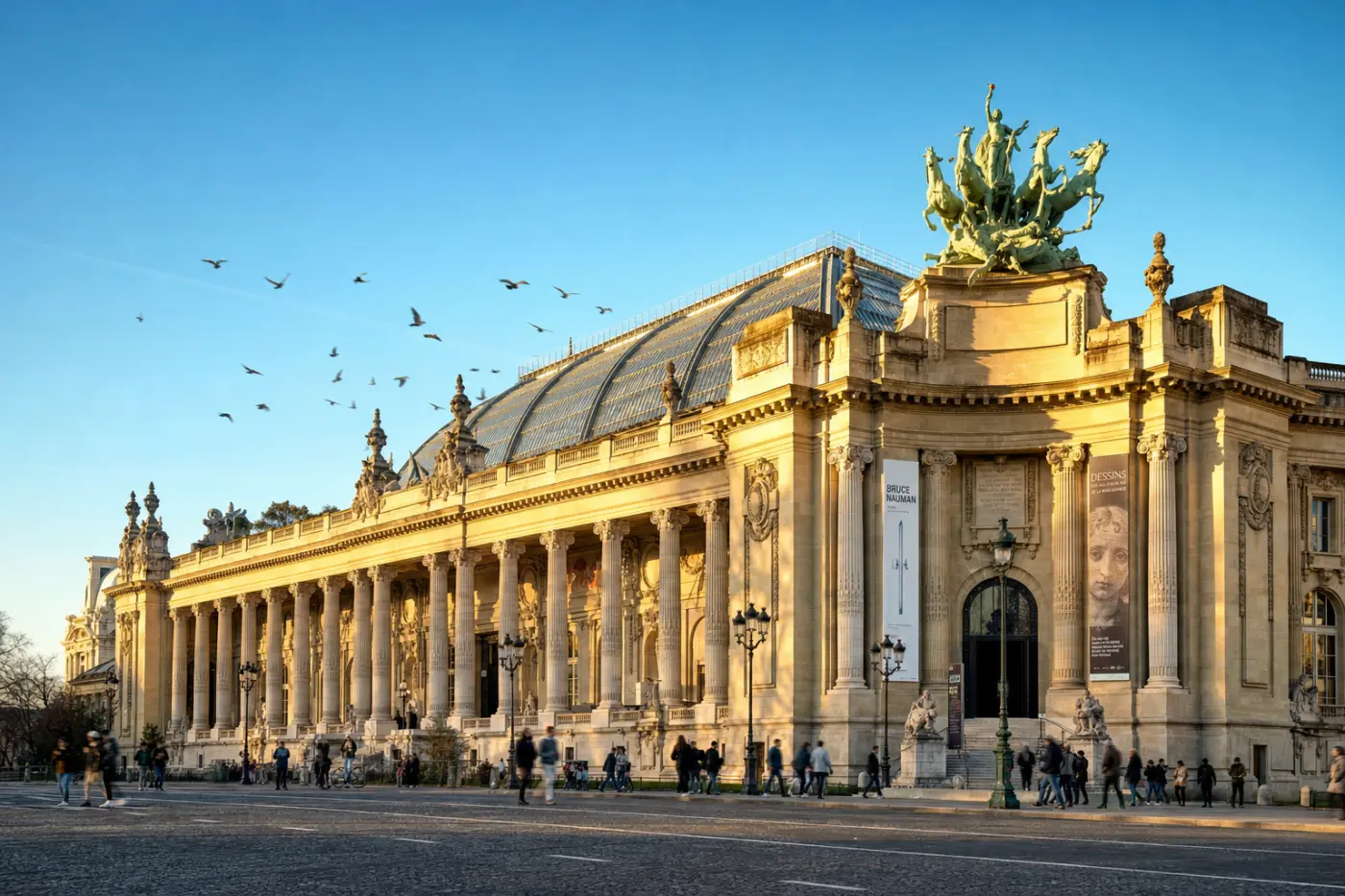
Tourist attraction
The Grand Palais is a monumental exhibition hall and cultural landmark standing on the Avenue des Champs-Élysées in Paris's 8th arrondissement. Commissioned by the French government for the Exposition Universelle of 1900, it was designed by four architects — Henri Deglane, Albert Louvet, Albert Thomas, and Charles Girault — who divided the building into distinct sections while unifying the whole under one of the largest glass-and-steel domes in Europe. The nave's barrel-vaulted glass roof spans 200 metres in length and rises 45 metres at its apex, flooding the interior with natural light that shifts dramatically throughout the day. The exterior is a confident marriage of Beaux-Arts stone colonnades and ironwork, adorned with allegorical bronze quadrigas by Georges Récipon above its corner pavilions — figures representing Immortality triumphing over Time and Harmony vanquishing Discord.
From its inauguration on April 1, 1900, the Grand Palais served as the centrepiece of France's bid to assert cultural and industrial supremacy at the turn of the century. It hosted the Salon des artistes français and the Salon de la Société nationale des beaux-arts simultaneously that year, beginning a long tradition as France's premier venue for major art salons. During World War I it was converted into a military hospital and a motor vehicle depot; during World War II, the Nazi occupation turned parts of it into a truck garage and a storage facility for looted goods. After extensive post-war restorations, it reopened as a world-class exhibition space and subsequently hosted landmark retrospectives dedicated to Picasso (1966), Tutankhamun (1967), and countless others through the late 20th century. The building underwent a sweeping, decade-long renovation — the most ambitious in its history — completed in time for Paris to host equestrian and taekwondo events of the 2024 Summer Olympics within its nave.
Visitors entering the Grand Palais today step into one of architecture's great interior spectacles: the nave's ribbed iron arches and glazed canopy create an atmosphere closer to a Gothic cathedral than a conventional exhibition hall. Depending on the current programme, guests may encounter blockbuster art exhibitions, international fairs such as FIAC (now Paris+ par Art Basel), fashion shows, circus performances, or sporting competitions — all staged beneath the same luminous vault. The adjacent Palais de la Découverte, the science museum that occupied the west wing from 1937, relocated during the renovation, though plans exist for its eventual return. Guided tours of the architecture itself are offered regularly, giving access to the ornate façades, the monumental staircases, and curatorial details often missed during ticketed events.
The Grand Palais sits between the Seine and the Champs-Élysées, directly opposite the Petit Palais across Avenue Winston Churchill — both buildings were constructed in tandem for the 1900 fair and remain paired landmarks of the same urban composition. The nearest Métro stations are Champs-Élysées–Clemenceau (lines 1 and 13) and Franklin D. Roosevelt (lines 1 and 9), each a short walk away. Because programming changes frequently and many events require advance tickets, checking the official schedule at grandpalais.fr before visiting is strongly advised. The building's monumental exterior and the esplanade in front of it are always freely visible and are themselves worth the detour.
Private tours with a local guide, at your own pace.
Paris

Paris
Paris
Paris
Paris
Paris
Paris
Paris
Paris
We use a single cookie, to remember this choice. We do not use analytics or advertising cookies. Read our cookie policy.