7 hrs
Paris
Paris Private Full Day Tour: Montmartre, Sights & Eiffel Tower
✓ Free cancellation Kids friendly
4.6(109 reviews)
From €353/ person
Book Now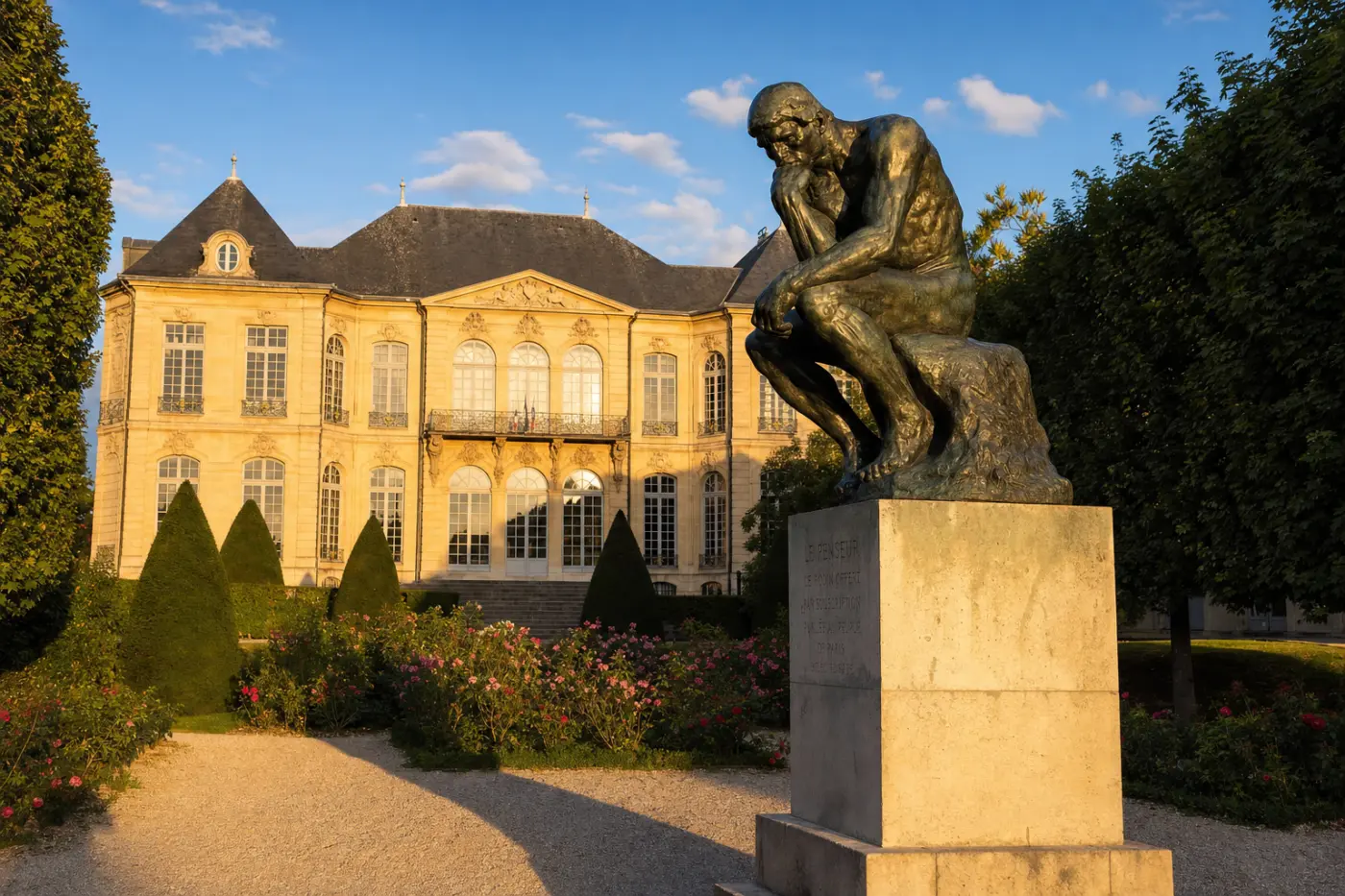
Tourist attraction
The Musée Rodin occupies the Hôtel Biron, an aristocratic mansion built in 1730 in Paris's 7th arrondissement, at 77 Rue de Varenne. The building drifted through various uses — a convent, a school, a series of artist studios — before Auguste Rodin began renting rooms there in 1908. Poets, painters, and composers worked alongside him in the same generous light-filled halls, drawn by the parquet floors, tall windows, and gardens that muffled the city beyond. When Rodin died in November 1917, he had already secured the building's future: in 1916 he donated his entire estate — sculptures, plasters, drawings, photographs, and copyrights — to the French state, on the explicit condition that the Hôtel Biron become a permanent museum dedicated to his work. It opened to the public in 1919 and has remained one of Paris's most-visited cultural institutions ever since.
The collection spans more than 6,000 works and traces the full arc of Rodin's career. Inside the mansion, rooms arranged thematically display finished marbles alongside plaster studies and fragmentary casts — hands, torsos, and heads that Rodin recombined across multiple compositions. This deliberate inclusion of process alongside masterpiece reflects his own studio philosophy. The centerpiece of the interior is The Gates of Hell, a monumental bronze portal commissioned by the French government in 1880 as a doorway for a planned decorative arts museum that was never built. Rodin labored on it until his death, populating its surface with 186 figures. Both The Thinker and The Kiss originated as figures within this ensemble before Rodin enlarged them into independent works. The Thinker — originally titled The Poet, conceived as a self-portrait of Dante surveying the Inferno — now stands in the garden on its own plinth, one of the most recognized sculptures in the world.
The 3-hectare garden is itself a major reason to visit. Rose beds, linden alleys, and a reflecting pool provide the setting for large-scale bronzes placed to interact with natural light and open sky. The Burghers of Calais (1889), Rodin's tribute to six medieval citizens who offered their lives to spare their city during the Hundred Years' War, stands at ground level without a traditional raised pedestal — just as Rodin had always insisted, so that viewers stand face-to-face with the figures rather than looking up at them. The garden also houses a dedicated room exploring the work of Camille Claudel, Rodin's student, collaborator, and companion, whose own sculptural voice is increasingly recognized as distinct and essential.
The museum opens daily except Mondays, from 10:00 AM to 6:30 PM. The garden alone can be visited at a reduced rate — an excellent option on clear afternoons. The closest Métro station is Varenne (Line 13), directly outside the museum gates. Arriving early on weekdays avoids the longest queues around The Thinker. Book tickets online in advance, particularly in summer, as timed-entry slots fill quickly. The on-site café overlooks the garden and is worth a stop after the collection. The museum sits minutes from Les Invalides and the Musée d'Orsay, making the 7th arrondissement a natural full-day itinerary for anyone serious about French art history.
Private tours with a local guide, at your own pace.
Paris

Paris
Paris
Paris

Paris
Paris
Paris
Paris
Paris