7 hrs
Paris
Paris Private Full Day Tour: Montmartre, Sights & Eiffel Tower
✓ Free cancellation Kids friendly
4.6(109 reviews)
From €353/ person
Book Now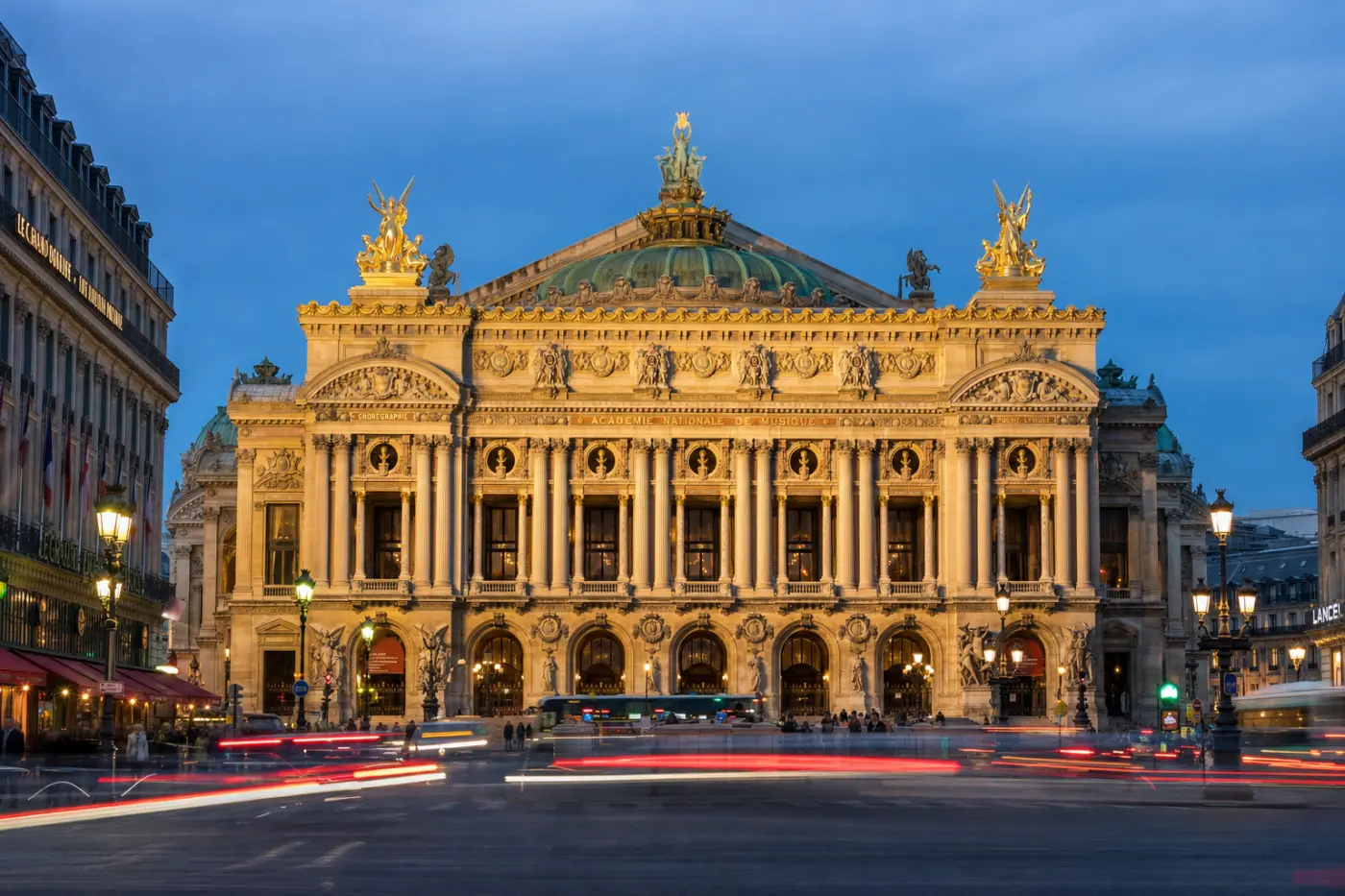
Tourist attraction
The Palais Garnier — officially the Académie Nationale de Musique — is a 1,979-seat opera house standing at the Place de l'Opéra in Paris's 9th arrondissement. Designed by the 35-year-old Charles Garnier, who won an 1860 open competition against 170 rival entries, the building was commissioned by Emperor Napoleon III as the crowning monument of Baron Haussmann's radical restructuring of Paris. Construction ran from 1862 to 1875, interrupted by the Franco-Prussian War and the Paris Commune of 1870–71, during which the unfinished shell served as a military depot and prisoner-of-war holding facility. When the opera finally inaugurated in January 1875 — under the Third Republic, not the empire that had conceived it — it was immediately recognized as a masterpiece of Second Empire and Beaux-Arts architecture, a style Garnier himself simply called "Napoleon III," a new visual language synthesizing Greek, Roman, Renaissance, and Baroque precedents into a single coherent spectacle.
Garnier's genius lay in designing the building as a choreography of movement and light. Visitors pass from a compressed, shadowed entrance vestibule into the soaring Grand Staircase — a cascade of white Algerian marble flanked by onyx balusters and green Levanto marble columns, lit by candelabras and culminating in a ceiling of painted allegories. The Grand Foyer, modeled loosely on the Hall of Mirrors at Versailles, stretches 54 meters along the façade and is encrusted with gilded mosaics, painted medallions, and bronze lampstands. The auditorium itself seats the audience beneath a circular ceiling painted by Marc Chagall in 1964 — a dreamy, chromatic departure commissioned by then-Minister of Culture André Malraux that replaced the original décor and remains a point of controversy and delight in equal measure. Suspended above the stalls hangs the legendary 8-tonne crystal chandelier, one of several elements that inspired Gaston Leroux's 1910 gothic novel The Phantom of the Opera, which fictionalizes an underground lake beneath the stage — in reality, a functional cistern built to stabilize the building's foundations in the waterlogged subsoil of the 9th arrondissement.
Beyond the main auditorium, the building conceals a library-museum holding over 100,000 documents — scores, stage designs, costumes, and photographs tracing the history of French opera and ballet from the 17th century to the present. The Palais Garnier is today home to the Paris Opera Ballet, one of the oldest and most prestigious ballet companies in the world, founded in 1661 under Louis XIV. Larger operatic productions have largely migrated to the Opéra Bastille since its opening in 1989, but the Garnier remains the prestige stage for ballet and select opera performances, as well as for the annual Paris Opera Ball.
Visitors can tour the interior independently on most mornings (typically 10:00 AM to 5:00 PM, closed during rehearsals and matinées — check schedules before visiting). Self-guided tours include the Grand Staircase, Grand Foyer, the auditorium when not in use, and the library-museum. Booking tickets in advance is strongly advised, particularly in summer. The building is a seven-minute walk from the Louvre and is directly served by Métro lines 3, 7, 8 at the Opéra station. Even those who never attend a performance should step inside: the exterior façade alone — with its sculpted groups including Jean-Baptiste Carpeaux's original La Danse (now replaced by a copy; the original is in the Musée d'Orsay) — constitutes one of the most concentrated displays of 19th-century sculptural ambition in Europe.
Private tours with a local guide, at your own pace.
Paris

Paris
Paris
Paris

Paris
Paris
Paris
Paris
Paris