7 hrs
Paris
Paris Private Full Day Tour: Montmartre, Sights & Eiffel Tower
✓ Free cancellation Kids friendly
4.6(109 reviews)
From €353/ person
Book NowTourist attraction
Covering more than 86,000 square meters at the eastern terminus of the Champs-Élysées, the Place de la Concorde is the largest public square in Paris and one of the most historically charged open spaces in Europe. It was originally designed in 1755 by royal architect Ange-Jacques Gabriel under the commission of King Louis XV, whose equestrian statue once stood at its center. The square was then called the Place Louis XV, and its octagonal layout — flanked by two matching neoclassical colonnaded buildings, the Hôtel de la Marine and the Hôtel de Crillon — set a new standard for French urban design in the 18th century.
The square's name has changed with France's political fortunes. During the French Revolution it became the Place de la Révolution, and between 1792 and 1795 a guillotine was erected here that claimed over 1,300 lives. King Louis XVI was executed on January 21, 1793, followed by Marie Antoinette on October 16 of the same year. Revolutionary figures Robespierre, Georges Danton, and Charlotte Corday also met their end on this spot. The square was renamed "de la Concorde" — meaning harmony — in 1795 as a deliberate act of reconciliation after the Terror, a name it has held ever since, save for a brief return to "Louis XVI" during the Restoration.
At the center of the square since 1836 stands the Luxor Obelisk, a 23-meter-tall, 230-tonne pink granite monolith originally erected in front of the Luxor Temple in Egypt around 1300 BCE under Pharaoh Ramesses II. It was gifted to France by Egyptian viceroy Muhammad Ali in 1833 and transported to Paris aboard a specially constructed ship, the Louqsor. The hieroglyphics covering its four faces recount the deeds of Ramesses II and his son Ramesses III. In 1998, Egypt gifted France the matching obelisk's pyramidion (tip), which had been lost — a golden replica now caps the monument. Two ornate 19th-century fountains, modeled on those in St. Peter's Square in Rome, flank the obelisk and animate the space with cascading water.
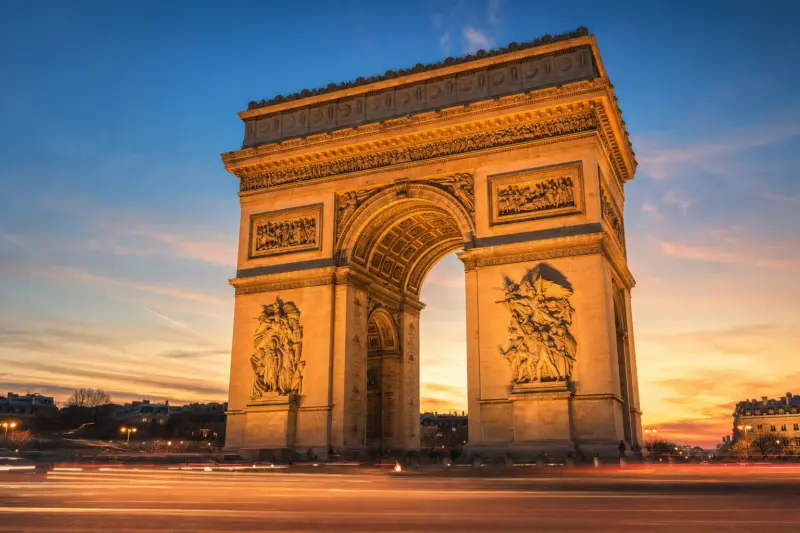
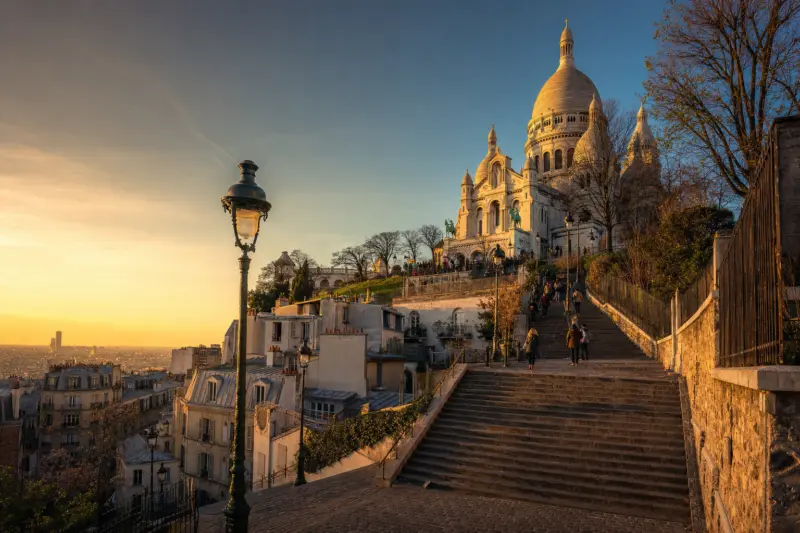
Visitors approaching from the Champs-Élysées enjoy one of Paris's most celebrated urban vistas: the obelisk perfectly framing the distant Arc de Triomphe to the west, and the Tuileries Garden gates to the east, with the dome of the Sacré-Cœur visible to the north on clear days. The square is also the finish line of the Tour de France and hosts Paris's largest New Year's Eve celebrations. For the best experience, arrive around sunset when the golden light catches the obelisk's hieroglyphics. The square is freely accessible at all times, and the nearby Concorde Métro station (lines 1, 8, and 12) makes it easily reachable from across the city.
Private tours with a local guide, at your own pace.
Paris

Paris
Paris
Paris

Paris
Paris
Paris
Paris
Paris