7 hrs
Paris
Paris Private Full Day Tour: Montmartre, Sights & Eiffel Tower
✓ Free cancellation Kids friendly
4.6(109 reviews)
From €353/ person
Book Now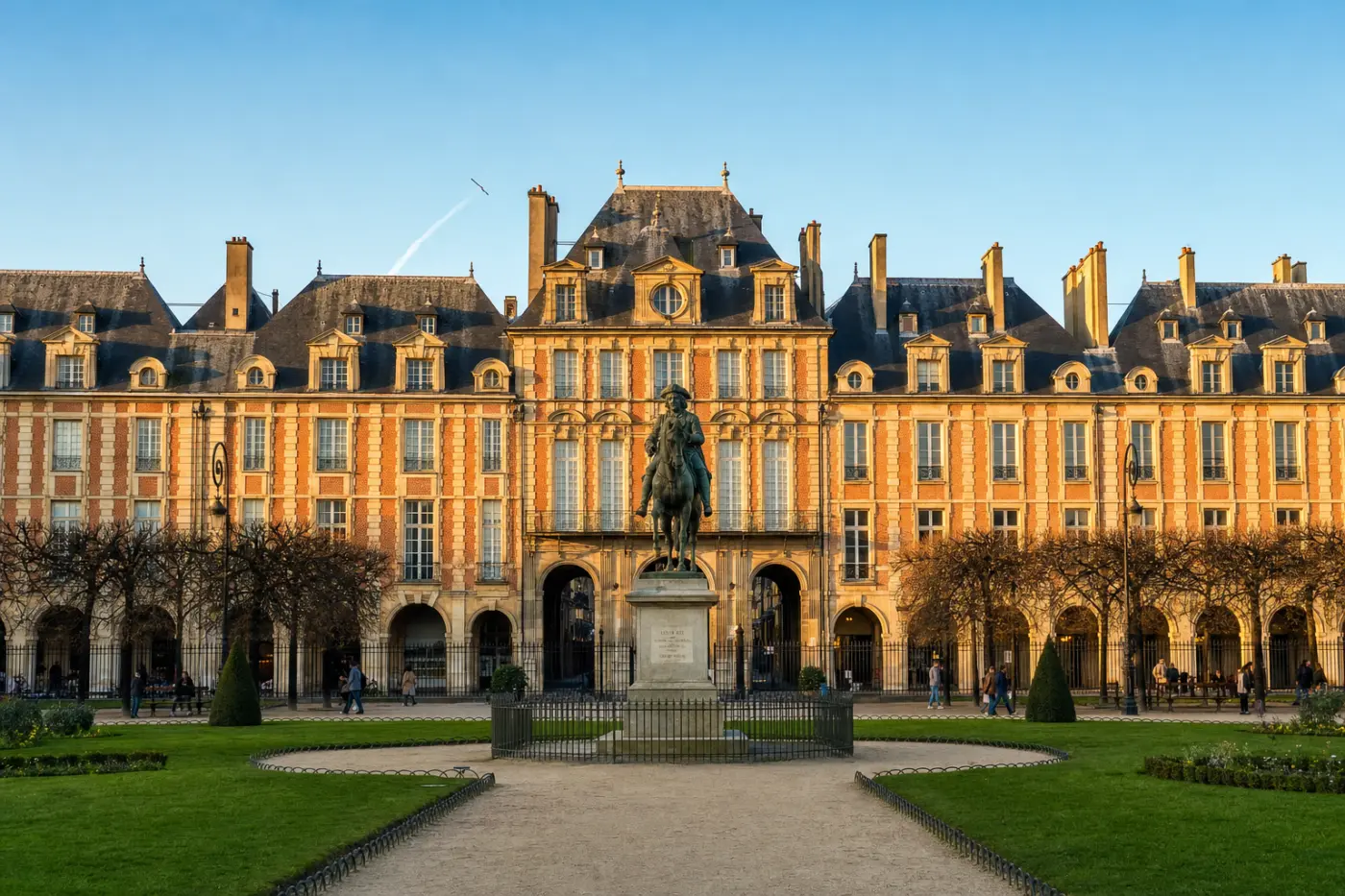
Tourist attraction
Place des Vosges is the oldest planned square in Paris, and arguably the most perfectly preserved urban space in France. Commissioned by King Henry IV in 1605 and inaugurated on April 5–7, 1612 — with a three-day carousel of jousting tournaments to celebrate the betrothal of Louis XIII — the square occupies the site of the former Hôtel des Tournelles, a royal residence abandoned after Henri II died there from a jousting wound in 1559. Henry IV envisioned a grand symmetrical plaza to house silk workers and promote French industry, though the project quickly evolved into an aristocratic showcase. The result is 36 red-brick-and-stone pavilions with steep blue slate roofs, arranged in a perfect 140-metre square around a formal garden — a design that set the template for urban planning across Europe for the next century.
Originally named Place Royale, the square was renamed Place des Vosges in 1800 to honour the Vosges département, the first in France to pay its revolutionary war taxes in full. Throughout the 17th century it was the beating heart of Parisian aristocratic life: Cardinal Richelieu lived at No. 21, and the square hosted duels, public celebrations, and the fashionable promenades of the French court. Victor Hugo took up residence at No. 6 from 1832 to 1848, writing much of Ruy Blas and Les Misérables there; his apartment is now the Maison Victor Hugo, a free public museum displaying his furniture, manuscripts, and the extraordinary Chinese-lacquer-style dining room he designed himself.
Walking through any of the nine vaulted archways into the square today, visitors enter a space that has changed remarkably little since the reign of Louis XIII. The four central pavilions — the Pavillon du Roi to the south and the Pavillon de la Reine to the north, each slightly taller than their neighbours — anchor the composition with a quiet authority. Beneath the continuous arcaded galleries that ring all four sides, art galleries, antique dealers, and intimate restaurants operate in ground-floor spaces that have housed commerce since the square's earliest decades. At the centre, four symmetrical lawns divided by gravel paths surround a 19th-century bronze equestrian statue of Louis XIII, replacing an original destroyed during the Revolution.
The square sits in the heart of Le Marais, making it an ideal anchor for a longer neighbourhood walk: the Musée Carnavalet (Paris's city history museum, free entry) is two minutes west on Rue de Sévigné, and the Picasso Museum is a ten-minute walk north. The garden is open daily from 8 a.m. to 9:30 p.m. (closing at dusk in winter) and entry is free. Arrive on a weekday morning to experience the arcades before the weekend crowds arrive, and look up at the rooflines from the garden's centre — the harmony of warm brick against a Parisian sky is the view that has drawn painters to this square for four centuries.
Private tours with a local guide, at your own pace.
Paris

Paris
Paris
Paris

Paris
Paris
Paris
Paris
Paris