3 hrs
Valencia
Valencia Art Nouveau Private Tour with Oceanográfic Option
✓ Free cancellation Kids friendly
4.5(45 reviews)
From €121/ person
Book Now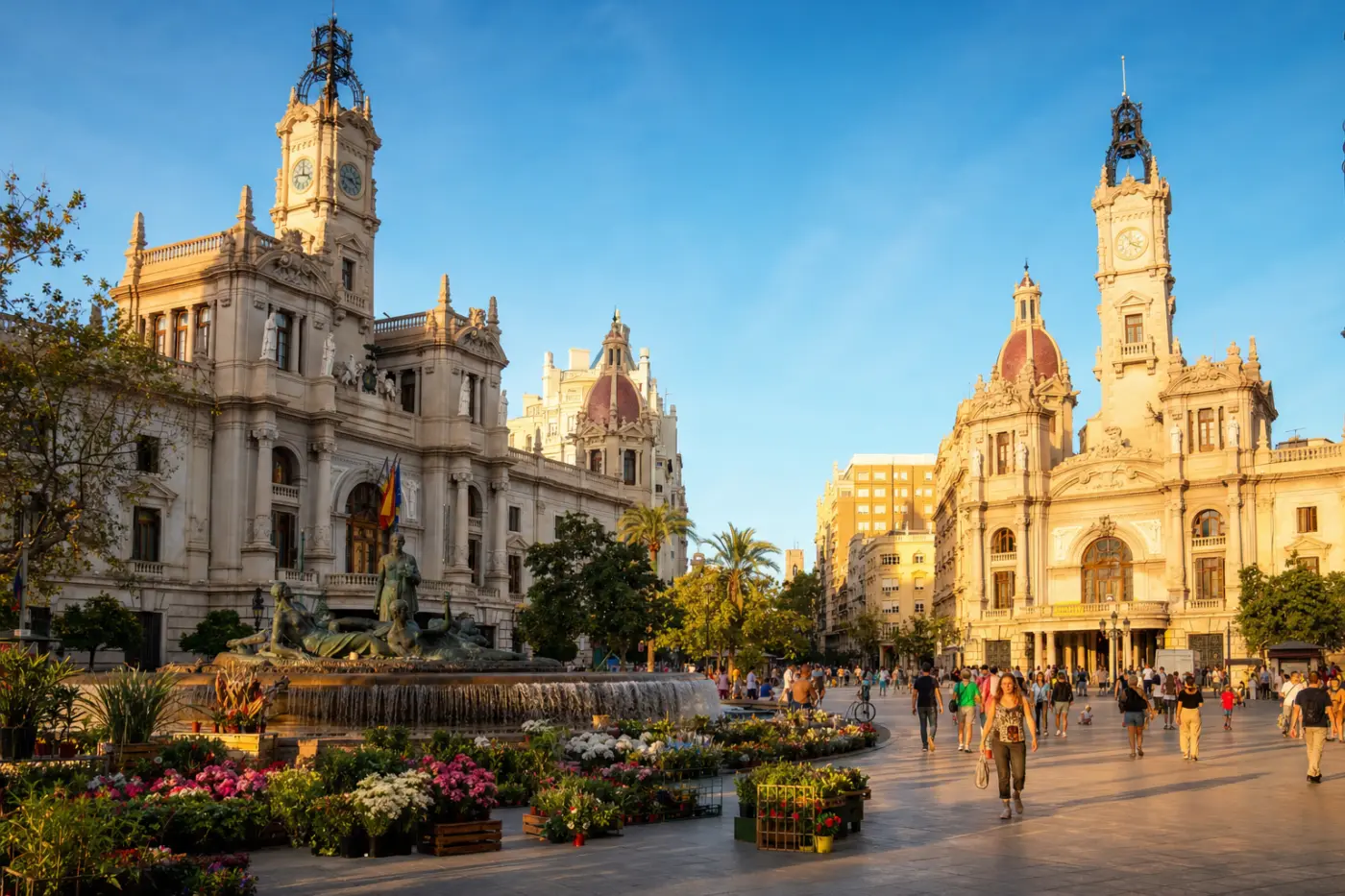
Tourist attraction
Plaza del Ayuntamiento is Valencia's largest and most ceremonially significant public square, occupying the geographic and civic center of the city. Flanked by the neoclassical City Hall (Ayuntamiento) to the north and the ornate 1920s Central Post Office building (Edificio de Correos y Telégrafos) to the south, the square forms a grand triangular space lined with wide promenades, manicured flower stalls, and bronze fountains. The site sits atop layers of urban history stretching back to the Roman founding of Valentia Edetanorum in 138 BC, when the original forum of the Roman city was located just blocks away near what is now the Plaza de la Virgen. The current square took its definitive monumental shape during the early 20th century, when large-scale urban renewal replaced a dense medieval neighborhood with the broad, light-filled esplanade seen today.
The City Hall building itself was constructed between 1935 and 1941 in an eclectic style blending neo-Renaissance and rationalist elements, though its institutional predecessor had governed Valencia from roughly the same location since the medieval period. Opposite it, the Edificio de Correos — completed in 1922 and designed by Miguel Ángel Navarro — displays an exuberant Baroque Revival facade with elaborate stonework and a soaring clock tower, making it one of the most photographed buildings in the city. Together, the two buildings give the square a sense of architectural dialogue between republican civic ambition and early 20th-century ornamental grandeur.
The square is inseparable from Las Fallas, Valencia's UNESCO-recognized festival held every March. For nearly two weeks, Plaza del Ayuntamiento becomes the epicenter of the celebrations: the daily mascletà — a precisely choreographed sequence of firecrackers and aerial shells detonated at exactly 2:00 PM — draws crowds of tens of thousands who pack the square to feel the percussion physically in their chests. On the night of La Cremà (March 19th, the feast of Saint Joseph), the square hosts the incineration of the central Falla monument, closing the festival in a wall of flame and pyrotechnics visible across the city skyline.
Visitors arriving outside of Fallas season will find the square animated by flower vendors, the central fountain, and a constant flow of locals and tourists. The square is served directly by Valencia's metro at the Xàtiva station (Lines 3 and 5) and sits within easy walking distance of the IVAM modern art museum, the Mercado Central, and the Llotja de la Seda — Valencia's 15th-century silk exchange and UNESCO World Heritage Site. The best light for photography falls in the late afternoon, when the warm Valencian sun catches the stone facade of the Post Office building and the City Hall balconies cast long geometric shadows across the promenade.
Private tours with a local guide, at your own pace.
Valencia
Valencia
Valencia

Valencia
Valencia
Valencia
Valencia
Valencia
We use a single cookie, to remember this choice. We do not use analytics or advertising cookies. Read our cookie policy.