7 hrs
Paris
Paris Private Full Day Tour: Montmartre, Sights & Eiffel Tower
✓ Free cancellation Kids friendly
4.6(109 reviews)
From €353/ person
Book Now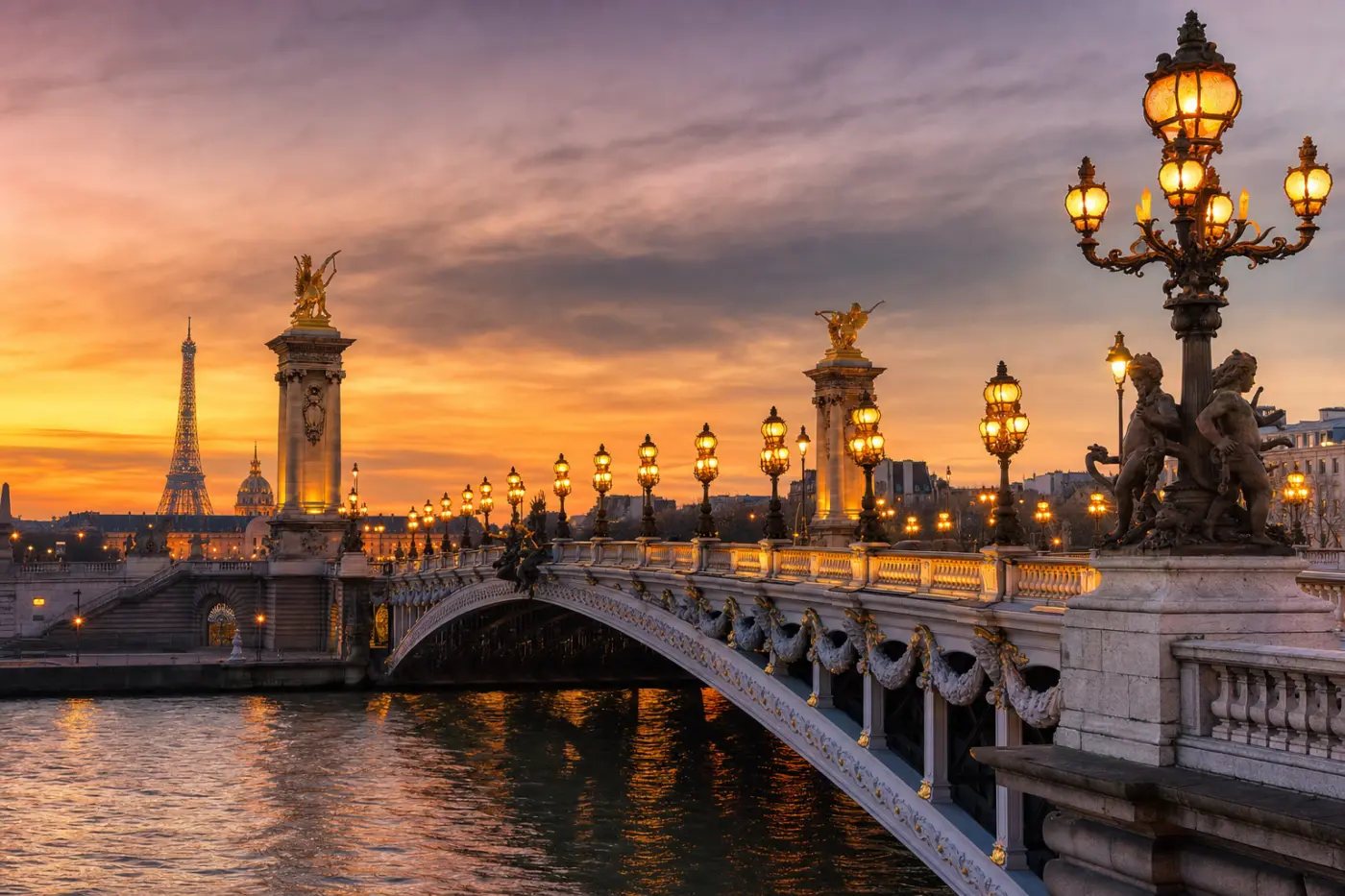
Tourist attraction
Pont Alexandre III is a single-span deck arch bridge crossing the Seine between the Champs-Élysées quarter on the Right Bank and the Esplanade des Invalides on the Left Bank. Stretching 160 metres in length and 40 metres in width, it was engineered to remain completely flat — its arch rising only 6 metres above the waterline — so that sightlines to the Invalides and the Grand Palais would remain unobstructed. Construction ran from 1896 to 1900, timed precisely to inaugurate the Exposition Universelle of 1900, and it was built by engineers Jean Résal and Amédée d'Alby using then-cutting-edge steel ribbed arch technology. The bridge is classified as a French historical monument (Monument Historique).
Its name and its very existence carry deep diplomatic significance. The bridge was conceived as a symbol of the Franco-Russian Alliance of 1892, a strategic pact forged between the French Republic and Imperial Russia to counterbalance the growing power of the German Empire. Tsar Nicholas II laid the foundation stone in October 1896 in honour of his late father, Tsar Alexander III, who had signed the original alliance. The four gilded bronze 17-metre pylons at each corner of the bridge are crowned with figures representing Fame on horseback, while the stone bases display coats of arms of France and Russia. The allegorical sculptures along the bridge — nymphs of the Seine and the Neva rivers facing one another — reinforce this theme of bilateral friendship cast permanently in bronze and stone.
Walking across the bridge is an encounter with the full vocabulary of Belle Époque decorative art. The 32 Art Nouveau lampposts, each topped with ornate candelabras, line both sides of the span. Between them, an elaborate programme of gilded sculptures includes cherubs, sea horses, nymphs, and winged lions. The decoration was executed by a team of prominent French sculptors including Georges Recipon, who created the Fame groups on the pylons, and Emmanuel Frémiet. At dusk, when the lampposts ignite against a darkening Seine and the gold-leaf sculptures catch the last of the light, the bridge offers one of the most photographed perspectives in Paris, framing the Eiffel Tower to the southwest and the Dôme des Invalides to the southeast.
Pont Alexandre III is open to pedestrians and traffic at all times and is free to cross. It sits within walking distance of several major landmarks: the Grand Palais and Petit Palais are directly adjacent on the Right Bank, the Musée de l'Armée and Napoleon's tomb lie a short walk south, and the Eiffel Tower is roughly 1.2 kilometres west. The nearest Métro station is Invalides (lines 8 and 13) or Champs-Élysées–Clemenceau (lines 1 and 13). Early morning visits reward photographers with soft light and minimal crowds; evening visits offer a fully illuminated spectacle that is especially vivid in the hour after sunset.
Private tours with a local guide, at your own pace.
Paris
Paris
Paris
Paris
Paris
Paris
Paris
Paris
Paris