3 hrs
Milan
Milan Private Family Tour: Castle, Gelato & Dinosaurss
✓ Free cancellation Kids friendly
4.5(23 reviews)
From €247/ person
Book NowTourist attraction
Porta Nuova is Milan's landmark urban regeneration district, developed between 2007 and 2015 across three interconnected sub-districts: Varesine, Garibaldi, and Isola. Built on land that had long been occupied by disused railway infrastructure and fragmented industrial plots, the project was master-planned by the Argentine-American firm Cesar Pelli & Associates alongside contributions from major international architects. The result is the most ambitious and widely praised urban renewal project in contemporary Italian history, adding over 290,000 square metres of mixed-use space to the heart of the city while preserving generous public parkland and pedestrian corridors throughout.
The district's historical roots stretch far deeper than its glass towers suggest. The name "Porta Nuova" derives from one of Milan's original Spanish-era city gates — a neoclassical arch designed by Giuseppe Zanoia between 1810 and 1813, which still stands today on Via Manzoni as a quiet counterpoint to the surrounding modernity. Nearby, the Porta Comasina arch, built by Giacomo Moraglia between 1826 and 1827, features four colossal statues representing Lombardy's principal rivers — the Po, Adda, Ticino, and Olona — sculpted by Giovanni Battista Perabò. These 19th-century monuments anchor the district in Milan's deeper civic and architectural identity. The contemporary centerpiece, the UniCredit Tower, completed in 2012 and rising 231 metres, holds the distinction of being the tallest skyscraper in Italy. Its spiraling glass spire has become an unmistakable fixture of the Milanese skyline.
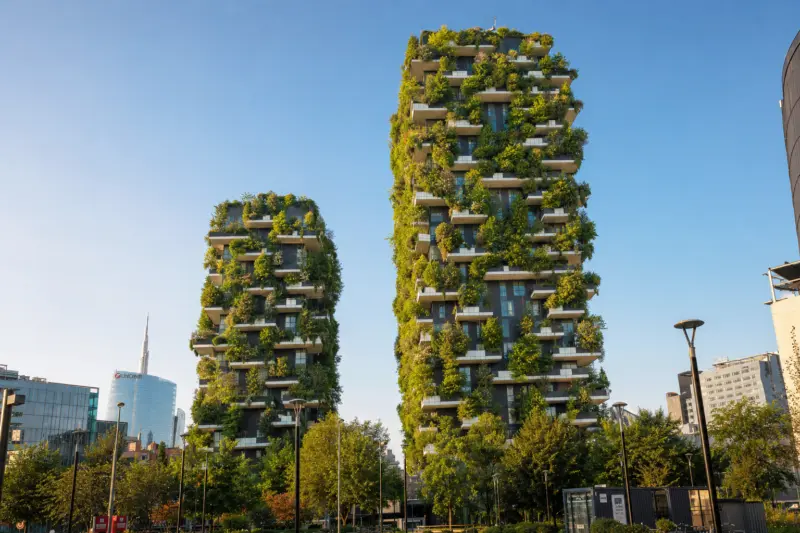
No structure in Porta Nuova has captured global imagination quite like the Bosco Verticale — the "Vertical Forest" — twin residential towers completed in 2014 and designed by architect Stefano Boeri. The two towers, standing at 111 and 76 metres respectively, host approximately 900 trees, 5,000 shrubs, and 11,000 ground-cover plants across their terraced balconies, creating a self-sustaining microhabitat equivalent in canopy coverage to roughly 20,000 square metres of forest. The Bosco Verticale won the International Highrise Award in 2014 and has since been replicated in cities from Eindhoven to Nanjing. At the district's social heart sits Piazza Gae Aulenti, a raised circular plaza named in honor of the Italian architect Gae Aulenti (1927–2012), whose career spanned the transformation of Paris's Musée d'Orsay. The plaza features interactive fountains, café terraces, and direct sightlines to the UniCredit Tower.
Visitors can explore Porta Nuova entirely on foot — the district is designed as a car-free, pedestrian-priority environment with direct connections to Garibaldi FS station and the M2/M5 metro lines. The best vantage points for photography are from the elevated walkways around Piazza Gae Aulenti at dusk, when the towers catch the last light, and from the Indro Montanelli Public Gardens to the south, which frame the Bosco Verticale against open sky. The surrounding Isola neighborhood, a formerly working-class district that retained its street-market character and independent restaurant scene, offers an ideal contrast for an afternoon visit. Porta Nuova is free to enter and accessible year-round.
Private tours with a local guide, at your own pace.
Milan

Milan
Milan

Milan
Milan
Milan