7 hrs
Paris
Paris Private Full Day Tour: Montmartre, Sights & Eiffel Tower
✓ Free cancellation Kids friendly
4.6(109 reviews)
From €353/ person
Book Now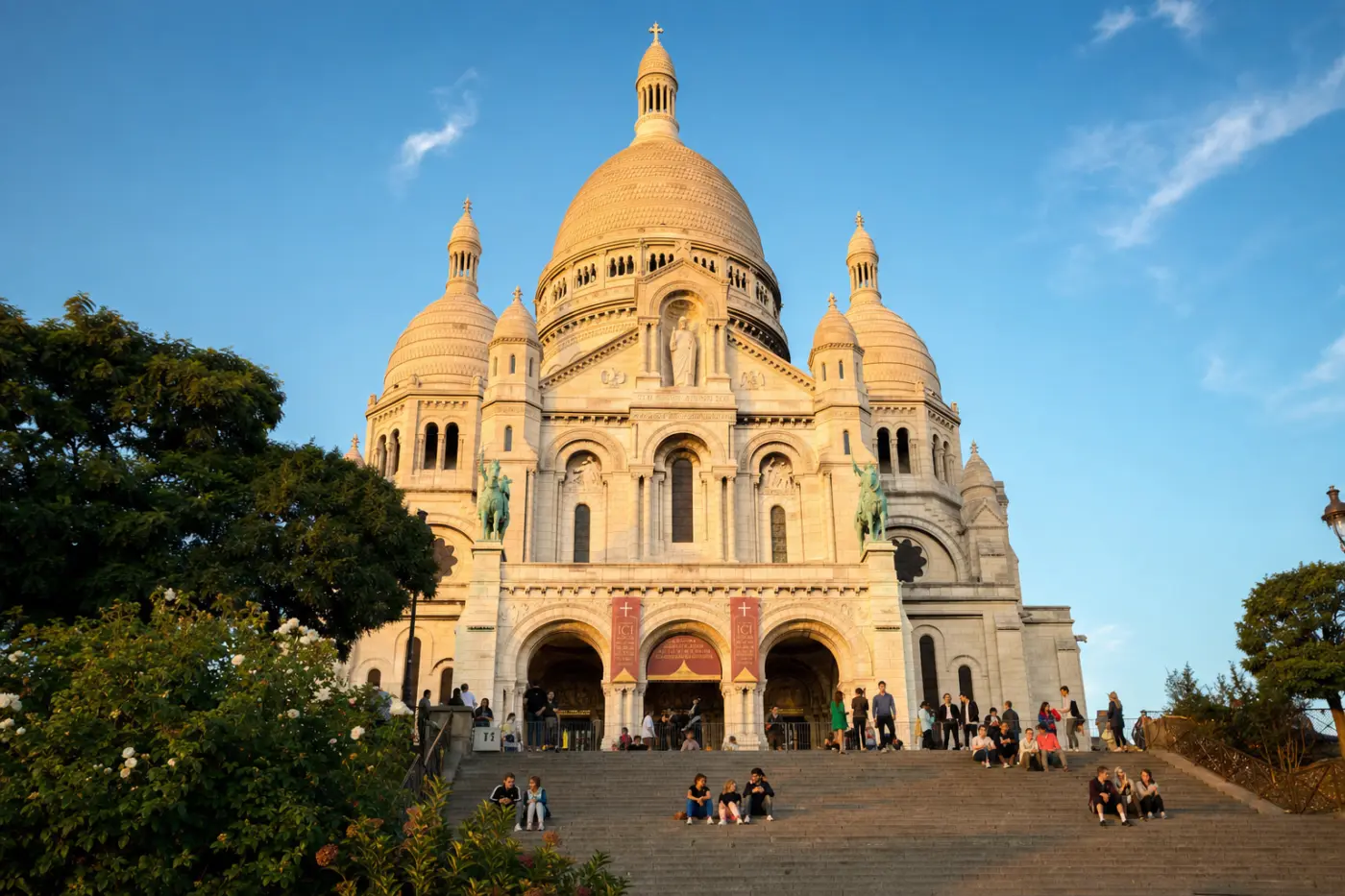
Tourist attraction
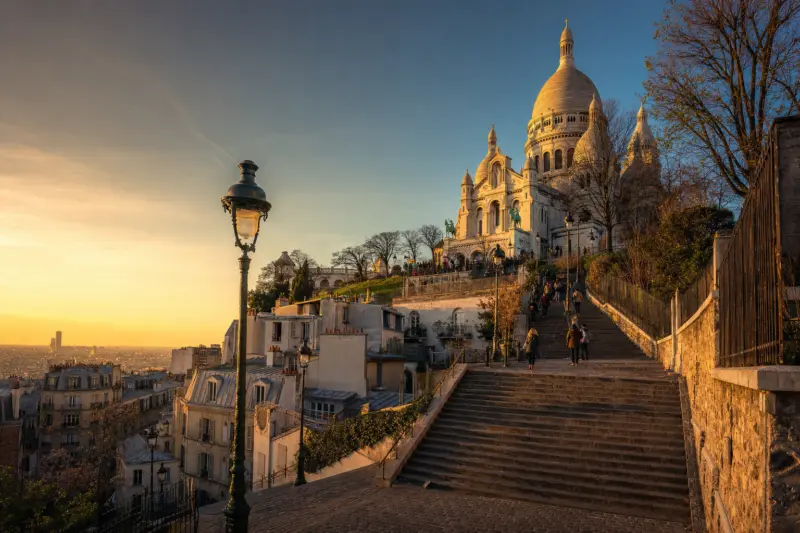
The Basilica of Sacré-Cœur stands at the summit of the Butte Montmartre — 130 metres above sea level, the highest natural point in Paris — and was conceived not as a monument to triumph but as an act of national penance. Its origins trace directly to the trauma of 1870–71: France's catastrophic defeat in the Franco-Prussian War, the four-month Prussian siege of Paris during which Parisians were reduced to eating zoo animals, and the violent civil uprising of the Paris Commune that followed. Two French Catholics, Alexandre Legentil and Hubert Rohault de Fleury, formally vowed in 1871 to fund a church dedicated to the Sacred Heart of Jesus as an act of atonement for what they saw as the moral failures that had brought France to ruin. The French National Assembly declared the project of "public utility" in 1873, and the first stone was laid on June 16, 1875.
Construction took 39 years — complicated enormously by the geology of Montmartre, whose gypsum-riddled subsoil required engineers to sink 83 pneumatic caissons, some as deep as 33 metres, before a stable foundation could be established. The architect Paul Abadie, who had also restored the Cathedral of Saint-Front in Périgueux, designed the basilica in a Romano-Byzantine idiom: four corner cupolas surrounding a central dome that rises 83 metres, all clad in travertine stone quarried at Château-Landon. That stone has a remarkable chemical property — it secretes calcite when it rains, continuously re-whitening the façade and making the basilica appear to glow brighter with every passing decade. The building was completed in 1914, but World War I delayed its consecration until October 16, 1919. Inside, the apse vault contains one of the largest mosaic compositions in the world, covering 473 square metres and depicting Christ with outstretched arms above a golden inscription: Gallia poenitens et devota — "France, penitent and devoted."
Visitors ascending the 300 steps of the dome (or taking the funicular from Square Louise Michel at the base) are rewarded with a panoramic view stretching up to 30 kilometres on clear days — encompassing the Eiffel Tower, the rooftops of Haussmann's boulevards, and the horizon beyond the Bois de Boulogne. The basilica's bell tower houses the Savoyarde, one of the heaviest bells in the world at 19 tonnes, cast in Annecy in 1895 and donated by the Catholics of Savoie. Perpetual adoration of the Blessed Sacrament has been maintained in the basilica without interruption since 1885 — before the building was even finished — a practice that continues to this day.
The basilica is open daily from 6:00 a.m. to 10:30 p.m., and entrance to the nave is free. Climbing the dome carries a modest fee and is worth it for the view from the external gallery, which is distinct from and higher than the terrace at the base. Visit on a weekday morning to avoid the densest crowds, and note that the steps of the parvis — the wide stone forecourt — have become a social landmark in their own right, busy at all hours with locals and musicians. The surrounding Montmartre quarter, home to artists like Picasso, Modigliani, and Utrillo in the early 20th century, extends the visit well beyond the basilica itself.
Private tours with a local guide, at your own pace.
Paris

Paris
Paris
Paris
Paris
Paris
Paris
Paris
Paris