6 hrs
Paris
Private Full Day Tour – Louvre & Sainte Chapelle Church Tickets
✓ Free cancellation Kids friendly
4.9(25 reviews)
From €360/ person
Book Now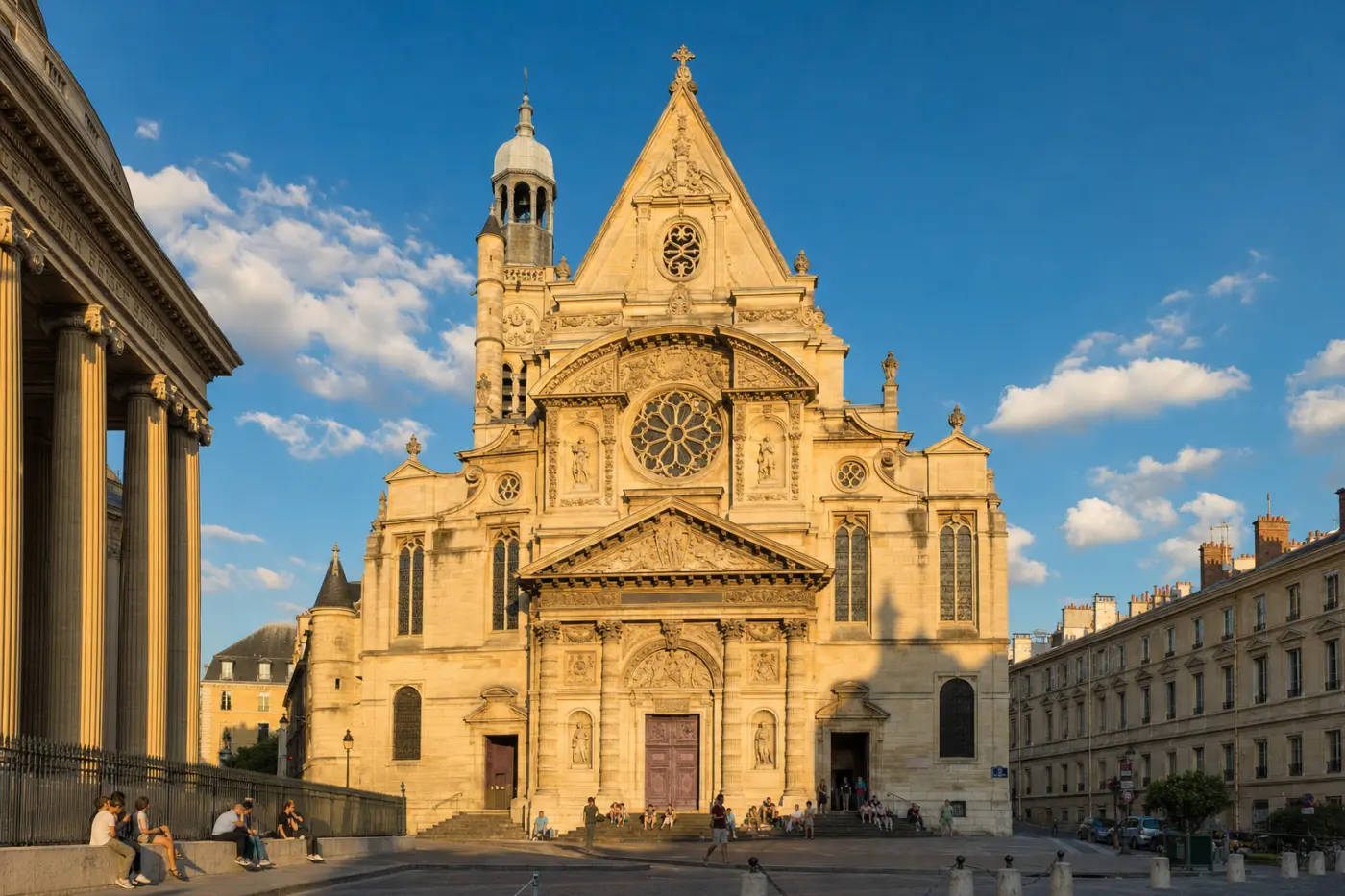
Tourist attraction
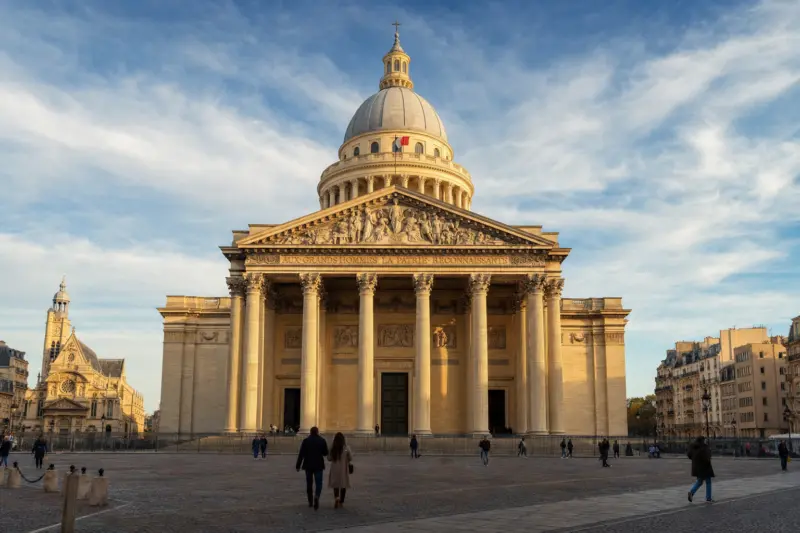
Saint-Étienne-du-Mont is a parish church in the 5th arrondissement of Paris, standing at Place Sainte-Geneviève directly beside the neoclassical Panthéon. Construction began in 1492 to accommodate the growing congregation of the adjacent Abbey of Saint Geneviève, whose monks had outgrown their own chapel. Work progressed slowly across two centuries, with the nave completed around 1540 and the façade finished only in 1622 — a timeline that produced one of the most architecturally layered buildings in Paris, blending Flamboyant Gothic structure with Renaissance ornamental detail and a strikingly asymmetrical three-tiered western front featuring a triangular pediment, rose window, and pinnacled gable stacked vertically like a compressed manifesto of two stylistic eras.
The church holds two distinctions that set it apart from every other historic church in Paris. First, it contains the only surviving jubé — a rood screen — in the city, an intricate Renaissance stone gallery built between 1521 and 1545 that once divided the clergy's choir from the lay congregation. While the French Revolution and 19th-century liturgical reforms led to the demolition of similar screens across France, Saint-Étienne-du-Mont's jubé endured, its double spiral staircases and lace-like stone balustrade remaining intact to this day. Second, the church houses the shrine of Saint Geneviève, patron saint of Paris, who died around 512 AD. Though her original tomb was destroyed during the Revolution, a gilded reliquary containing her remains was reconstituted in 1803 and draws pilgrims and visitors to a dedicated chapel on the church's south side. The graves of two towering figures of French intellectual history — mathematician and philosopher Blaise Pascal (d. 1662) and playwright Jean Racine (d. 1699) — are also located within the church, their remains transferred here after the Revolution scattered the original burial sites.
Stepping inside, visitors are immediately arrested by the nave's soaring height and the flood of light from its unusually large windows, many filled with 16th- and 17th-century stained glass. The jubé itself is the visual centerpiece: standing in the nave and looking toward the choir, its twin spiral ramps rise symmetrically to a central walkway adorned with carved foliage and figures. The ambulatory behind the choir retains some of the finest Renaissance glazing in Paris, with narrative panels depicting biblical scenes in vivid cobalt, crimson, and gold. The overall atmosphere is intimate compared to Notre-Dame — the scale is human, the stone warm, and the layers of history physically present in the fabric of the walls.
Saint-Étienne-du-Mont is open to visitors daily and admission is free. It is an active parish, so visitors should be mindful of Mass schedules, particularly on Sunday mornings when access may be restricted. The church is a short walk from the Luxembourg Gardens and the Sorbonne, making it a natural stop on any exploration of the Latin Quarter. For fans of Woody Allen's Midnight in Paris (2011), the church's front steps serve as the precise location where the film's protagonist is swept back to the 1920s — lending the building an extra layer of cinematic mystique on top of its five centuries of genuine history.
Private tours with a local guide, at your own pace.
Paris

Paris
Paris
Paris
Paris
Paris
Paris
Paris
Paris
We use a single cookie, to remember this choice. We do not use analytics or advertising cookies. Read our cookie policy.