2.5 hrs
Paris
Kickstart Paris PRIVATE Tour. City Highlights for newcomers
✓ Free cancellation Kids friendly
5.0(21 reviews)
From €166/ person
Book Now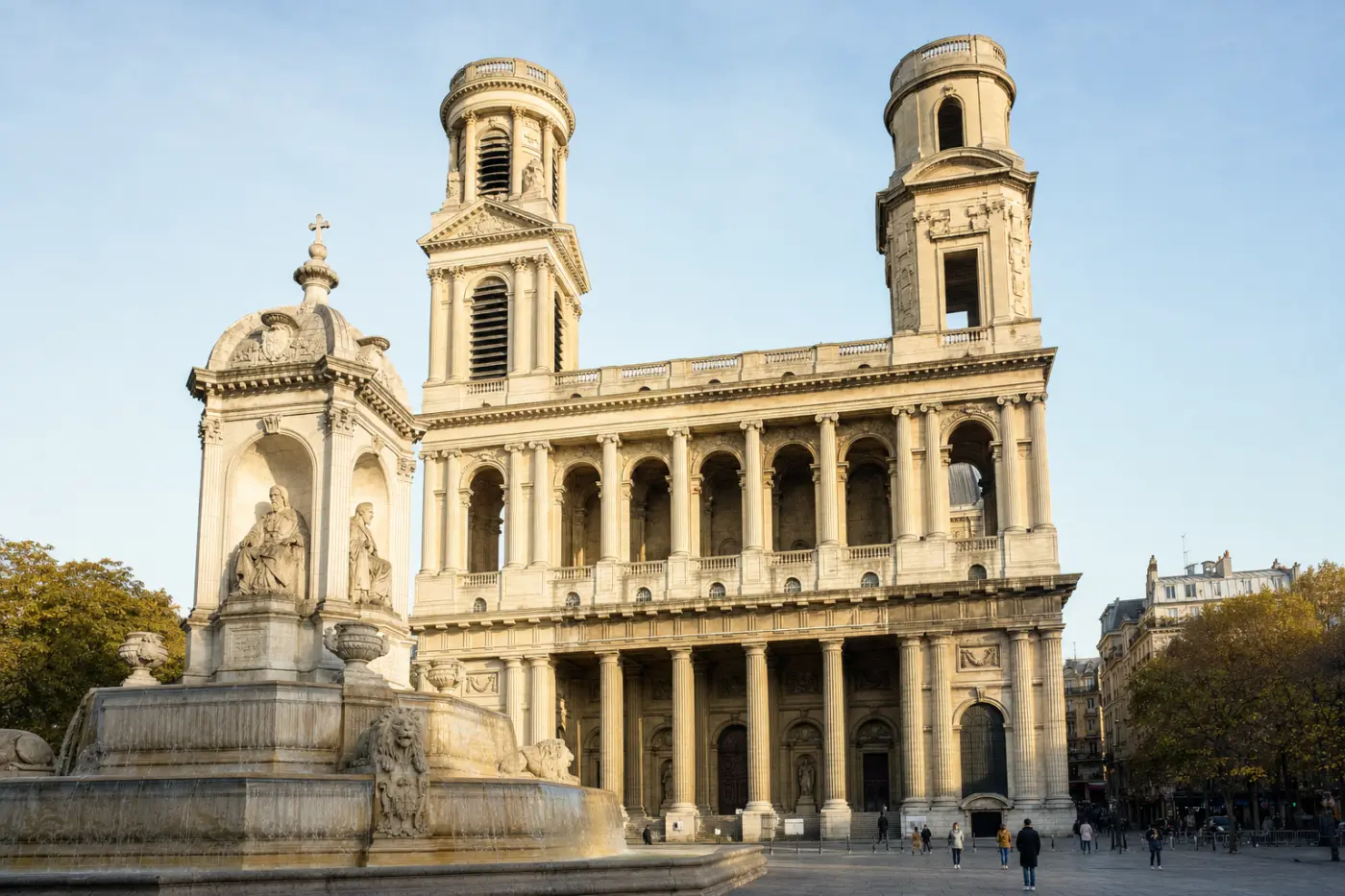
Tourist attraction
Saint-Sulpice is a Roman Catholic parish church on the Place Saint-Sulpice in Paris's 6th arrondissement, and at 119 meters long and 57 meters wide, it is the second-largest church in the city after Notre-Dame de Paris. Construction began in 1646 under architect Christophe Gamard on the foundations of an older medieval church, and the building proceeded in fits and starts across six different architects over more than a century — a troubled timeline that directly explains its most distinctive visual quirk: the two western towers, completed in the 1770s to designs by Giovanni Servandoni and later Jean-François Chalgrin, were never finished to the same height or style, leaving the north tower noticeably taller and more ornate than the south. Far from a flaw, this asymmetry gives the Baroque facade an idiosyncratic energy that architects have debated and admired ever since.
Inside, the church holds one of the great undiscovered treasures of Parisian painting: three monumental murals by Eugène Delacroix, completed between 1849 and 1861 in the Chapel of the Holy Angels. The largest, Jacob Wrestling with the Angel, covers an entire wall and is considered among the artist's finest achievements — Delacroix reportedly spent the final years of his life climbing scaffolding to work on these canvases, and he died in 1863, just two years after their completion. Also notable is the church's 1781 Clicquot organ, one of the most celebrated instruments in France, later expanded by Aristide Cavaillé-Coll in 1862 to 102 stops; it has been played by Charles-Marie Widor and Marcel Dupré, both of whom served as titulaires for decades.
Running across the floor of the transept is a brass line inlaid in the stone — the gnomon of a meridian line, commissioned in 1727 by the parish to assist in calculating the precise date of Easter. A tall white obelisk at the north end marks where the sun's rays strike at the winter solstice. This scientific instrument, pre-dating the Eiffel Tower by over 160 years, gained worldwide attention when Dan Brown's 2003 novel The Da Vinci Code misidentified it as a "pagan Rose Line" — a claim the church firmly refutes with a placard placed near the brass strip.
Visitors should arrive on a Sunday morning when the Cavaillé-Coll organ is played during Mass, filling the nave with sound in a way that no recording can replicate. The Place Saint-Sulpice outside, with its twin-tiered fountain featuring the bishops Bossuet, Fénelon, Massillon, and Fléchier, makes for a fine spot to pause before or after a visit. Entry is free, the church is open daily, and the Delacroix chapel is in the first chapel on the right as you enter — easily missed if you head straight for the nave.
Private tours with a local guide, at your own pace.
Paris

Paris
Paris
Paris
Paris

Paris
Paris
Paris
Paris
We use a single cookie, to remember this choice. We do not use analytics or advertising cookies. Read our cookie policy.