7 hrs
Milan
Private Milan Full-Day Tour - Duomo Tickets, Highlights & Lunch
✓ Free cancellation Kids friendly
5.0(17 reviews)
From €377/ person
Book Now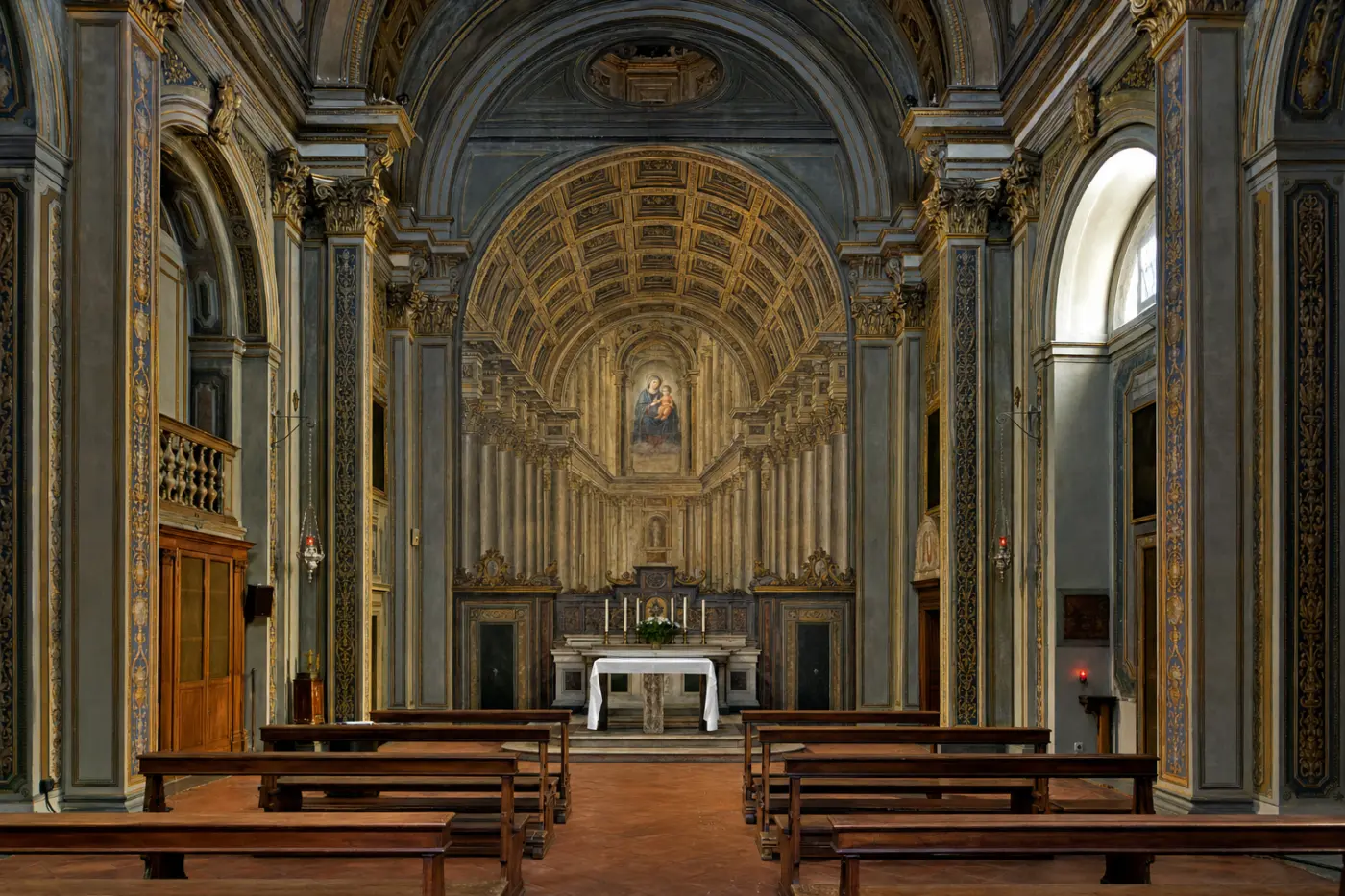
Tourist attraction
Santa Maria presso San Satiro stands at Via Torino 17 in Milan's historic center, barely a five-minute walk from the Duomo, yet overlooked by thousands of people who pass it daily. Its origins reach back to 876, when Archbishop Ansperto da Biassono established a small oratory on the site reputedly associated with St. Satyrus — the brother of St. Ambrose — and a pre-Romanesque circular temple was built in his honor. By the 13th and 14th centuries, a devotional fresco of the Madonna and Child inside the complex had become a major pilgrimage destination after witnesses reported it miraculously shedding blood when struck by a vandal. The fresco's fame moved Duke Galeazzo Maria Sforza to commission a new church to enshrine it in 1472, with construction finally beginning in 1478 under his successor Ludovico il Moro.
The commission brought Donato Bramante — then establishing himself in Milan before his later work on St. Peter's Basilica in Rome — his first major independent project in the city. Working between 1482 and 1486, Bramante faced an immediate constraint: the narrow Via Falcone ran directly behind where the apse needed to be, leaving him physically unable to extend the building. His solution was revolutionary. He designed a trompe-l'œil apse using painted stucco reliefs, coffered barrel vaults, and precisely foreshortened pilasters that together create an illusion of a choir stretching roughly 9.7 meters into the wall — a space that is, in reality, only 97 centimeters deep. It was an idea with no direct precedent in Lombardy, and it remains one of the most studied optical deceptions in Western architecture. Bramante also designed the sacristy around 1485, a classically proportioned octagonal space later repurposed as the baptistery, which features terracotta sculptures by Agostino de Fondulis. The Romanesque bell tower dates to the 9th century and contains a curiosity of its own: its base was absorbed into a neighboring building, and from an upper floor of the adjacent café, visitors can look directly into the church's interior through the tower.
The interior follows a T-shaped Latin cross plan decorated in rich gold-and-blue tones, and its proportions create a sense of spaciousness that belies the building's modest footprint — a deliberate effect Bramante achieved through careful manipulation of column height and nave width. The venerated 13th–14th century fresco of the Madonna remains on display above the altar, still the devotional heart of the complex. The current Renaissance facade, however, is a relatively recent addition: it was completed in 1872 by architect Giuseppe Vandoni, long after Bramante's work was done.
Santa Maria presso San Satiro is free to enter and open to visitors during church hours. Because it sits on one of Milan's busiest shopping streets, mornings on weekdays offer the quietest experience inside the nave, giving you uninterrupted time to study the apse illusion from different distances and angles — something strongly worth doing, as the deception is most striking from the crossing and gradually dissolves as you approach the altar wall. The church is compact enough to explore thoroughly in under an hour, making it a natural stop on any walk between the Duomo and the Navigli district.
Private tours with a local guide, at your own pace.
Milan
Milan
Milan
Milan

Milan

Milan
We use a single cookie, to remember this choice. We do not use analytics or advertising cookies. Read our cookie policy.