2:30 to 3 hrs
Paris
Paris Private Family Tour - Highlights & the Best Museum for Kids
✓ Free cancellation Kids friendly
4.9(26 reviews)
From €119/ person
Book Now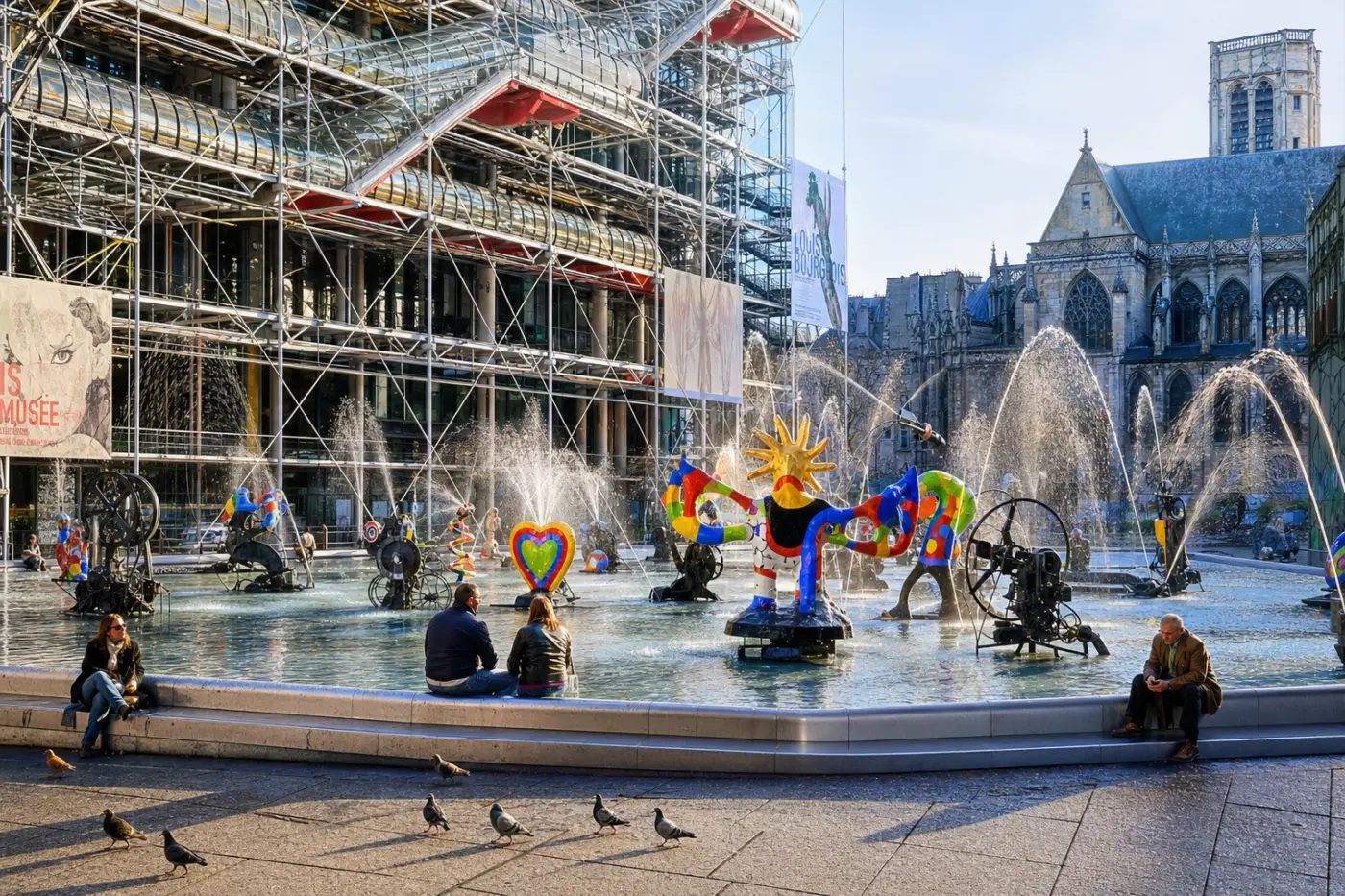
Tourist attraction
The Stravinsky Fountain — officially the Fontaine Igor Stravinsky — is a kinetic sculpture installation occupying Place Igor Stravinsky in the 4th arrondissement of Paris, directly beside the Centre Georges Pompidou and the medieval Église Saint-Merri. Inaugurated on 16 March 1983, it was commissioned by the French Ministry of Culture as part of the broader cultural programme surrounding the Pompidou Centre. The shallow basin, spanning approximately 6,200 square feet, holds sixteen moving sculptures that spray, spin, and spout water continuously, transforming an otherwise ordinary urban square into one of the most joyfully irreverent public artworks in Europe.
The fountain is a collaboration between two artists whose aesthetic sensibilities could hardly differ more — which is precisely what makes it work. Swiss kinetic sculptor Jean Tinguely contributed seven black, mechanised metal constructions: angular, noisy, deliberately chaotic machines that rattle and rotate in homage to Stravinsky's dissonant rhythms. French-American artist Niki de Saint Phalle added six rounded, brilliantly coloured polyester figures — voluptuous, almost cartoon-like forms painted in reds, yellows, and blues. The remaining three pieces were conceived jointly. Each sculpture references a specific work from Stravinsky's catalogue: a spiky, explosive form evokes the primal violence of The Rite of Spring (1913); a marionette-like figure nods to Petrushka (1911); a winged, fiery element represents The Firebird (1910). The pairing of Tinguely's mechanical severity with Saint Phalle's exuberant colour mirrors the tension between structure and liberation that defined Stravinsky's own compositional revolution.
Visitors encounter the fountain at ground level with no barrier between the sculptures and the pavement — children routinely dash through the water jets on warm days, and the mechanical churning of Tinguely's constructions is audible from several metres away. The contrast between the fountain's playful chaos and the austere industrial façade of the Pompidou Centre immediately behind it is entirely intentional, reinforcing the neighbourhood's identity as Paris's designated quarter of cultural experimentation. The adjacent Église Saint-Merri, whose foundations date to the 12th century, adds a further layer of historical counterpoint to the scene.
The fountain underwent a significant restoration in 2023 to address wear to the mechanical components and weathering of Saint Phalle's painted surfaces. It operates daily throughout the year, though the water jets are typically switched off in winter months to prevent frost damage to the pumping system. The best time to visit is a sunny morning in late spring or summer, when the light catches the water arcing off the coloured sculptures and the square fills with street musicians, café-goers, and visitors spilling out of the Pompidou. Entry to the square is free and unrestricted at all hours.
Private tours with a local guide, at your own pace.
Paris

Paris

Paris
Paris
Paris
Paris
Paris
Paris
Paris
We use a single cookie, to remember this choice. We do not use analytics or advertising cookies. Read our cookie policy.