4 hrs
Paris
Paris Private Tour: Highlights, Top Quarters & Eiffel Tower
✓ Free cancellation Kids friendly
4.5(28 reviews)
From €185/ person
Book Now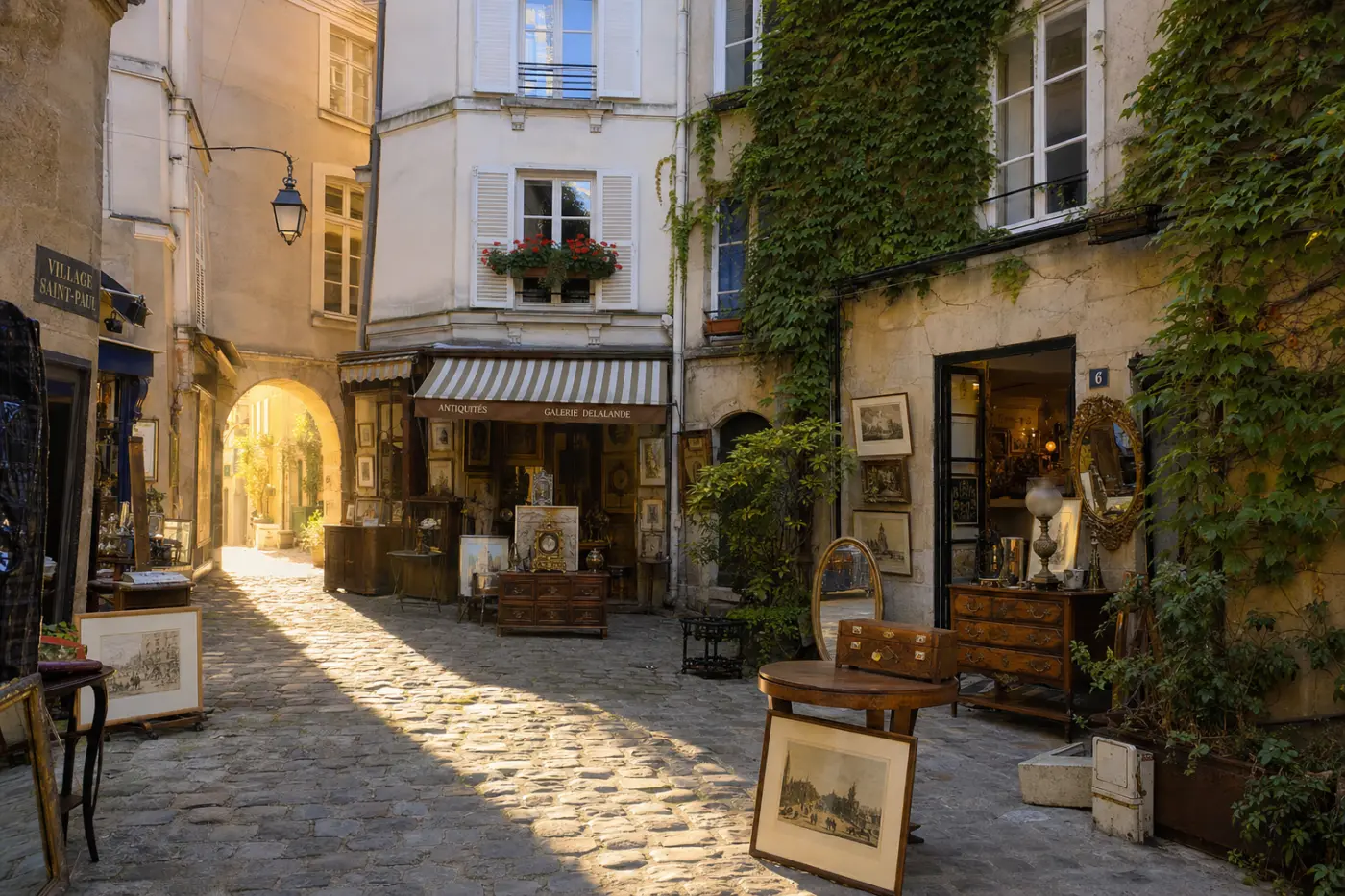
Tourist attraction
Village Saint-Paul is a labyrinthine cluster of interconnected courtyards and passageways tucked between the Rue Saint-Paul, Rue Charlemagne, Rue de l'Ave Maria, and the Quai des Célestins in Paris's 4th arrondissement. The site occupies land that was once enclosed within the personal garden of King Charles V, who built his grand royal residence — the Hôtel Saint-Paul — here in the 1360s. After the king's death in 1380, the estate gradually fell into disuse and was subdivided, eventually absorbed into the urban fabric of the Marais. The walled passageways and staggered levels that give Village Saint-Paul its distinctive character are direct remnants of the medieval property boundaries that subdivided the former royal grounds over six centuries ago.
The area was revitalized in the 1970s when antique and second-hand dealers began colonizing its forgotten courtyards, transforming what had been a neglected backstreet zone into one of Paris's most concentrated antiques villages. Today, roughly 100 dealers operate across the interconnected spaces, trading in furniture, prints, vintage posters, silverware, ceramics, and curiosities ranging from Art Deco lamps to 19th-century scientific instruments. Unlike the formalized antiques markets of the Puces de Saint-Ouen, Village Saint-Paul retains an improvised, almost residential atmosphere — dealers spill goods onto cobblestones, cats sleep in doorways, and ivy climbs the exposed stone walls of buildings that date back to the 17th century.
Wandering through Village Saint-Paul is as much an architectural experience as a shopping one. The courtyards open unexpectedly into one another through low archways and iron gates, rewarding visitors who resist the urge to map their route. The surrounding streets add further historical density: the nearby Église Saint-Paul-Saint-Louis, completed in 1641, is a Jesuit baroque masterpiece that houses two holy-water stoups donated by Victor Hugo, and the stretch of Philippe Auguste's 12th-century city wall is visible just steps away on Rue des Jardins Saint-Paul — one of the longest surviving sections of medieval fortification in Paris.
Village Saint-Paul is open to the public most days, though individual dealers typically keep Thursday through Monday hours, with many closing Tuesday and Wednesday. The courtyards themselves are accessible throughout the day at no cost, making it an ideal destination for a slow morning stroll before the Marais crowds arrive. The nearest Métro stations are Saint-Paul (Line 1) and Pont Marie (Line 7), both within a five-minute walk. Come with patience and cash — many dealers do not accept cards — and expect to spend at least an hour losing yourself in the passageways.
Private tours with a local guide, at your own pace.
Paris

Paris
Paris
Paris

Paris
Paris
Paris
Paris
Paris
We use a single cookie, to remember this choice. We do not use analytics or advertising cookies. Read our cookie policy.