11 hrs
Barcelona
Private Full Day Trip to Medieval Villages of Catalonia + Lunch front of a Lake
✓ Free cancellation Kids friendly
4.8(20 reviews)
From €647/ person
Book Now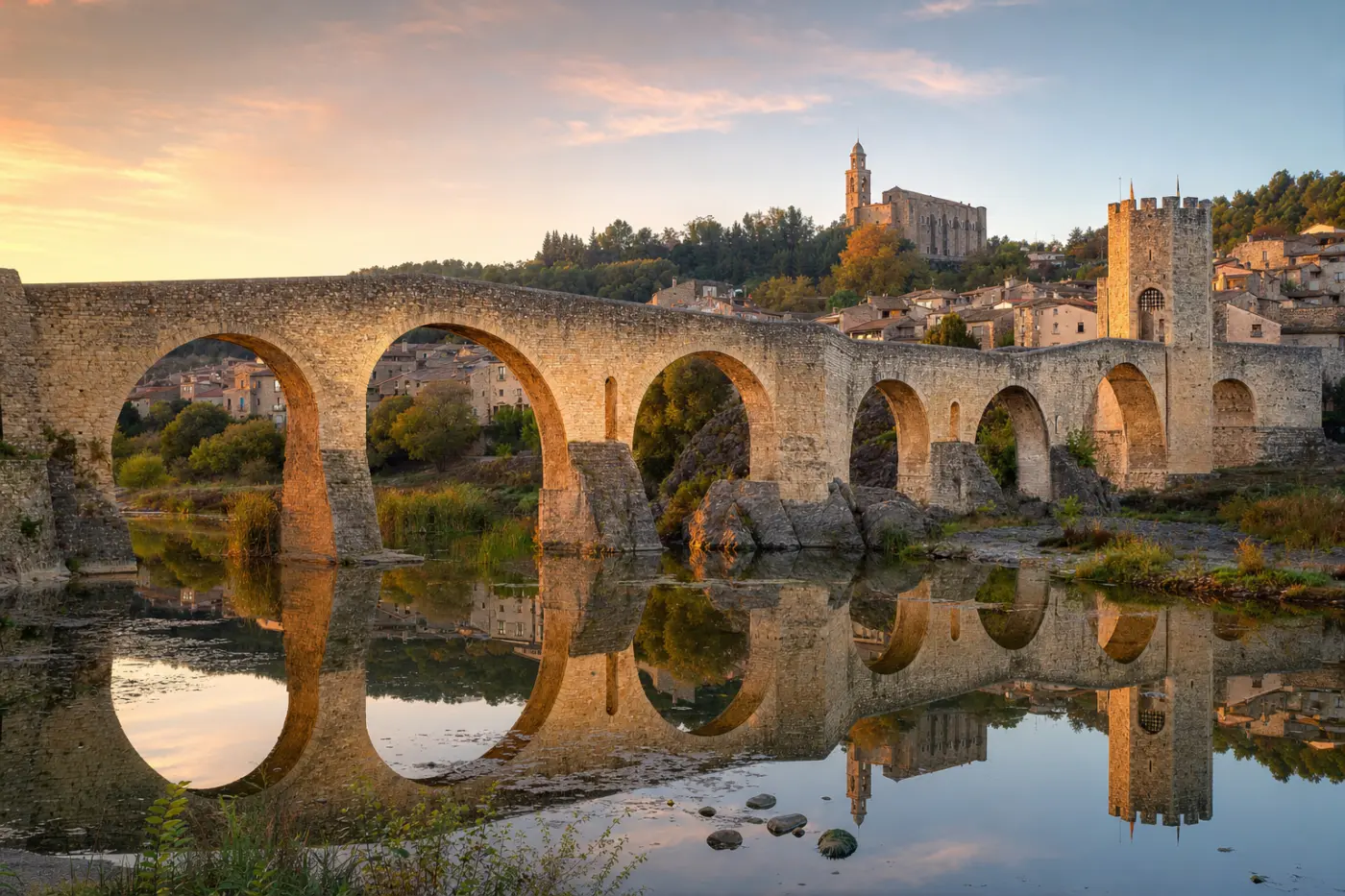
Tourist attraction
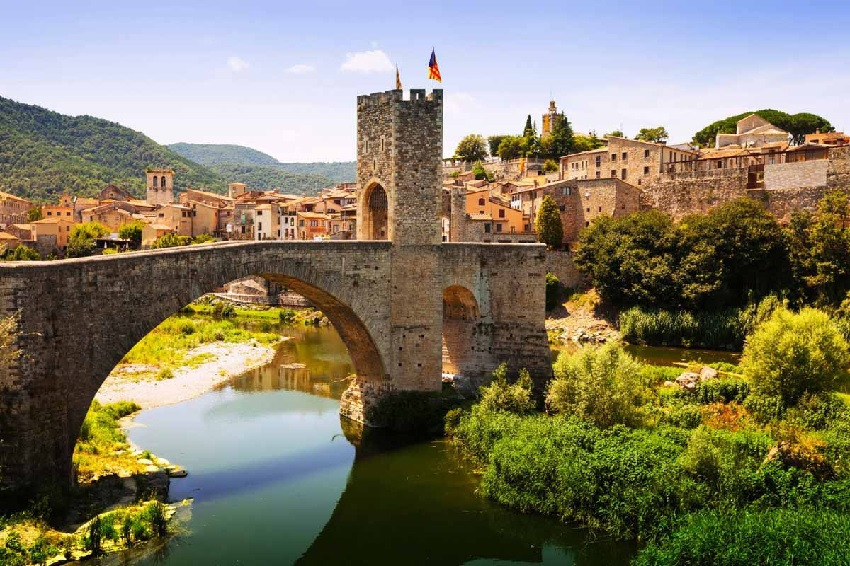
The Pont Vell of Besalú — Old Bridge — is an 11th-century fortified crossing that spans the Fluvià river at the entrance to one of Catalonia's most intact medieval towns. Built in the Romanesque style and completed around 1075, the bridge stretches approximately 55 metres across seven irregular arches. What looks at first like a design eccentricity is in fact precise medieval engineering: the bridge deliberately zigzags mid-span to allow each pier to anchor into the volcanic basalt outcrops embedded in the riverbed, giving the structure the geological stability it has held for nearly a thousand years. A defensive tower with a fortified gate, the Torre de la Lluna, once commanded the bridge's midpoint, and a second gate still stands at the town entrance, reminding visitors that crossing this bridge once meant entering a sovereign political entity.
Besalú was no mere village when this bridge was built. From the 9th century onward it served as the capital of the independent County of Besalú, which minted its own currency and maintained its own courts. The county retained this autonomy for over a century before Ramon Berenguer III, Count of Barcelona, absorbed it in 1111 through dynastic succession — a consolidation that proved decisive in shaping the territorial foundations of medieval Catalonia. The town that grew around the bridge retained its Jewish quarter, its Benedictine monastery of Sant Pere (founded 977), and a Romanesque church ensemble that together earned Besalú its designation as a Conjunto Histórico-Artístico, Spain's highest category of heritage protection for a historic settlement.
Perhaps the most extraordinary discovery connected to Besalú's medieval past came not from any archaeological dig but from a local resident in 1964, who broke through the floor while installing a well and found a subterranean chamber. Rabbinical authorities later confirmed it as a 12th-century miqveh — a Jewish ritual bath — one of only four medieval examples preserved in all of Europe and the only one in Spain. The find confirmed the historical record of a thriving Jewish community in Besalú during the 11th and 12th centuries, one that maintained religious life under the protection of the Counts of Besalú before the community's eventual dispersal.
Visiting the bridge is free and open at all hours; the most dramatic views come at dawn or dusk when low light catches the golden limestone of the arch faces against the Fluvià's reflective surface. The town of Besalú is located in the comarca of La Garrotxa, approximately 130 kilometres north of Barcelona. Regular bus connections run from Barcelona's Estació del Nord, with journey times of around two hours. The miqveh requires a guided visit and must be booked in advance through the Besalú tourist office — it is the single experience in town that cannot be accessed independently and is well worth the planning.
Private tours with a local guide, at your own pace.
Barcelona
Barcelona
Barcelona
Barcelona
Barcelona
Barcelona
Barcelona
Barcelona
Barcelona
We use a single cookie, to remember this choice. We do not use analytics or advertising cookies. Read our cookie policy.