11 hrs
Barcelona
Private Full Day Trip to Medieval Villages of Catalonia + Lunch front of a Lake
✓ Free cancellation Kids friendly
4.8(20 reviews)
From €647/ person
Book Now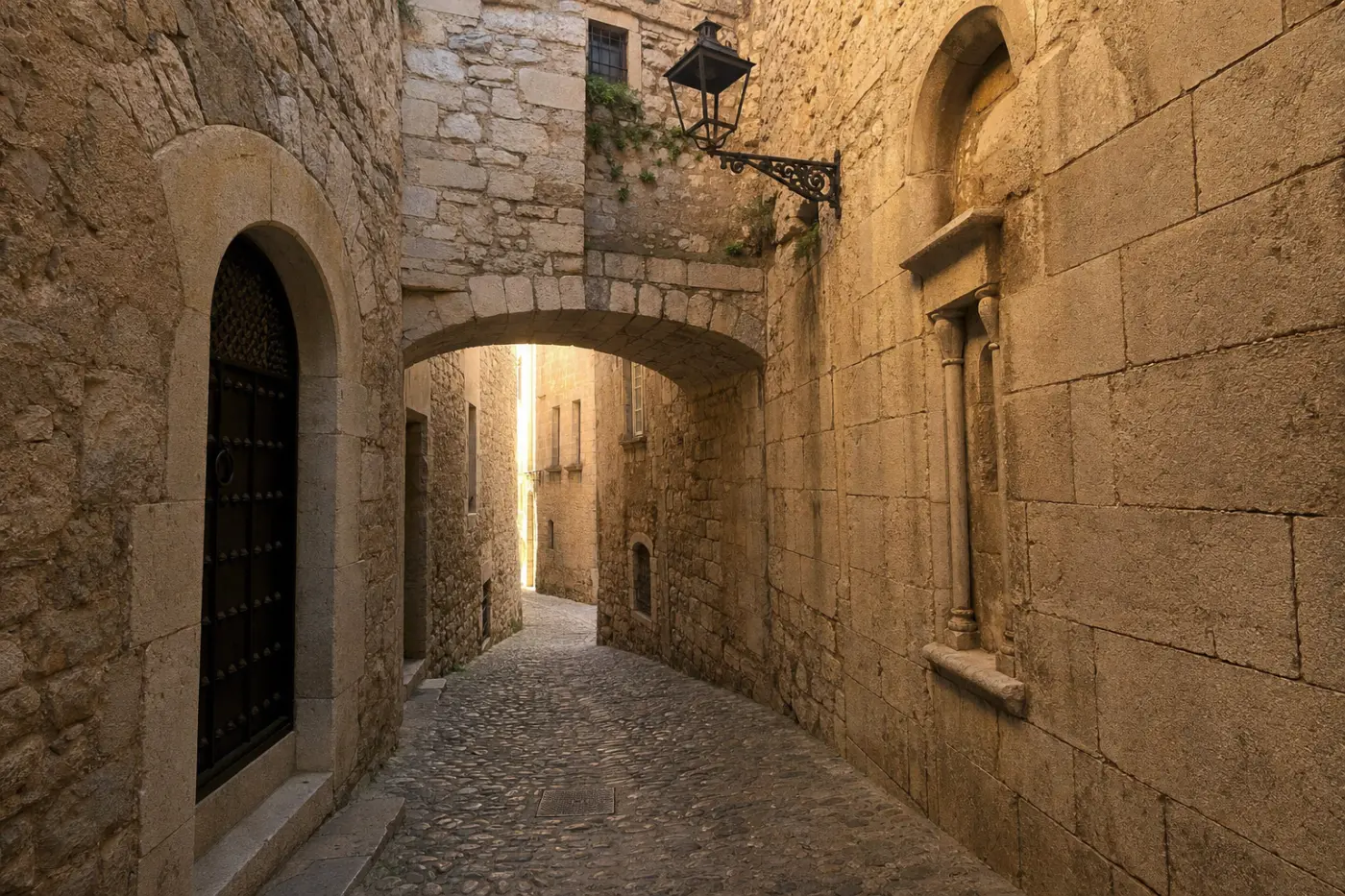
Tourist attraction
El Call is the medieval Jewish quarter of Girona, tucked within the city's walled old town on the eastern bank of the Onyar River. The word "call" derives from the Hebrew qahal, meaning community or congregation, and Girona's call was established no later than the 9th century, making it one of the oldest continuously inhabited Jewish communities on the Iberian Peninsula. At its peak in the 13th and 14th centuries, the community numbered around 1,000 people — roughly a third of Girona's total population — living within a dense network of narrow streets, interior courtyards, and stacked stone buildings that remain largely intact today. The quarter is centered on Carrer de la Força, the ancient Roman Via Augusta that once connected Rome to Hispania, and spreads into a web of alleyways including the evocatively named Carrer dels Jueus (Street of the Jews).
Girona's Jewish community was intellectually distinguished: the city was home to a celebrated Kabbalistic school during the 12th and 13th centuries, producing figures such as Rabbi Moses ben Nachman — known as Nachmanides or Ramban — who was born here around 1194. His school helped make Girona a center of Jewish mystical thought across medieval Europe. The community's prosperity ended abruptly with a catastrophic pogrom in 1391, when the call was violently attacked, and definitively in 1492 when the Alhambra Decree expelled all Jews from Spain. The quarter was subsequently absorbed into the Christian city, with synagogues converted or demolished, yet the architecture survived with remarkable fidelity beneath layers of later construction.
The heart of the quarter today is the Museum of Jewish History (Museu d'Història dels Jueus), housed in a restored medieval building at Carrer de la Força 8. Its permanent collection spans 23 rooms and includes carved stone tomb slabs (matzevot), Hanukkah lamps, ritual objects, and documentary evidence of daily life and commerce from the 9th to 15th centuries. Adjacent to the museum, visitors can examine the remains of the main synagogue and the separate women's synagogue, whose vaulted spaces give a visceral sense of the quarter's layered history. The alleyways themselves — some barely a meter wide, with overhead arches connecting buildings — are as compelling as any exhibit.
El Call is freely accessible as a walking quarter at all hours, though the museum charges a modest entrance fee (free on the first Sunday of each month). The best time to visit is early morning before tour groups arrive, when the stone lanes are quiet and the interplay of light and shadow on medieval masonry is at its most atmospheric. Girona is 100 km northeast of Barcelona, reachable in 38 minutes by high-speed AVE train, making it a highly practical day trip. Wear comfortable shoes — the quarter's cobblestones and steep lanes demand it.
Private tours with a local guide, at your own pace.
Barcelona
Barcelona
Barcelona
Barcelona
Barcelona
Barcelona
Barcelona
Barcelona
Barcelona
We use a single cookie, to remember this choice. We do not use analytics or advertising cookies. Read our cookie policy.