11 hrs
Barcelona
Private Full Day Trip to Medieval Villages of Catalonia + Lunch front of a Lake
✓ Free cancellation Kids friendly
4.8(20 reviews)
From €647/ person
Book Now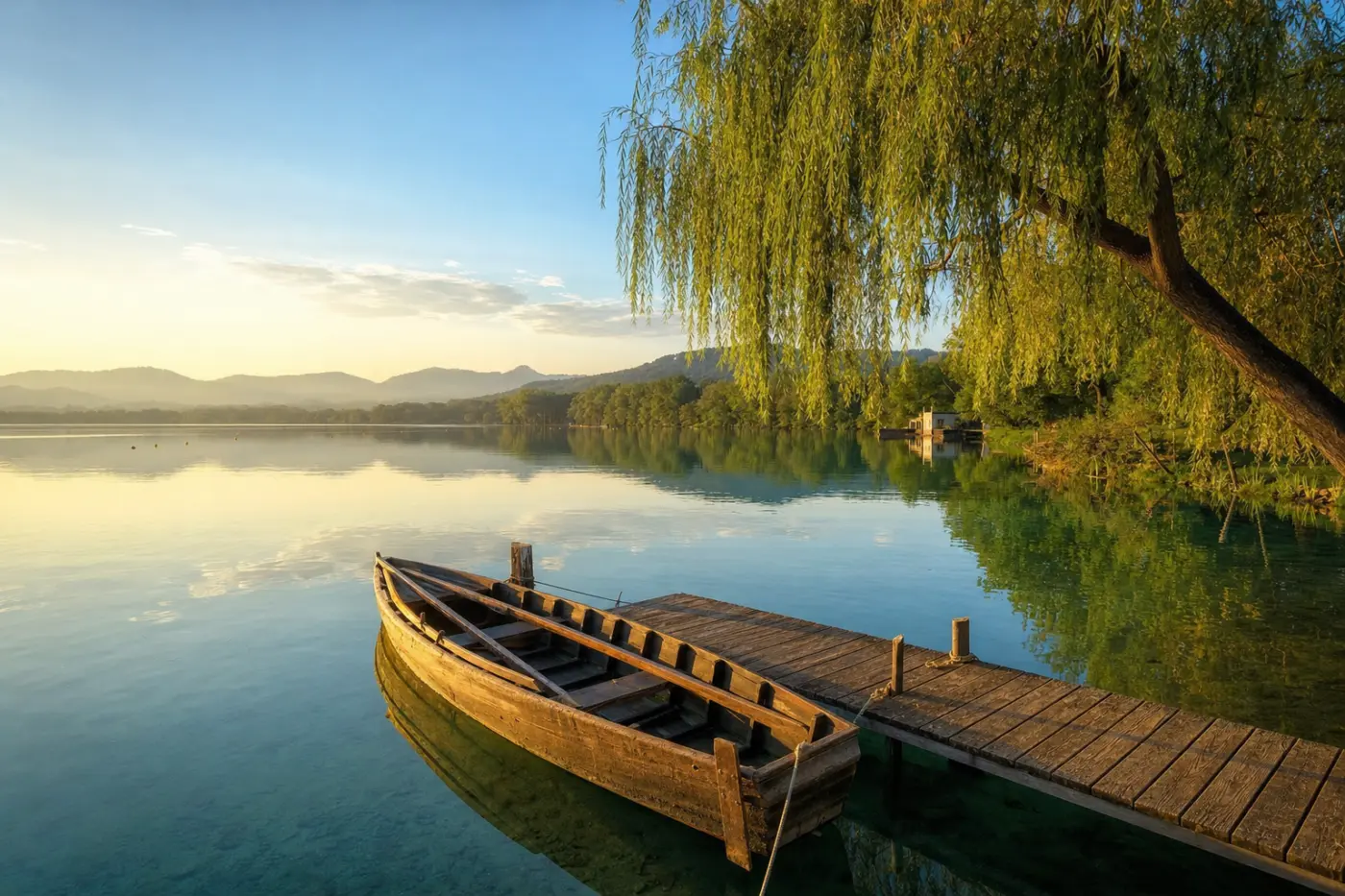
Tourist attraction
The Lake of Banyoles (Estany de Banyoles) is Catalonia's largest natural lake, stretching roughly 2.2 km long and 1 km wide, with a surface area of approximately 112 hectares and depths reaching up to 62 metres in its sinkholes. Located in the comarca of Pla de l'Estany in the province of Girona — about 120 km north of Barcelona and just 15 km from the French border city of Figueres — the lake owes its existence not to glacial action but to a process of karstification: underground dissolution of limestone and evaporite rock over millions of years, which caused the terrain to collapse and groundwater to surface. This makes it geologically unique in the Iberian Peninsula, technically classified as a glaciokarst lake fed by subterranean springs rather than rivers.
Human presence around the lake dates back at least 300,000 years — a prehistoric human jawbone discovered in 1887 near the lakeshore, known as the Mandible of Banyoles, is considered one of the most significant Palaeolithic human remains found in the Iberian Peninsula and is housed in the Archaeology Museum of Catalonia in Banyoles. The town itself grew around a Benedictine monastery founded in 812 AD, and the lake's shoreline has been shaped by centuries of mill construction, fishing communities, and the textile industry that flourished during the medieval period. By the 20th century, the lake had earned international recognition: it served as the rowing venue for the 1992 Barcelona Olympic Games, with the regatta course still operational and used for training and competitions today.
Visitors arriving at the lake are greeted by a 7.5 km circular promenade that traces the entire perimeter through weeping willows, poplars, and waterside cafés. The water's exceptional clarity — fed by constant underground springs maintaining a stable temperature of around 16–18°C — has made it one of Spain's premier freshwater diving destinations, with underwater sinkholes (locally called "ulls," meaning "eyes") drawing divers to explore submerged caverns. Rowing, kayaking, and paddleboarding are available year-round from rental points along the shore. The old town of Banyoles, a short walk from the waterfront, rewards exploration with its medieval arcaded Plaça Major, the 14th-century Gothic Monastery of Sant Esteve, and the Archaeology Museum, which displays the famous jawbone alongside Neolithic and Roman artefacts.
The lake is easily reached by car via the C-66 road from Girona (approximately 20 minutes), or by bus from Girona's main bus station with services running several times daily. The best time to visit is spring and early autumn, when the light is golden, tourist crowds are thin, and the surrounding wetlands — a protected natural area home to herons, grebes, and otters — are at their most active. Dedicated cyclists will appreciate the flat, well-signed bike path connecting Banyoles to Girona along the Ter and Fluvià river valleys.
Private tours with a local guide, at your own pace.
Barcelona
Barcelona
Barcelona
Barcelona
Barcelona
Barcelona
Barcelona

Barcelona
Barcelona
We use a single cookie, to remember this choice. We do not use analytics or advertising cookies. Read our cookie policy.