11 hrs
Barcelona
Private Full Day Trip to Medieval Villages of Catalonia + Lunch front of a Lake
✓ Free cancellation Kids friendly
4.8(20 reviews)
From €647/ person
Book Now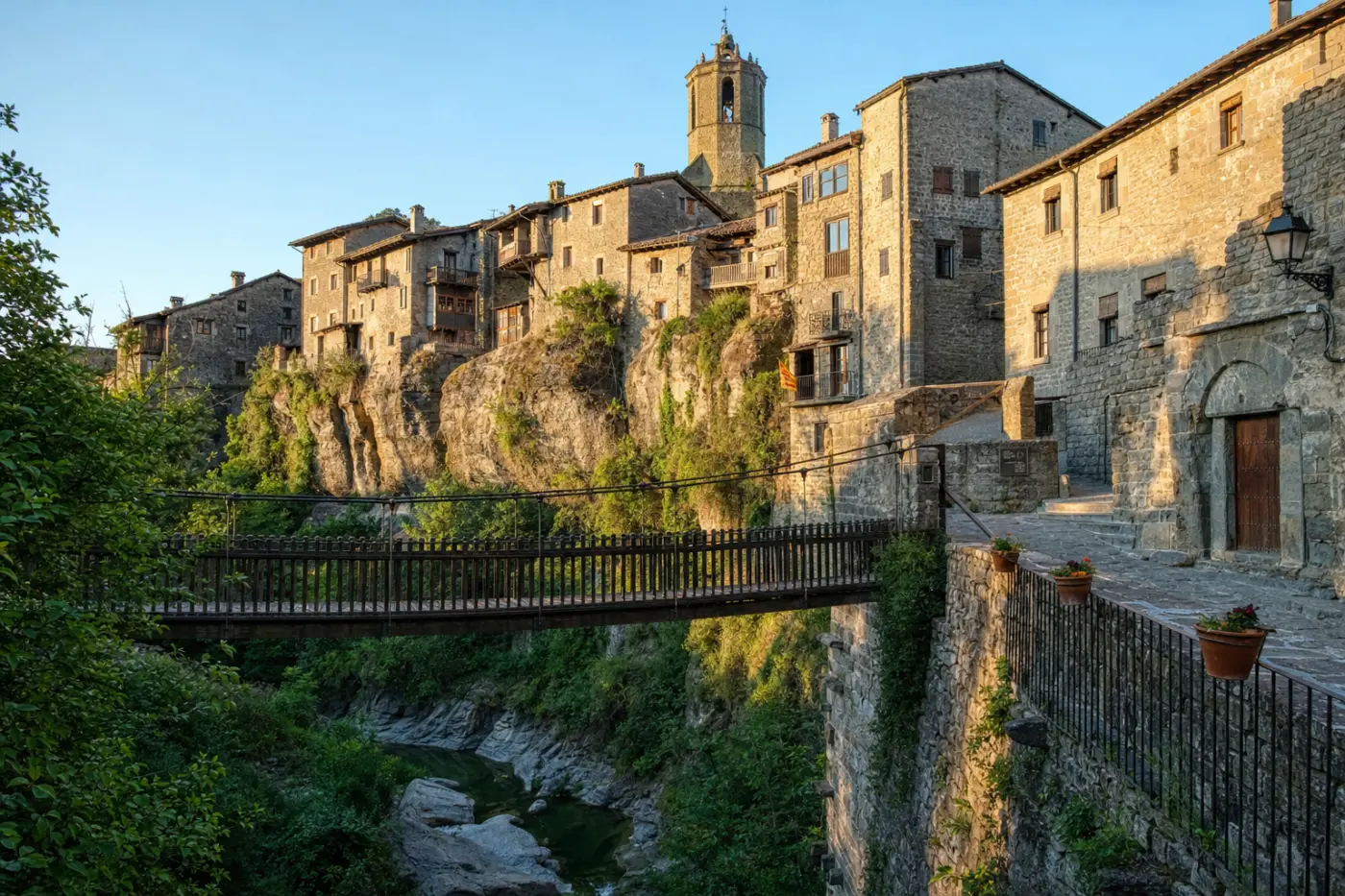
Tourist attraction
Rupit is a fortified medieval village perched above the volcanic and limestone terrain of the Collsacabra massif, in the comarca of Osona, roughly 100 kilometres north of Barcelona. Its name derives from the Latin rupes, meaning rock — an apt description for a settlement built almost entirely from the grey stone cliffs on which it sits. The village's origins trace back to at least the 10th century, when its first Romanesque church was erected, and the surrounding lands show evidence of even earlier habitation: Iberian archaeological sites have been identified at nearby Tavertet and L'Esquirol, and prehistoric dolmens and cave dwellings dot the wider area. The Carolingian dynasty — the Frankish royal line that governed much of Western Europe between the 8th and 10th centuries — also left its mark here before the village took its recognisably medieval shape.
The built fabric of Rupit is remarkably intact. Its narrow cobbled streets are lined with stone houses dating predominantly from the 16th to 18th centuries, many exceeding 400 years in age, their facades softened by flowering balconies in spring and summer. The village was formally recognised as a Conjunto Histórico-Artístico (Historic-Artistic Ensemble) under Spanish heritage law, and in 2003 it received the prestigious Cataluña en Flor award for the best-decorated village in Catalonia — a distinction that reflects the community's enduring pride in its appearance. No motor vehicles are permitted within the village limits, which preserves both the soundscape and the physical fabric of the medieval street plan.
The defining crossing point of Rupit is its suspended wooden footbridge, strung over the Rupit stream gorge at the village entrance. First constructed to replace earlier precarious crossings of the ravine, the current structure sways perceptibly underfoot and delivers visitors directly into the medieval core. Beyond it, the 11th-century Romanesque church of Sant Miquel towers over the central square, and the ruins of the baronial castle — seat of the Lords of Rupit — occupy the highest rocky outcrop above the village. The surrounding landscape offers rewarding hiking, most notably toward the basalt cliff terraces of Tavertet and the Sau Reservoir, where, during dry seasons, the flooded Romanesque bell tower of the submerged village of Sant Romà de Sau emerges dramatically from the water.
Rupit sits about 1.5 hours from Barcelona by car via the C-17 motorway toward Vic, then mountain roads through the Guilleries range. There is no direct public transport, so a car or organised tour is essential. The village has a handful of traditional restaurants serving Catalan mountain cuisine — botifarra sausage, embotits, and locally baked bread — and several craft and honey shops. Weekday visits avoid the weekend day-trip crowds from Barcelona and Vic. Arrive before 10:30 am to walk the cobbled lanes in near-solitude, when morning light rakes across the stone façades at a low angle.
Private tours with a local guide, at your own pace.
Barcelona
Barcelona
Barcelona
Barcelona
Barcelona
Barcelona
Barcelona

Barcelona
Barcelona
We use a single cookie, to remember this choice. We do not use analytics or advertising cookies. Read our cookie policy.