11 hrs
Barcelona
Private Full Day Trip to Medieval Villages of Catalonia + Lunch front of a Lake
✓ Free cancellation Kids friendly
4.8(20 reviews)
From €647/ person
Book Now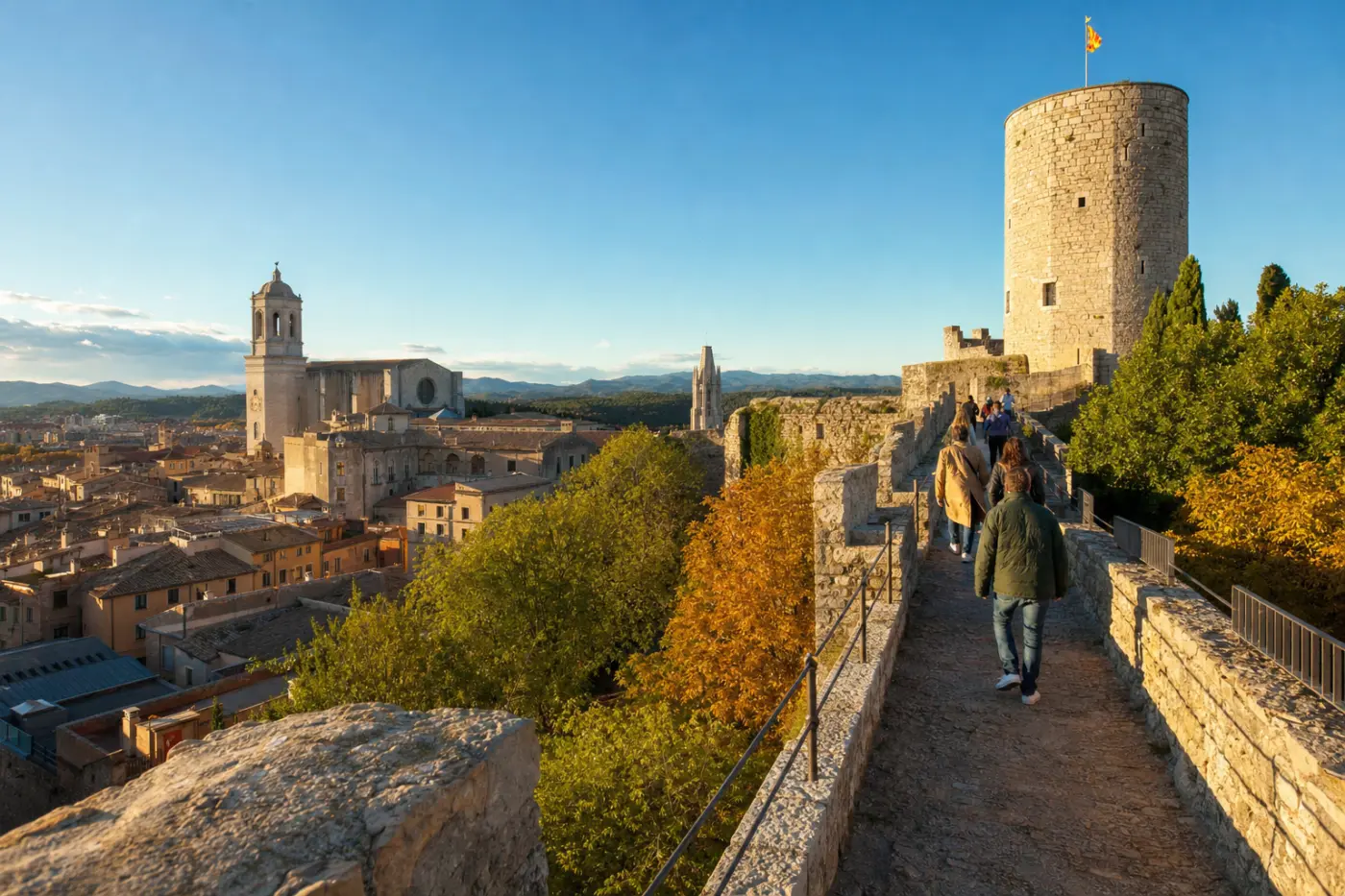
Tourist attraction
The Walls of Girona are one of the best-preserved sets of medieval fortifications in the Iberian Peninsula, encircling the old city (Barri Vell) on the eastern bank of the Onyar River. Their origins are Roman, dating to the 1st century BC when the city was established as Gerunda along the Via Augusta, the Roman road connecting Rome to the Iberian south. The Romans built the first stone circuit, sections of which — including massive opus incertum masonry — are still visible today embedded within later construction. The walls were substantially reinforced and expanded during the medieval period, particularly between the 9th and 14th centuries, when Girona was a fortified stronghold under Carolingian and later Catalan County rule.
Over the centuries, Girona earned the title "City of a Thousand Sieges" for enduring repeated military onslaughts. Most notably, during the Napoleonic Wars, the city withstood three French sieges between 1808 and 1809, the last of which lasted a grueling seven months before its fall in December 1809. The towers punctuating the walls — including the Torre Gironella, the highest surviving point of the fortifications — served as critical defensive positions during these sieges. The Gironella tower dates to the 11th century and offers the most commanding panoramic views over the city's terracotta rooftops, the cathedral's Gothic apse, and the distant Pyrenean foothills.
Today, visitors can walk approximately 1.5 kilometres of the wall's elevated walkway, a promenade that runs from the Portal de Sobreportes — a Roman gate rebuilt in the medieval era — along the northern and eastern edges of the old city. The route passes through the Jardins de la Francesa, terraced public gardens carved into the hillside against the fortifications, offering shaded rest stops and striking views at every turn. Along the way, interpretive panels detail the walls' construction phases, from Roman rubble-work to Gothic ashlar additions commissioned by Aragonese kings in the 14th century.
Access to the wall walk is free and open year-round, with the most scenic light occurring in the early morning or late afternoon when the warm stone glows amber. The walk connects naturally to Girona's Cathedral, the Arab Baths, and the Jewish Quarter (El Call), making it an ideal starting or finishing point for a full exploration of the old city. Girona is reachable from Barcelona in approximately 37 minutes by high-speed AVE train, making it a highly practical and rewarding day trip from the Catalan capital.
Private tours with a local guide, at your own pace.
Barcelona
Barcelona
Barcelona
Barcelona
Barcelona
Barcelona
Barcelona

Barcelona
Barcelona
We use a single cookie, to remember this choice. We do not use analytics or advertising cookies. Read our cookie policy.