6 hrs
Lisboa
Lisbon Private Full-day Tour - History, Culture, Local Life & Gastro Experience
✓ Free cancellation Kids friendly
5.0(27 reviews)
From €219/ person
Book Now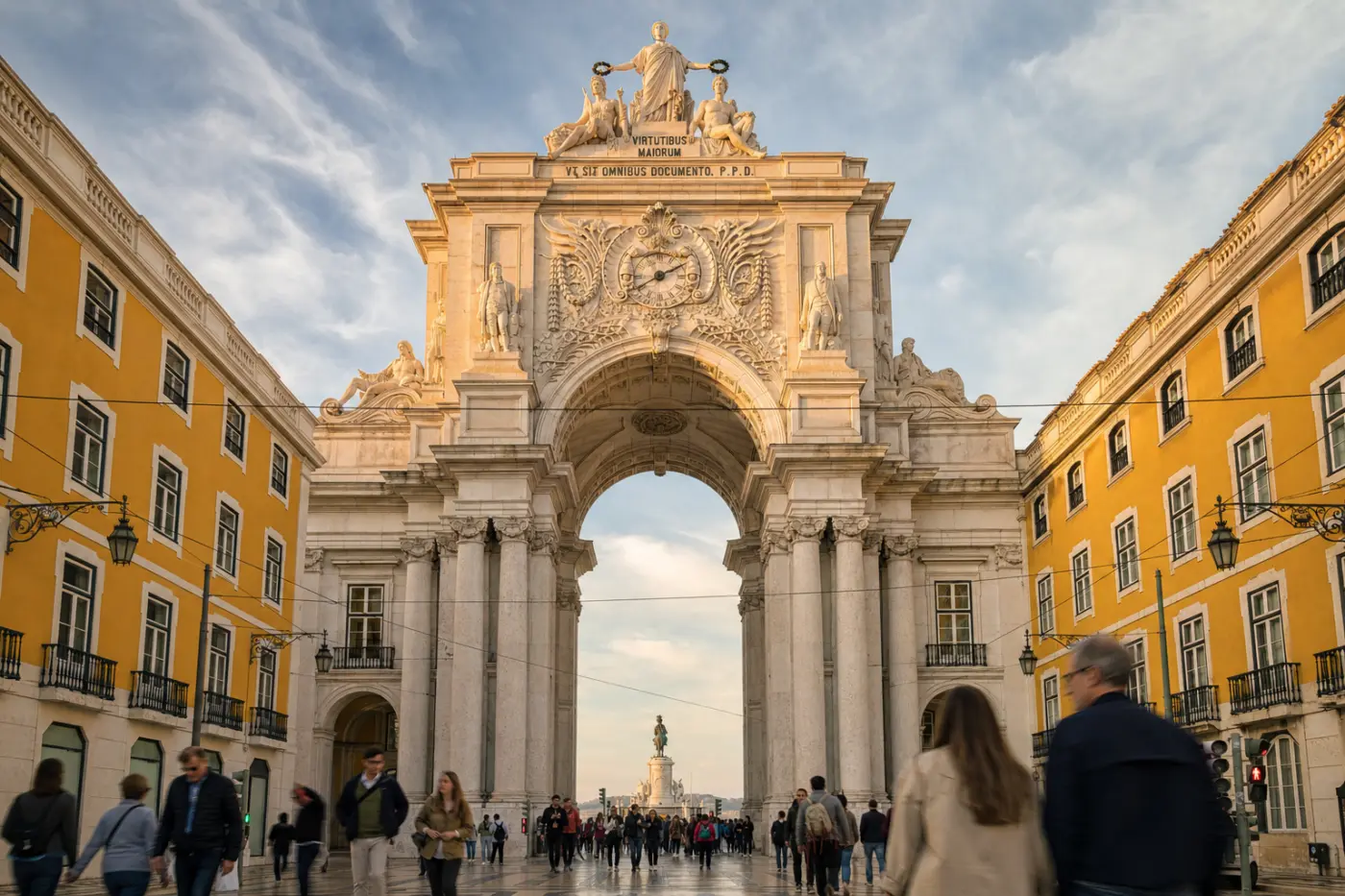
Tourist attraction
The Arco da Rua Augusta is a neoclassical triumphal arch standing at the northern end of Praça do Comércio in Lisbon's Baixa district, framing the city's most iconic view of the Tagus River. It was built as a direct consequence of the catastrophic earthquake of November 1, 1755, which — combined with the subsequent tsunami and fires — devastated nearly the entire city. The Marquis of Pombal, chief minister to King José I, oversaw Lisbon's systematic reconstruction on a rationalist urban grid, and the arch was conceived as the grand ceremonial gateway to the new Pombaline Baixa. Though construction began in 1755 under architect Santos de Carvalho, the project was repeatedly delayed and the arch was not completed until 1873 — over a century later — making it one of the longest-running construction projects in Lisbon's history.
The arch stands approximately 30 metres tall and is richly ornamented with allegorical sculpture. At its summit, a central clock is flanked by figures representing Glory crowning Valour and Genius, sculpted by Célestin Anatole Calmels. Below, two imposing lateral niches hold statues of the Tagus and Douro rivers personified as reclining gods. The façade also bears a prominent Latin inscription — "Virtutibus Maiorum ut Sideri Orbem" — honouring the virtues of Portugal's ancestors. On the side facing Rua Augusta, bas-relief panels depict Vasco da Gama and the Marquis of Pombal, anchoring the arch firmly within Portugal's narrative of maritime expansion and Enlightenment-era reconstruction.
Visitors can climb to the terrace atop the arch via an interior staircase and a small lift, emerging onto one of the finest elevated viewpoints in central Lisbon. From this platform, the geometry of the Pombaline street grid fans northward in perfect symmetry, while to the south, Praça do Comércio opens onto the wide Tagus estuary — a panorama that makes the city's relationship with its river immediately legible. The interior also houses a small permanent exhibition on the arch's construction history and its role within the urban fabric of post-earthquake Lisbon.
Admission to the terrace is ticketed and separate from the free pedestrian passage through the arch itself, which remains open at all hours as a public thoroughfare. The best light for photography falls in the late afternoon, when the low Atlantic sun illuminates the stone sculptures from the west and the terrace offers an unobstructed view of the river. The arch sits steps from Lisbon's waterfront tram stops and is easily combined with a visit to Praça do Comércio's colonnaded arcades, the nearby Museu do Design e da Moda (MUDE), and the pedestrian stretch of Rua Augusta itself.
Private tours with a local guide, at your own pace.
Lisboa
Lisboa
Lisboa

Lisboa
Lisboa

Lisboa

Lisboa
Lisboa
Lisboa
We use a single cookie, to remember this choice. We do not use analytics or advertising cookies. Read our cookie policy.