5 hrs
copenhagen
Copenhagen Private Full Day Tour with Lunch Option
✓ Free cancellation Kids friendly
4.8(138 reviews)
From €334/ person
Book Now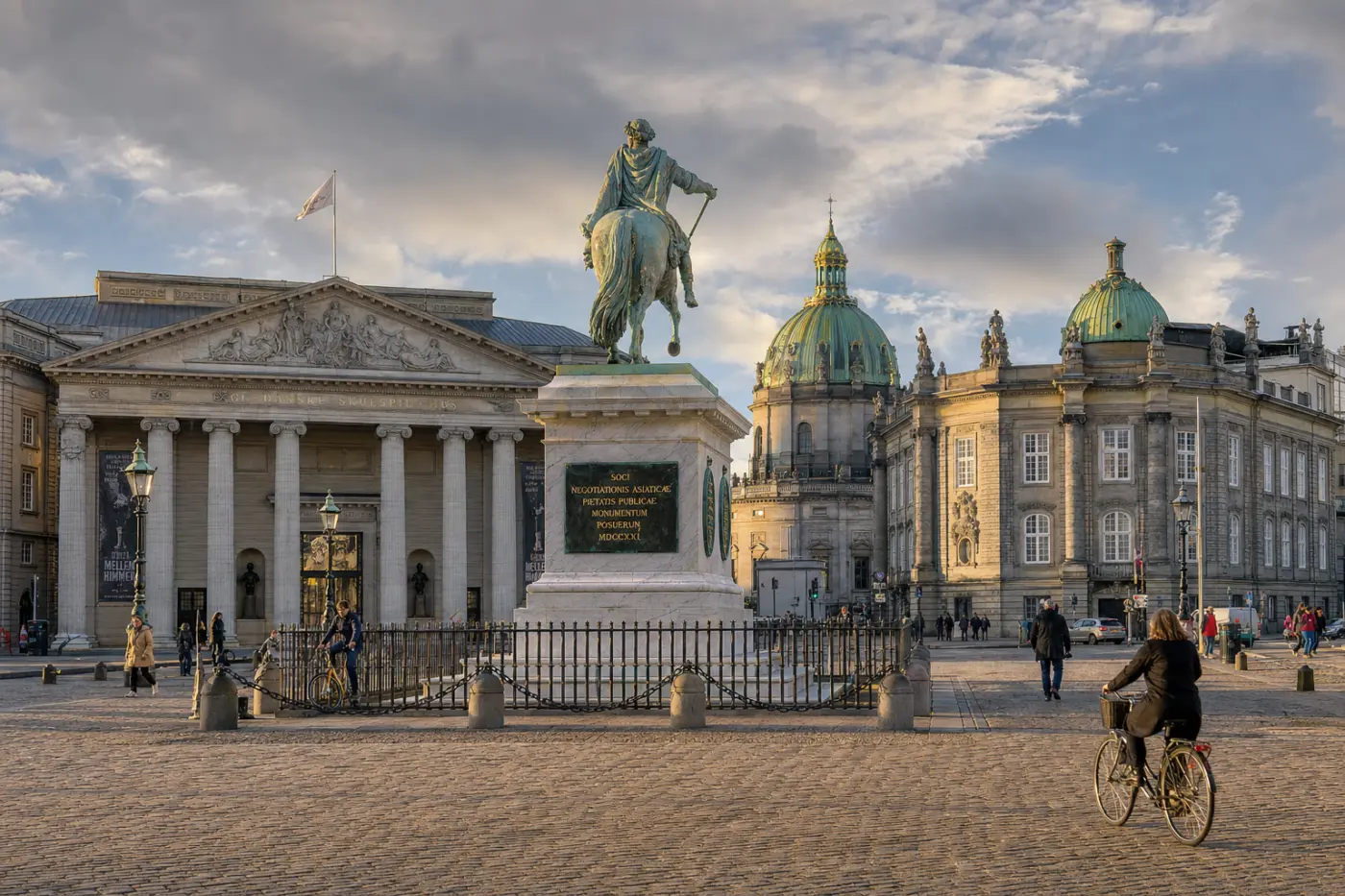
Tourist attraction
Kongens Nytorv — literally "King's New Square" — is Copenhagen's largest and most ceremonial public square, laid out in 1670 on the direct orders of King Christian V. The site had a decidedly unglamorous past: it was a waterlogged dumping ground on the city's eastern fringe, locally nicknamed "Hallandsåsen" for its accumulated refuse. Christian V's ambition was explicitly Parisian — he wanted a formal, Baroque-style plaza that would shift Copenhagen's gravitational centre away from the medieval Gammeltorv and announce Denmark as a modern European monarchy. The result was one of Scandinavia's most architecturally coherent urban spaces, whose essential character has remained intact for more than three centuries.
The square's dominant monument is the gilded equestrian statue of Christian V himself, cast in lead in 1688 by the French sculptor Abraham-César Lamoureux — making it the oldest equestrian statue in Scandinavia. The lead original deteriorated over time and was recast in bronze in 1946, but it has occupied the same central plinth without interruption. Around the statue, the square is framed by landmark buildings that accumulated across the 18th and 19th centuries: Charlottenborg Palace (1683), a Dutch Baroque mansion built for Christian V's illegitimate son that today houses the Royal Danish Academy of Fine Arts; and the original Royal Danish Theatre, founded on the square in 1748 and rebuilt in its current neoclassical form in 1874. The theatre remained Denmark's national stage for drama, opera, and ballet until the opening of the new opera house in 2005. The grand Magasin du Nord department store, occupying the former Hôtel du Nord building on the square's north side, has drawn shoppers since 1879.
The square has also played a darker role in Copenhagen's history. The wide cobbled expanse was used for military drills throughout the 17th and 18th centuries, and public punishments — including executions — were carried out within sight of the king's own statue. Today, the tone is entirely festive: every November and December a traditional Christmas market fills the square with wooden stalls selling æbleskiver and gløgg, and each June the city's graduating secondary school students (studenter) arrive by decorated truck to dance around the statue in a rite that has been observed since the 19th century. In winter, the central garden area is flooded to create an outdoor ice-skating rink.
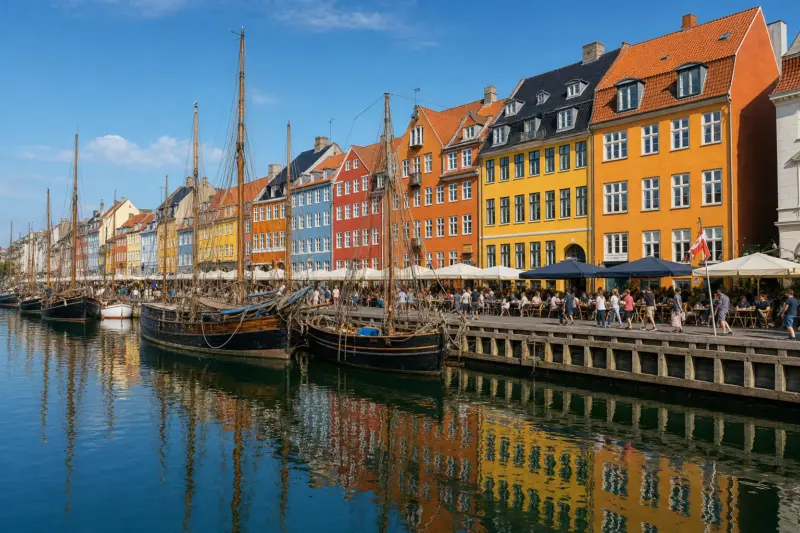
Kongens Nytorv sits at the junction of three of Copenhagen's most-visited streets and waterfronts: Strøget, the pedestrian shopping spine, begins here heading west; Nyhavn's colourful canal opens directly to the northeast; and Bredgade leads north toward the Marble Church and Amalienborg Palace. The Metro's Kongens Nytorv station, opened in 2002, is the system's main interchange hub, making the square the easiest entry point for visitors arriving from the airport. Allow time to walk the full perimeter — the contrast between the 17th-century palace facades, the 19th-century theatre, and the busy canal mouth at Nyhavn captures Copenhagen's layered history in a single, unhurried loop.
Private tours with a local guide, at your own pace.
copenhagen

copenhagen
copenhagen
copenhagen
copenhagen
We use a single cookie, to remember this choice. We do not use analytics or advertising cookies. Read our cookie policy.