2 hrs
Vienna
Vienna Private Classical Music Tour: Museum Entry & Concert
✓ Free cancellation Kids friendly
4.7(12 reviews)
From €166/ person
Book NowTourist attraction
Leopoldstadt — Vienna's 2nd district — occupies a large island between the Danube Canal and the Danube River, and for nearly four centuries it has functioned as the city's Jewish heartland. The district's Jewish history begins formally in 1625, when Emperor Ferdinand II concentrated Vienna's Jewish population here, naming the quarter after himself. By the late 19th century, successive waves of immigration from Galicia and Moravia had made Leopoldstadt home to more than 60,000 Jewish residents — roughly a third of the district's population — producing an intellectual and cultural flowering that shaped Vienna's identity in law, medicine, journalism, and psychoanalysis. Sigmund Freud spent much of his formative years in the district; Theodor Herzl, father of modern Zionism, lived and worked nearby. That world was systematically annihilated after the Nazi annexation of Austria in March 1938, when Leopoldstadt became a site of brutal dispossession, deportation, and murder.
The most significant surviving monument of that history is the Vienna Stadttempel, tucked discreetly behind a residential façade at Seitenstettengasse 4. Completed in 1826 and designed by architect Josef Kornhäusel in a restrained Biedermeier-Neoclassical style, it is the only synagogue in Vienna to survive Kristallnacht — the Nazi pogrom of November 9–10, 1938, during which 94 synagogues and prayer houses across Vienna were destroyed. The Stadttempel survived because its structure was physically integrated into the surrounding apartment buildings; burning it would have set the entire block ablaze. Today it remains the operational center of Vienna's Jewish community, seating approximately 900 worshippers beneath an elliptical gallery and a sky-blue ceiling studded with gilt stars. Guided visits are available, though security checks are thorough and advance booking is required. The Leopoldstädter Tempel, the district's grand 19th-century synagogue that once held 2,000 worshippers, was destroyed in 1938; a commemorative plaque marks the site on Tempelgasse.
Walking through Leopoldstadt today means reading a district in two registers simultaneously: the weight of erasure and the energy of reinvention. The Jewish Museum Vienna operates a satellite branch at Dorotheergasse in the 1st district but connects deeply to Leopoldstadt's story through its permanent collection, which documents the full arc of Viennese Jewish life from medieval expulsions to the Shoah. Within Leopoldstadt itself, Stolpersteine — the small brass cobblestones installed by German artist Gunter Demnig since the 1990s — mark the former addresses of deported and murdered residents throughout the neighborhood's streets. The Augarten, a Baroque park dating to 1650 and opened to the public by Emperor Joseph II in 1775, anchors the northern end of the district and is dominated by two enormous WWII flak towers whose concrete hulks remain too costly and technically complex to demolish, standing as inadvertent monuments to the war that reshaped everything around them.
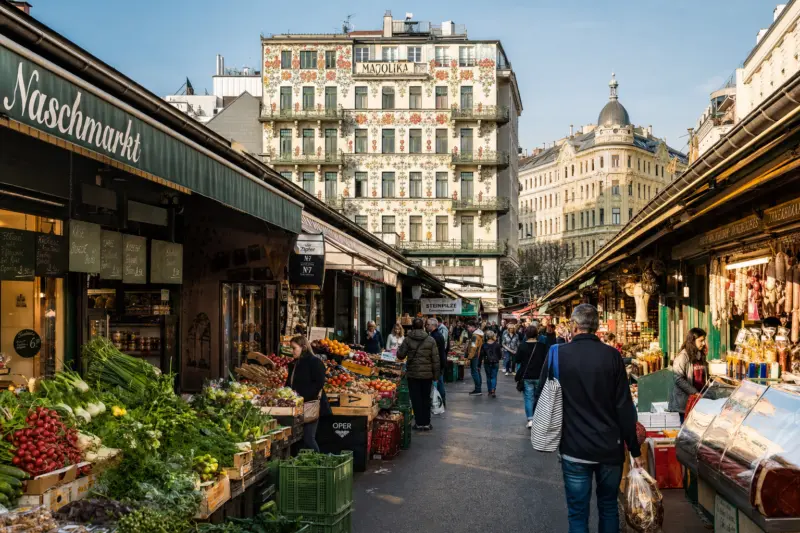
Modern Leopoldstadt has attracted Vienna's creative class with a density of independent cafés, galleries, and market stalls that has made Karmelitermarkt — the district's outdoor farmers' market, held Tuesday through Saturday — a gathering point for the city's food culture. The Prater, with its famous 1897 Riesenrad (Giant Ferris Wheel), borders the district's southern edge and offers a sharp tonal contrast: fairground nostalgia beside layered historical grief. Visitors who want structured orientation should seek out one of the walking tours offered by licensed guides specializing in Jewish Vienna; these typically depart from the Stadttempel area and cover roughly two hours on foot. For independent exploration, the district rewards slow walking: read the Stolpersteine names, cross the Augarten in the morning light, and allow the neighborhood's dual identity — archive and living city — to unfold without rushing.
Private tours with a local guide, at your own pace.
Vienna
Vienna
Vienna
Vienna
Vienna
Vienna
Vienna
Vienna
Vienna