6 hrs
Lisboa
Lisbon Private Full-day Tour - History, Culture, Local Life & Gastro Experience
✓ Free cancellation Kids friendly
5.0(27 reviews)
From €219/ person
Book Now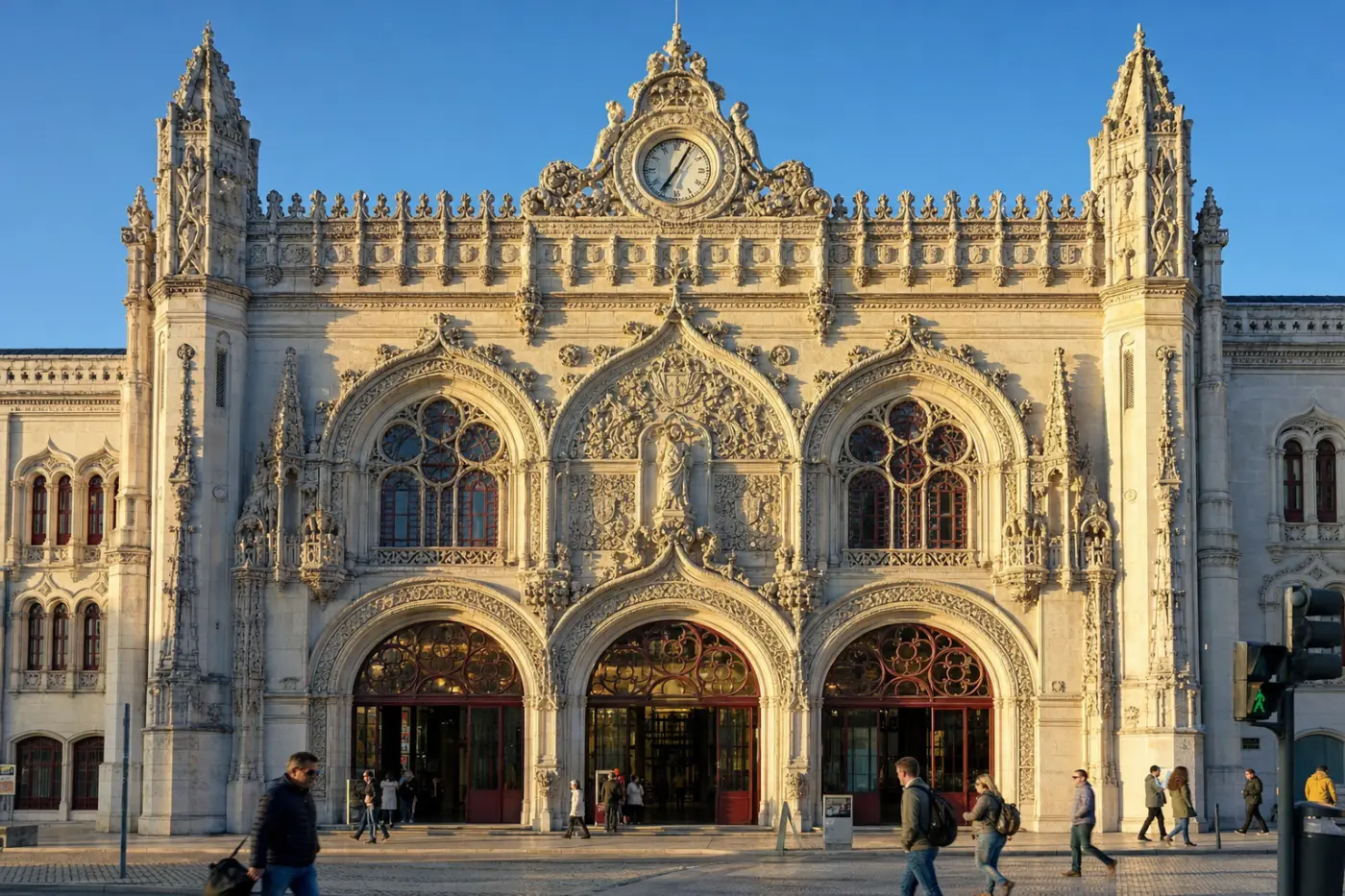
Tourist attraction
Rossio Station — formally the Estação de Caminhos de Ferro do Rossio — stands at the northwest edge of Praça Dom Pedro IV in central Lisbon, its extravagant façade announcing itself as one of the most architecturally dramatic railway terminals in Europe. Commissioned by the Portuguese Royal Railway Company and designed by architect José Luís Monteiro, it was constructed between 1886 and 1887 and inaugurated in 1890. The building was conceived not merely as a transit hub but as a civic monument, its twin horseshoe arches — borrowed from the Manueline doorways of Jerónimos Monastery — signaling that Portugal's industrial age would be dressed in the grandeur of its Age of Discovery.
The station's façade is a defining example of Neo-Manueline architecture, a 19th-century Romantic revival of the ornate late-Gothic style that flourished in Portugal between roughly 1490 and 1520. Monteiro covered the stone frontage in densely layered maritime motifs — twisted ropes, armillary spheres, and botanical tracery — rendered in limestone with a craftsmanship that deliberately echoed the reign of King Manuel I. The two soaring horseshoe arches, each framing a monumental doorway, are flanked by pinnacled towers and topped with an elaborate clock, making the façade simultaneously a timetable and a history lesson. Inside, the main hall rises to an iron-and-glass canopy of restrained elegance, the structural logic of the industrial era providing a deliberate counterpoint to the ornamental riot outside.
What made the station an engineering landmark of 19th-century Portugal was not its façade but what lay beneath it. To bring rail lines into the heart of Lisbon without demolishing the dense urban fabric of Baixa and the hills of Bairro Alto, engineers excavated the Túnel do Rossio — a tunnel bored under the city to connect the terminal with the main rail network heading north toward Sintra. At the time of its construction, this was considered one of the most significant civil engineering achievements in the country. The station served as Lisbon's primary passenger terminus until 1957, after which Estação do Oriente and Santa Apolónia absorbed much of the long-distance traffic, leaving Rossio to serve primarily the scenic Sintra line.
Today, Rossio Station remains fully operational and is the most convenient departure point for the 40-minute train journey to Sintra, making it a natural first stop for day-trippers. Visitors arriving on foot from Praça do Rossio should look up before entering: the interplay of carved stone, the patina of the limestone, and the symmetry of the arches reward careful attention. The station's interior retains its original iron structure and period tilework. Trains to Sintra run frequently throughout the day, and the station connects directly to the Rossio metro stop. Early morning light hits the façade at a low angle that brings the carved relief work into sharp relief — worth the slight detour before heading elsewhere in the city.
Private tours with a local guide, at your own pace.
Lisboa
Lisboa

Lisboa
Lisboa

Lisboa
Lisboa

Lisboa
Lisboa
Lisboa
We use a single cookie, to remember this choice. We do not use analytics or advertising cookies. Read our cookie policy.