7 hrs
London
Oxford Private Day Trip from London – Sightseeing & Lunch
✓ Free cancellation Kids friendly
4.8(19 reviews)
From €578/ person
Book Now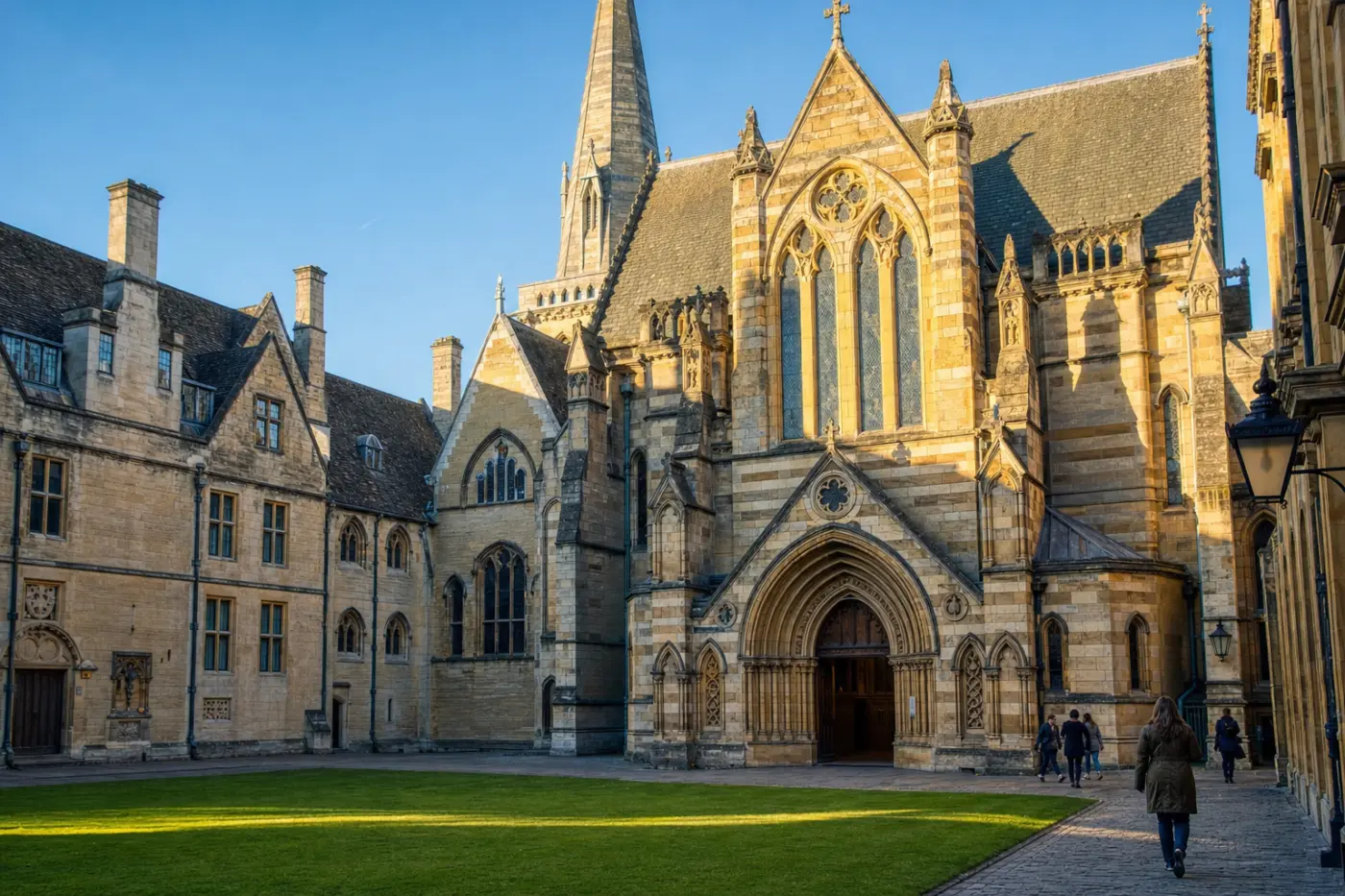
Tourist attraction
Balliol College is one of the oldest constituent colleges of the University of Oxford, with origins dating to around 1263, when John I de Balliol — a powerful Anglo-Norman baron — was compelled by the Bishop of Durham to perform an act of penance by providing financial support for poor scholars studying at Oxford. After John's death in 1268, his widow Dervorguilla of Galloway formalized the institution by granting it a permanent endowment and a set of statutes in 1282, making Balliol one of the first colleges in the English-speaking world to operate under a formal governing charter. The college sits at the heart of Oxford's city centre on Broad Street, its buildings spanning architectural periods from the medieval to the Victorian Gothic Revival.
Balliol's architectural fabric reflects its long and layered history. The front quadrangle features the distinctive Gothic-style chapel, rebuilt in 1857 by architect William Butterfield, whose polychrome stonework and high Victorian interior — complete with stained glass by Pre-Raphaelite artists — contrasts sharply with the college's older medieval stonework. A blackened cross embedded in the cobbles of Broad Street just outside the college gates marks the spot where Protestant martyrs Thomas Cranmer, Hugh Latimer, and Nicholas Ridley were burned at the stake in 1555 and 1556, a somber reminder of the religious upheaval that surrounded the college's early centuries. The medieval library, parts of which date to the 15th century, holds rare manuscripts and incunabula among its historic collections.
Academically and politically, Balliol has an unrivalled record of producing figures who shaped British and world affairs. Its alumni include three British Prime Ministers — Herbert Henry Asquith, Harold Macmillan, and Edward Heath — as well as the economist Adam Smith, who studied here in the 1740s, and writers Aldous Huxley and Graham Greene. Under the reforming Mastership of Benjamin Jowett (1870–1893), Balliol cultivated a philosophy of public service that sent its graduates into the highest offices of the British Empire, earning the college a reputation as a nursery of statesmen. Jowett himself translated Plato's dialogues into English, works still widely read today.
Visitors to Balliol can enter the front and garden quadrangles during public opening hours, which are typically available in the afternoons throughout the academic year and more broadly during vacations — though hours vary, so checking the college website before visiting is advisable. Broad Street itself is walkable from the city's main shopping area and sits close to the Bodleian Library, the Sheldonian Theatre, and the History of Science Museum, making Balliol a natural anchor for a walking tour of central Oxford. Entry is free, though a small fee may apply during peak tourist periods. The lodge porter can direct visitors to the chapel and garden, and informational boards throughout the quadrangles provide historical context for each building.
Private tours with a local guide, at your own pace.
London
London
London
London

London
London
London

London

London
We use a single cookie, to remember this choice. We do not use analytics or advertising cookies. Read our cookie policy.