3 hrs
London
London: Private Family Tour, Natural History Museum & Games
✓ Free cancellation Kids friendly
4.5(0 reviews)
From €208/ person
Book Now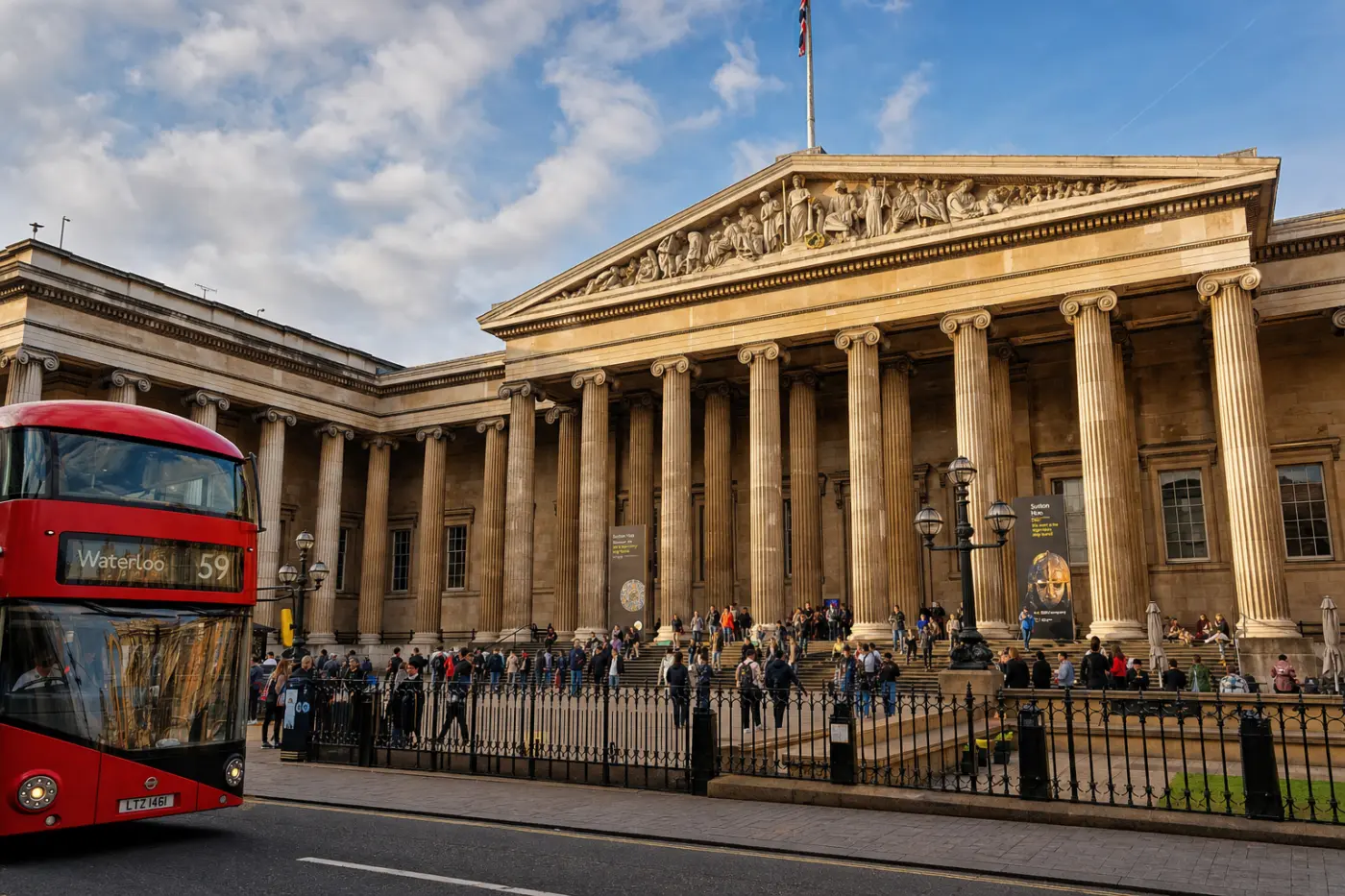
Tourist attraction
The British Museum in Bloomsbury, London, is the world's oldest and one of its largest public museums, with a permanent collection of approximately eight million objects spanning two million years of human history. It was founded in 1753 through an Act of Parliament — the first national museum established by a government anywhere in the world — and opened its doors to the public on 15 January 1759, initially housed in Montagu House on the same Great Russell Street site it occupies today. The founding collection was built on the bequest of the physician and naturalist Sir Hans Sloane, who left over 71,000 objects, manuscripts, and natural specimens to the nation in exchange for £20,000 paid to his estate. Subsequent royal donations, including King George II's Old Royal Library in 1757 and King George IV's library of 65,000 volumes in 1823, rapidly expanded its scope.
The museum's current neoclassical building, designed by architect Robert Smirke, was constructed between 1823 and 1852, with its iconic south façade featuring 44 Ionic columns stretching 213 metres across Great Russell Street. The reading room at the heart of the building — a vast copper-domed structure completed in 1857 — became one of the most celebrated intellectual spaces in the world, where Karl Marx researched Das Kapital and Virginia Woolf found material for her essays. In 2000, architect Norman Foster transformed the museum's central courtyard into the Queen Elizabeth II Great Court, installing a spectacular steel-and-glass roof comprising 3,312 unique triangular panes, creating the largest covered public square in Europe.
The collection's highlights draw visitors from across the globe: the Rosetta Stone, discovered by French soldiers in Egypt in 1799 and transferred to British custody in 1802, remains the single most-visited object in the museum and was instrumental in deciphering Egyptian hieroglyphics. The Elgin Marbles — classical Greek sculptures removed from the Parthenon in Athens between 1801 and 1812 by the Earl of Elgin — fill an entire dedicated gallery and are the subject of ongoing repatriation discussions with the Greek government. Other unmissable artefacts include the Lewis Chessmen (12th-century Norse gaming pieces carved from walrus ivory), Lindow Man (a 2,000-year-old Iron Age bog body found in Cheshire in 1984), and the Sutton Hoo helmet, an Anglo-Saxon burial treasure excavated in Suffolk in 1939.
The museum is free to enter for its permanent collection and receives around six million visitors per year, making it the most visited attraction in the United Kingdom. Visitors planning a trip should note that the galleries span 92 rooms across multiple floors, so prioritising in advance is essential — the audio guide app, available for download before arrival, provides curated routes by theme and time available. Temporary exhibitions carry a separate admission charge and require advance booking. The museum is open daily, with extended hours on Fridays, and is a short walk from Tottenham Court Road and Holborn Underground stations.
Private tours with a local guide, at your own pace.
London
London

London
London
London
London
London

London