3 hrs
London
Authentic British Food and Drink Private Tour in London- Local Taverns & Pubs
✓ Free cancellation Kids friendly
4.8(15 reviews)
From €206/ person
Book Now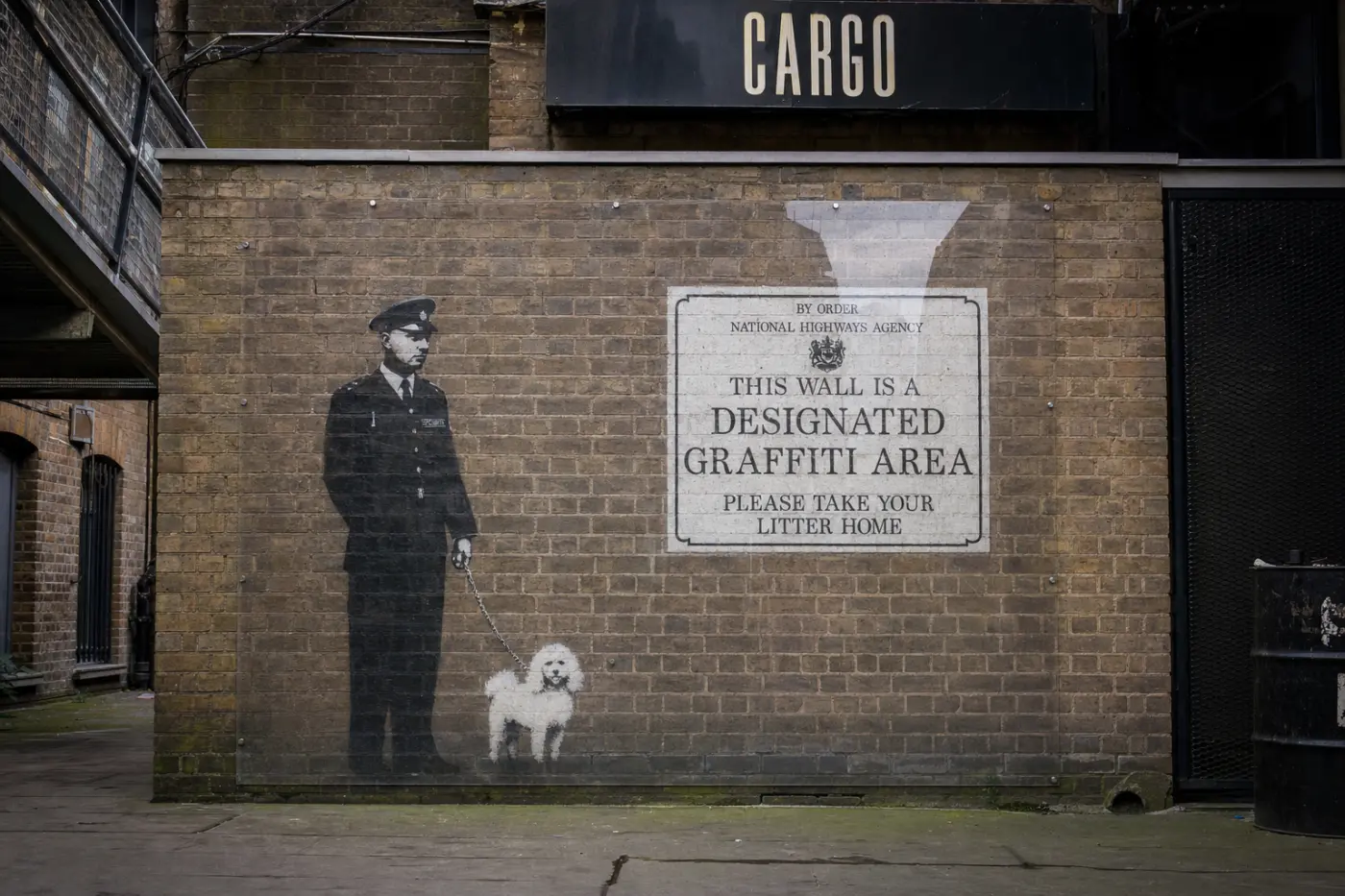
Tourist attraction
Painted in 2003 on the courtyard wall of Cargo nightclub on Rivington Street in Shoreditch, Graffiti Area is one of Banksy's most philosophically loaded early murals. The composition shows a stiff, uniformed security guard standing beside an absurdly small fluffy poodle, both positioned next to an official-looking notice that reads: "BY ORDER NATIONAL HIGHWAYS AGENCY — THIS WALL IS A DESIGNATED GRAFFITI AREA — PLEASE TAKE YOUR LITTER HOME." The fictional "National Highways Agency" and the formal serif typography are precise imitations of the visual language of British public authority — the same bureaucratic register used on road signs and planning notices that citizens are conditioned to obey without question.
The concept predates the Cargo mural and was central to Banksy's practice as early as 2002, when a contemporary review of his self-published book Banging Your Head Against a Brick Wall specifically singled out the Designated Graffiti Area stencil. A 2003 iteration placed on the South Bank demonstrated the idea's real-world potency: other writers, taking the fictitious notice at face value, covered the wall with their own tags. The stencil did not merely comment on the relationship between permission and transgression — it actively reorganised it. At Cargo, the addition of the guard and his poodle sharpens the irony further. The figure of authority is physically present but rendered ridiculous; he now watches over a wall where vandalism has supposedly been officially sanctioned. The final line — "Please Take Your Litter Home" — implies that graffiti has been so thoroughly absorbed into civic administration that even illegal art now comes with etiquette guidelines.
The mural's subsequent history produced an irony Banksy could not have scripted. The unauthorized work was eventually encased in a Perspex protective sheet to shield it from other graffiti and weather damage — an act of institutional preservation applied to a piece that explicitly mocks institutional control. It remains visible in the Rivington Street courtyard more than two decades after it was created, alongside another significant early Banksy work at the same venue, His Master's Voice. The Cargo site itself became a landmark of Shoreditch's early 2000s creative scene, a neighbourhood that has since undergone the kind of gentrification Banksy's work frequently anticipated and critiqued.
To visit, enter the Cargo courtyard from Rivington Street — the mural is on the rear wall and viewable during venue opening hours, though the exterior courtyard is often accessible independently. Shoreditch is dense with street art, and Rivington Street itself functions as an informal open-air gallery; arriving on foot from Old Street station (Northern line, ten minutes' walk) allows you to take in the broader mural landscape of the area. The Perspex covering means the mural is best photographed on overcast days, when glare is minimal.
Private tours with a local guide, at your own pace.
London
London
London
London
London
London

London
London

London
We use a single cookie, to remember this choice. We do not use analytics or advertising cookies. Read our cookie policy.