3 hrs
Rome
Private Cooking Class with Colosseum Views and Local Chef
✓ Free cancellation Kids friendly
4.7(19 reviews)
From €223/ person
Book Now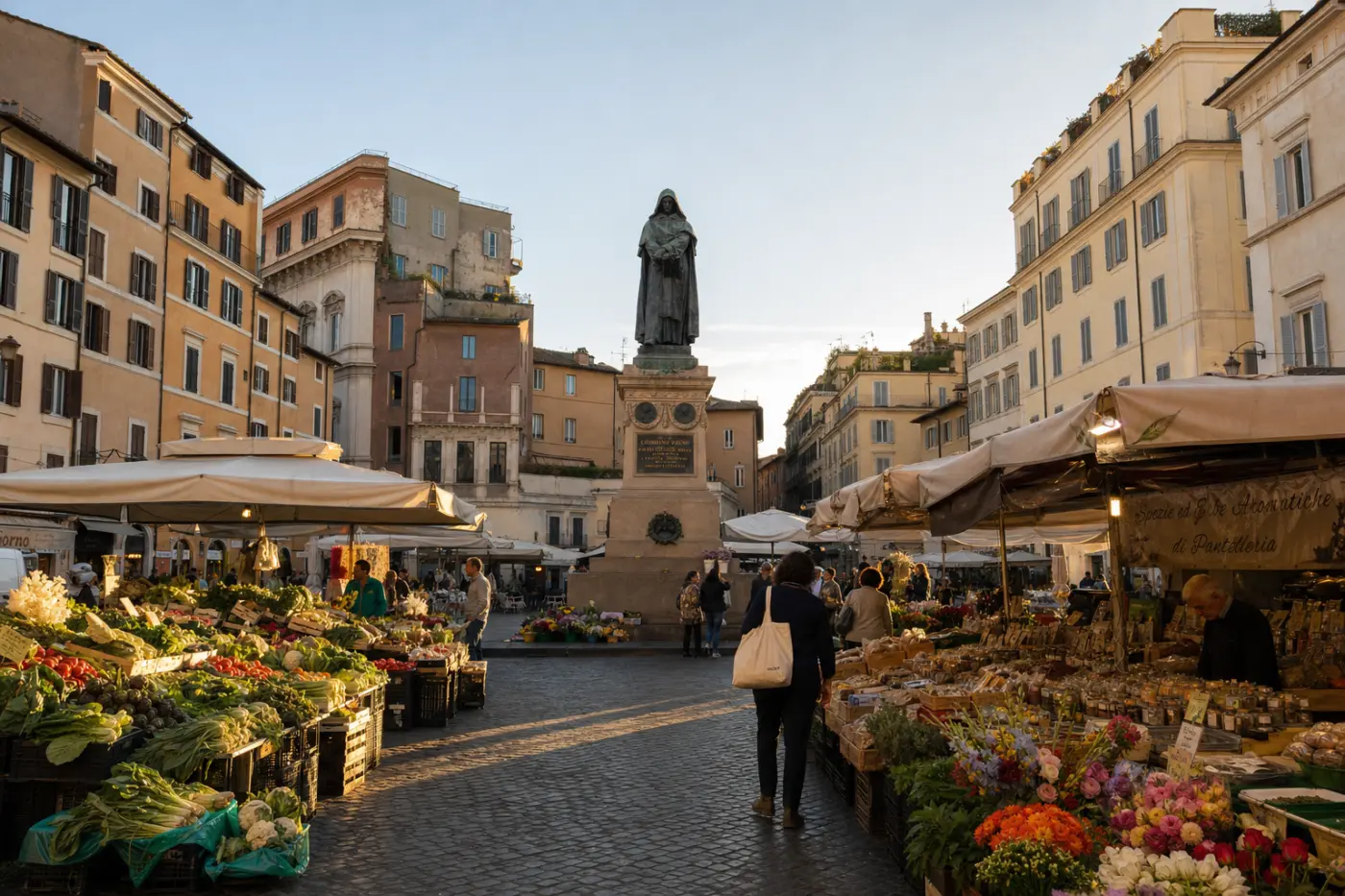
Tourist attraction
Campo de' Fiori — literally "Field of Flowers" — sits in the Rione Parione, one of Rome's oldest inhabited districts, roughly halfway between Piazza Navona and the Tiber River. Unlike virtually every other major piazza in Rome, it is conspicuously free of churches, obelisks, and imperial monuments. That secular character is no accident: from the late medieval period through the 17th century, the square functioned as the city's primary site for public executions, markets, and the kind of daily commerce that unfolded well away from the authority of altar and throne. Before the 15th century, the area was literally an open meadow on the outskirts of the abitato, the densely built core of medieval Rome. Urban development accelerated after the papacy returned from Avignon in 1377, and by the mid-1400s inns, workshops, and the residences of cardinals' households had colonized the square's perimeter.
The event that defined Campo de' Fiori's identity for centuries occurred on February 17, 1600, when the Dominican friar and philosopher Giordano Bruno was burned alive at the stake there by order of the Roman Inquisition. Bruno had spent eight years imprisoned in Castel Sant'Angelo after being extradited from Venice, convicted of heresy for championing a heliocentric, infinite universe and denying the divinity of Christ. The brooding bronze statue that now dominates the center of the square was erected in 1889 — deliberately on the spot of the execution — by a coalition of anticlerical intellectuals and Freemasons. The sculptor Ettore Ferrari gave Bruno a downcast hood and a defiant posture; his gaze is aimed directly at the Vatican. When the statue was unveiled, Pope Leo XIII reportedly retreated to his rooms in protest. It remains one of the most politically charged monuments in Rome.
Every weekday and Saturday morning from roughly 7 a.m. to 2 p.m., the square fills with one of Rome's oldest continuously running outdoor markets. Vendors sell seasonal produce, cured meats, fresh pasta, cut flowers, and spices from stalls clustered tightly around Bruno's plinth. The market is authentically Roman rather than purely touristic — locals from the surrounding neighborhoods still shop here, though the density of visitors has increased significantly since the 1990s. The surrounding Renaissance-era palazzi, with their ochre and terracotta facades, frame the square in warm tones that shift dramatically as the light moves from morning to afternoon.
By early evening the market dismantles and the piazza reinvents itself as one of the city's most animated aperitivo and nightlife destinations, with bars and restaurants extending tables across the cobblestones. Visitors should aim to arrive before 9 a.m. to experience the market at its most authentic and least crowded. The square is easily reached on foot from Piazza Navona (roughly 500 meters northwest) or the Campo de' Fiori neighborhood's warren of medieval lanes. Palazzo Farnese, the finest Renaissance palace in Rome, is less than a two-minute walk to the south. No entry fee; the square is open at all hours.
Private tours with a local guide, at your own pace.
Rome
Rome
Rome
Rome

Rome
Rome
Rome
Rome