3 hrs
Rome
Rome Private Family Walking Tour with Games for Kids
✓ Free cancellation Kids friendly
4.7(32 reviews)
From €177/ person
Book Now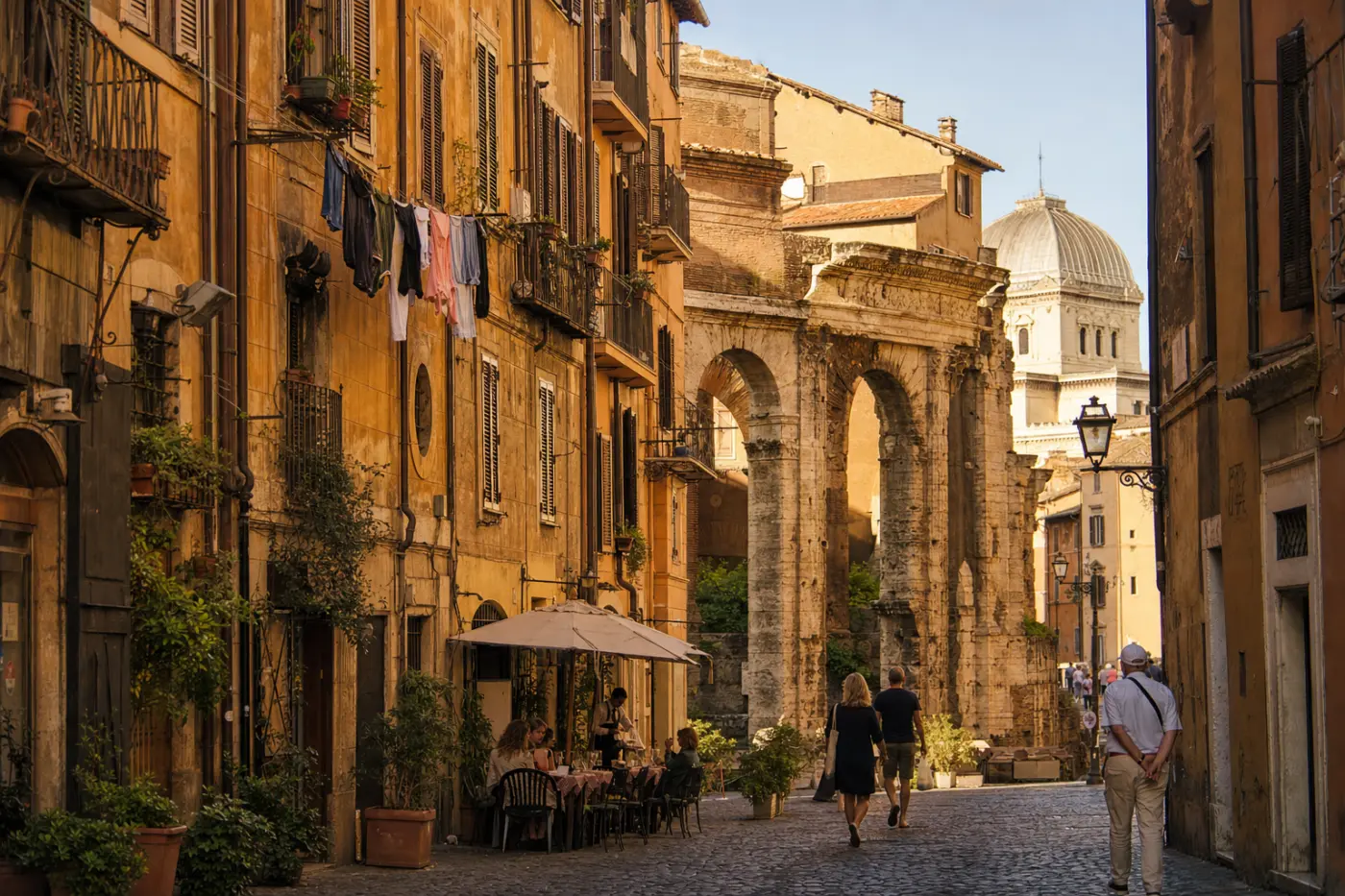
Tourist attraction
The Jewish Ghetto of Rome occupies a compact bend of the Tiber on the left bank, just south of the Campo de' Fiori, and it is home to one of the longest-surviving Jewish communities on earth. Jews have lived in Rome continuously since at least 161 BCE, when Judah Maccabee sent ambassadors to the Senate to negotiate an alliance — making the Roman Jewish community older than Christianity itself. For centuries they lived with relative tolerance, but on July 26, 1555, Pope Paul IV issued the papal bull Cum nimis absurdum, confining Rome's approximately 3,000 Jewish residents to a walled enclosure of barely 3 hectares on the flood-prone bank of the Tiber. The gates were locked at nightfall and opened at dawn, and the number of synagogues was restricted to one. What resulted was extreme overcrowding that forced buildings to rise six and seven stories — unusually tall by Roman standards — to accommodate the trapped population.
The Ghetto was formally abolished in 1848 under the brief Roman Republic, reinstated, and then permanently dismantled in 1870 when Rome became the capital of unified Italy. Much of the medieval fabric was demolished in the 1880s during a sweeping urban renewal project, but the neighbourhood retains its dense, labyrinthine character and its sacred landmarks. The centrepiece is the Great Synagogue of Rome (Tempio Maggiore), completed in 1904 in Assyrian-Babylonian style with a distinctive square aluminium dome visible from across the city. It houses the Jewish Museum of Rome, whose collection spans more than four centuries of liturgical objects, manuscripts, and documentary evidence of community life under the popes. Nearby, the Portico d'Ottavia — a monumental gateway built by Augustus in 23 BCE and dedicated to his sister — frames the ruins of the ancient Theatre of Marcellus and anchors the neighbourhood in Rome's deepest antiquity.
Walking through the Ghetto today, visitors move across layers of time within a few hundred metres. The Piazza delle Cinque Scole marks where five different Jewish rites once shared a single building. Via del Portico d'Ottavia is lined with restaurants serving the distinct Roman-Jewish cuisine that evolved in isolation over centuries — artichokes alla giudia (deep-fried whole and flattened), salt cod, and ricotta pastries that exist nowhere else in Italy. A bronze plaque near Largo 16 Ottobre 1943 commemorates the morning when SS units rounded up 1,259 Jews from these same streets and deported them to Auschwitz; only 16 returned. Brass Stolpersteine (stumbling stones) set into the cobblestones by artist Gunter Demnig mark the former addresses of deportees across the neighbourhood.
The Ghetto is walkable in an hour but rewards a half-day. The Jewish Museum inside the Great Synagogue requires a ticket and offers guided tours that access the sanctuary's ornate interior and its treasure of Torah mantles embroidered in gold thread. Visiting on a Saturday means most shops and the museum will be closed in observance of Shabbat; Friday afternoons see the neighbourhood at its most atmospheric, with families shopping at the outdoor market stalls near the Portico. The area is busiest at lunch — book ahead at any of the historic trattorie on Via del Portico d'Ottavia or arrive before 12:30 to secure a table.
Private tours with a local guide, at your own pace.
Rome
Rome

Rome

Rome
Rome
Rome
Rome
Rome

Rome
We use a single cookie, to remember this choice. We do not use analytics or advertising cookies. Read our cookie policy.