7 hrs
London
Oxford Private Day Trip from London – Sightseeing & Lunch
✓ Free cancellation Kids friendly
4.8(19 reviews)
From €578/ person
Book Now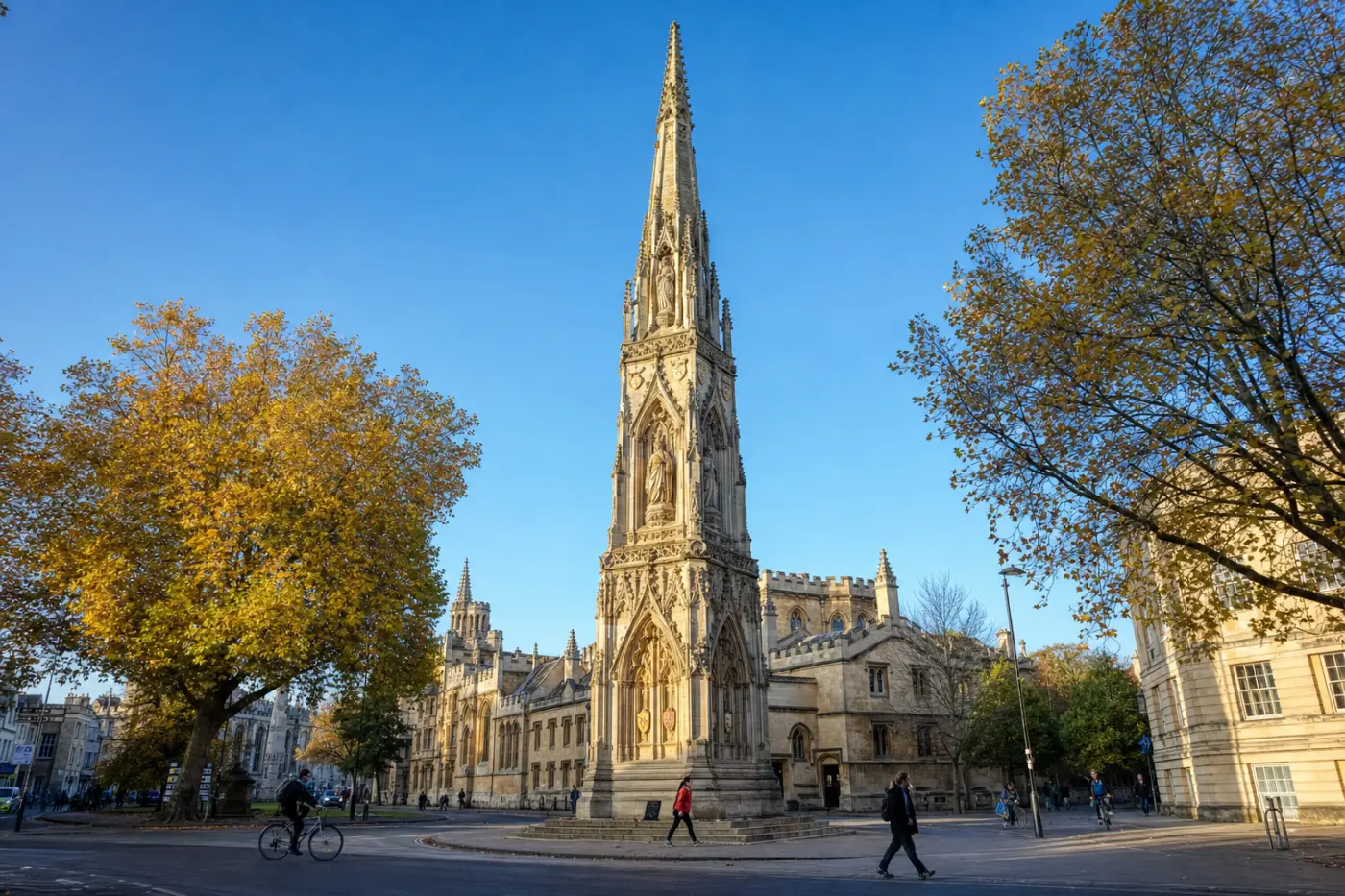
Tourist attraction
Standing at the southern end of St Giles' Street in Oxford, the Martyrs' Memorial is a soaring Gothic spire of magnesium limestone completed in 1843 to the design of Sir George Gilbert Scott — the same architect who would later restore the nearby Bodleian complex and go on to build St Pancras Station in London. Scott modelled it closely on the 14th-century Waltham Cross, one of the Eleanor Crosses erected by Edward I. Rising in three diminishing tiers of canopied niches, pinnacles, and carved heraldry, the structure replaced what a contemporary account called "a picturesque but tottering old house" and immediately became the visual anchor of one of Oxford's grandest streets. It is Grade II* listed (Historic England entry 1107172), reflecting its exceptional architectural and historical interest.
The memorial commemorates three Protestant clergymen tried for heresy under the Roman Catholic Queen Mary I: Archbishop of Canterbury Thomas Cranmer, Bishop of London Nicholas Ridley, and Bishop of Worcester Hugh Latimer. In 1553, all three were summoned to the University Church of St Mary the Virgin to answer charges of denying transubstantiation. Found guilty, Ridley and Latimer were burned together in the ditch outside the city's north gate — the site now occupied by Broad Street — on 16 October 1555. Latimer's reported last words to Ridley, "Be of good comfort, and play the man," became among the most quoted sentences of the English Reformation. Cranmer, compelled to watch, eventually submitted written recantations, but on 21 March 1556 he repudiated them publicly at St Mary the Virgin and thrust his right hand — the hand that had signed the recantations — into the flames first. A small cross set into the tarmac of Broad Street still marks the exact location of the ditch where all three died.
What gives the memorial its particular historical texture is the gap between event and monument. It was erected nearly 290 years after the executions, and its construction in 1843 was driven as much by the fierce Victorian religious controversy surrounding the Oxford Movement — whose leaders, including John Henry Newman, were accused of drawing the Church of England back toward Rome — as by any straightforward act of historical commemoration. The three statues in the niches reflect that tension: Cranmer faces north holding a Bible; Ridley faces east; Latimer faces west with arms folded across his chest. By the early twentieth century the structure had deteriorated badly, and a full restoration was carried out jointly by Oxford City Council and the Oxford Preservation Trust, completed in 2003.
The memorial sits at a natural crossroads of Oxford's historic centre, within easy walking distance of Balliol and St John's colleges, the Ashmolean Museum, and the Bodleian Library. Visitors who want the full context should walk the short distance south-east to Broad Street to find the paving-stone cross that marks the actual site of martyrdom — a deliberately understated counterpoint to Scott's elaborate Victorian monument. There is no admission charge, and the structure is accessible at all hours.
Private tours with a local guide, at your own pace.
London

London
London

London

London
London
London

London

London
We use a single cookie, to remember this choice. We do not use analytics or advertising cookies. Read our cookie policy.