3 hrs
London
Private London Kickstart Tour - City Highlights for newcomers
✓ Free cancellation Kids friendly
4.8(20 reviews)
From €145/ person
Book Now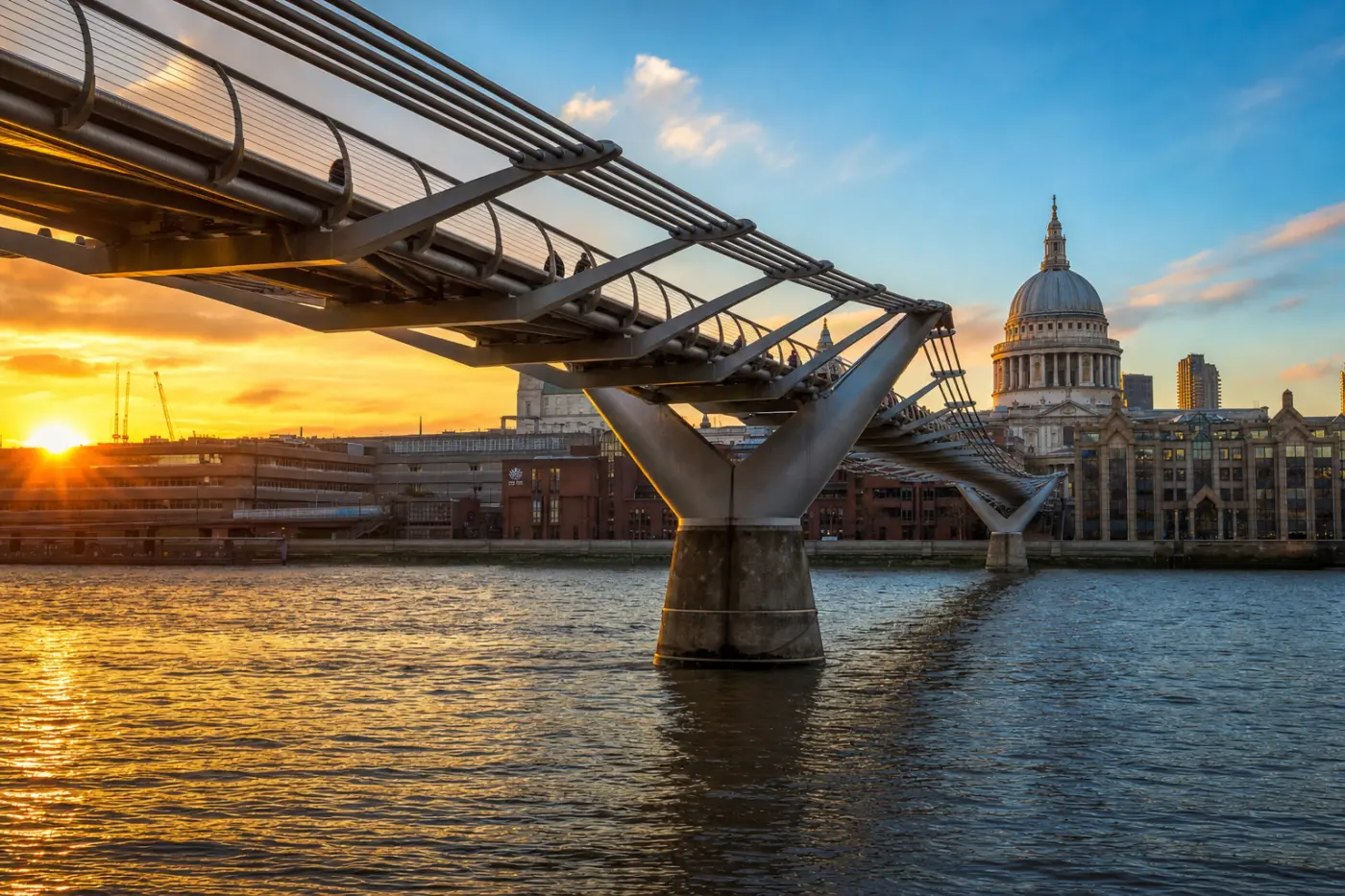
Tourist attraction
The Millennium Bridge is London's first new Thames crossing in over a century and its only bridge reserved exclusively for pedestrians. Spanning 325 metres between Bankside on the south bank and the City of London on the north, it was designed through a collaboration between architect Sir Norman Foster, sculptor Sir Anthony Caro, and engineering firm Arup. The sleek, low-slung steel suspension structure carries two Y-shaped supports and a deck just four metres wide, creating a deliberately unobtrusive silhouette that frames rather than competes with the views along the river — St Paul's Cathedral rising directly ahead when walking northward, and Tate Modern's converted Bankside Power Station chimney visible to the south.
The bridge opened on 10 June 2000 as part of London's millennium celebrations, but it was closed just two days later after thousands of pedestrians caused an unexpected lateral resonance — a swaying motion of up to 70mm — that made crossing feel distinctly unsettling. Engineers diagnosed the problem as "synchronous lateral excitation": pedestrians instinctively adjusted their stride to match the bridge's natural frequency, amplifying the oscillations. Arup spent nearly two years and £5 million fitting 37 fluid-viscous dampers and 52 tuned mass dampers beneath the deck before the bridge reopened on 22 February 2002. The engineering fix is now a landmark case study in structural dynamics taught in universities worldwide.
Beyond its engineering story, the Millennium Bridge occupies one of the most historically rich corridors in London. The north end emerges steps from Peter's Hill and the south steps of St Paul's Cathedral, rebuilt by Christopher Wren after the Great Fire of 1666. The south end opens onto Bankside, where Shakespeare's reconstructed Globe Theatre stands 200 metres to the east. The bridge also gained global cultural visibility when it was dramatically destroyed in the opening sequence of the 2005 film Harry Potter and the Half-Blood Prince, cementing its place in popular imagination.
Crossing the Millennium Bridge is free and accessible at all hours. The best light for photography falls in the early morning, when the low sun catches St Paul's dome directly along the bridge's axis and foot traffic is minimal. Southwark and St Paul's Underground stations are each a short walk from either end. The bridge is fully step-free, making it one of the most accessible Thames crossings in central London.
Private tours with a local guide, at your own pace.
London
London
London
London
London
London
London

London

London
We use a single cookie, to remember this choice. We do not use analytics or advertising cookies. Read our cookie policy.