3 to 4 hrs
London
Highlights & Secrets of London Private Tour - Camden Town, Downtown & Markets
✓ Free cancellation Kids friendly
4.9(19 reviews)
From €267/ person
Book Now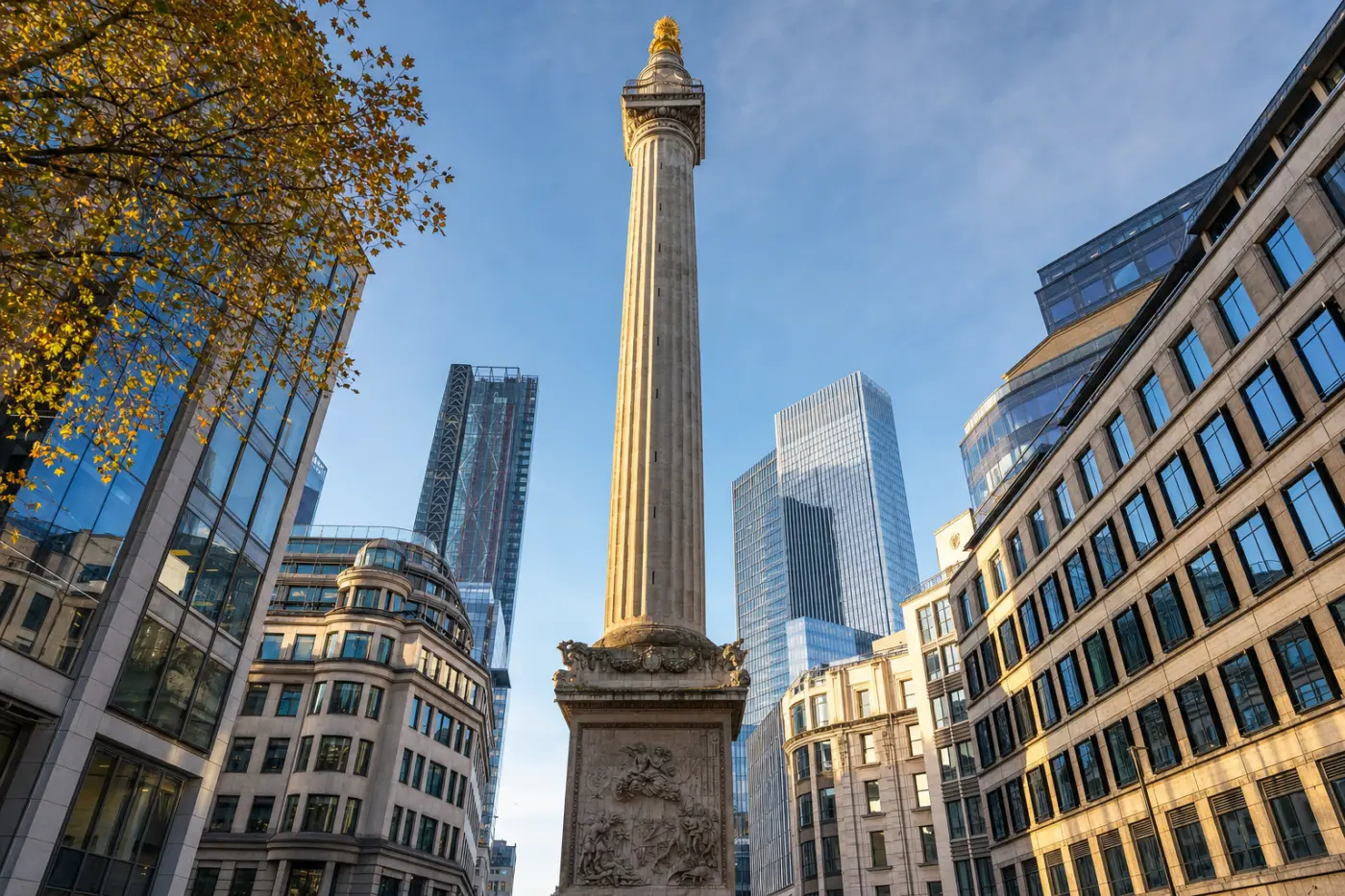
Tourist attraction
The Monument to the Great Fire of London is a free-standing Roman Doric column standing 202 feet (61.57 metres) tall, located on Monument Street in the City of London. Designed by Sir Christopher Wren and his fellow Royal Society scientist Robert Hooke, it was constructed between 1671 and 1677 — making it the tallest isolated stone column in the world, a distinction it still holds today. Its height is precisely equal to its distance from the bakehouse on Pudding Lane where the Great Fire broke out on 2 September 1666, a deliberate geometric conceit that means the column would lie flat exactly over its own origin point if toppled westward. The column is built of Portland stone and is crowned by a gilded bronze urn of flames, a visual reference to the catastrophe it commemorates.
The Great Fire itself burned for four days and nights, destroying 13,200 houses, 87 parish churches, and St Paul's Cathedral across 373 acres of the medieval city. Though casualties were remarkably low — only six deaths are officially recorded — the disaster displaced an estimated 70,000 of London's 80,000 inhabitants and triggered the most ambitious rebuilding programme in the city's history. The Monument was conceived not merely as a memorial but as a working scientific instrument: its hollow shaft and internal staircase were designed so that the column could function as a zenith telescope, with the base serving as a laboratory for Hooke's experiments on gravity and atmospheric pressure. Though the vibrations of passing traffic rendered astronomical observations impractical, this dual purpose reflects the rationalist, empirical spirit of Restoration-era England.
The carved stone relief on the column's pedestal — executed by Caius Gabriel Cibber — depicts King Charles II in Roman dress directing the rebuilding of London, flanked by allegorical figures representing the city in ruins and its subsequent restoration. Around the base, four Latin inscriptions record the fire's extent, the speed of the city's rebuilding, and — in a passage added in 1681 and controversially removed in 1831 — an accusation blaming the fire on a "popish frenzy," a slur that reflects the virulent anti-Catholic sentiment of the period. Visitors can climb the 311 spiral steps inside the column to reach a viewing platform 160 feet above street level, where on clear days the panorama extends across the Square Mile, with St Paul's Cathedral — itself a Wren rebuilding — dominating the skyline.
The Monument is managed by the City of London Corporation and sits adjacent to Monument tube station, making it extremely easy to reach. The climb is moderately demanding and not suitable for those with vertigo or limited mobility, but all who complete it receive a certificate marking the ascent. Opening hours are typically 9:30am to 6pm in summer and 9:30am to 5:30pm in winter, with a small admission fee charged. Visiting on a weekday morning avoids the heaviest tourist traffic and gives the clearest views of the surrounding financial district, whose gleaming towers form a striking contrast with this 17th-century stone survivor.
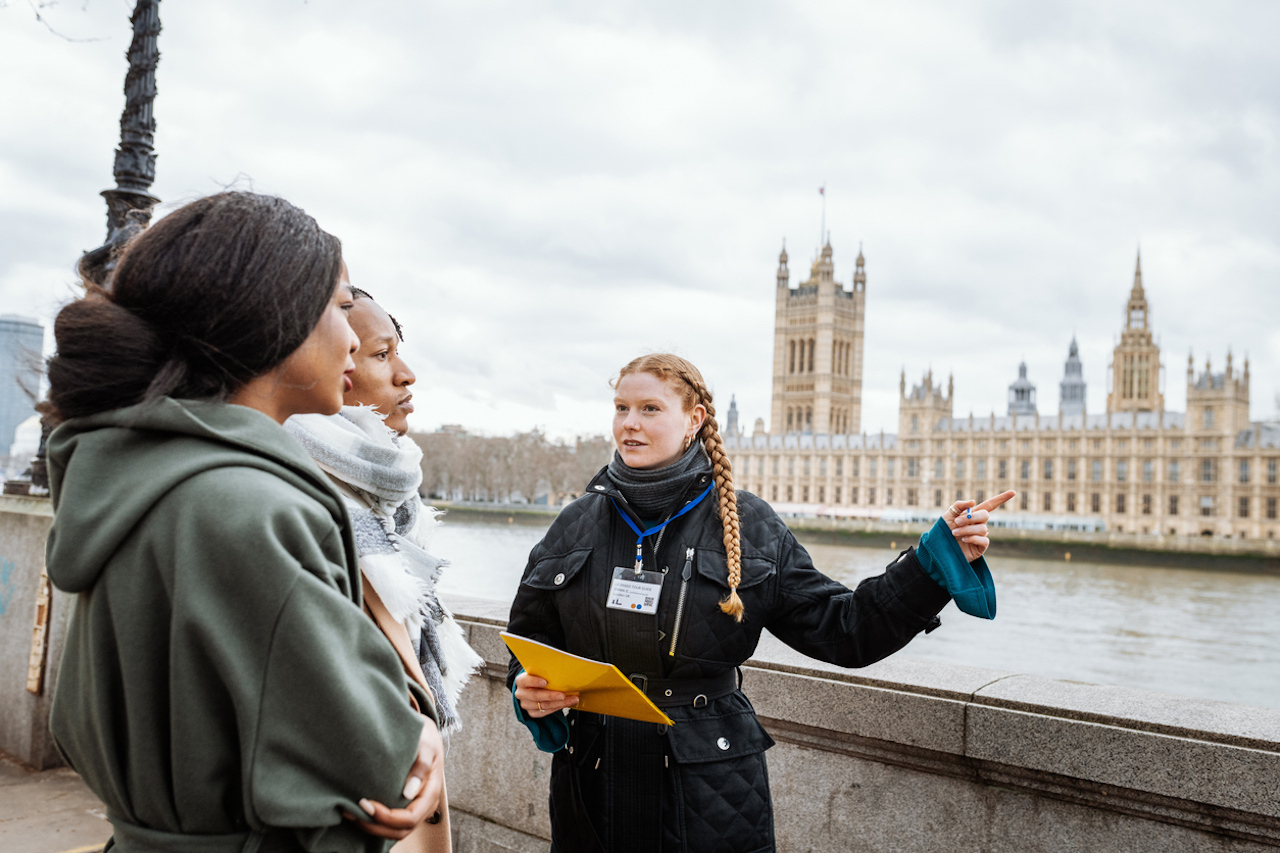
Private tours with a local guide, at your own pace.
London
London
London

London
London
London
London

London

London
We use a single cookie, to remember this choice. We do not use analytics or advertising cookies. Read our cookie policy.