7 hrs
London
Oxford Private Day Trip from London – Sightseeing & Lunch
✓ Free cancellation Kids friendly
4.8(19 reviews)
From €578/ person
Book Now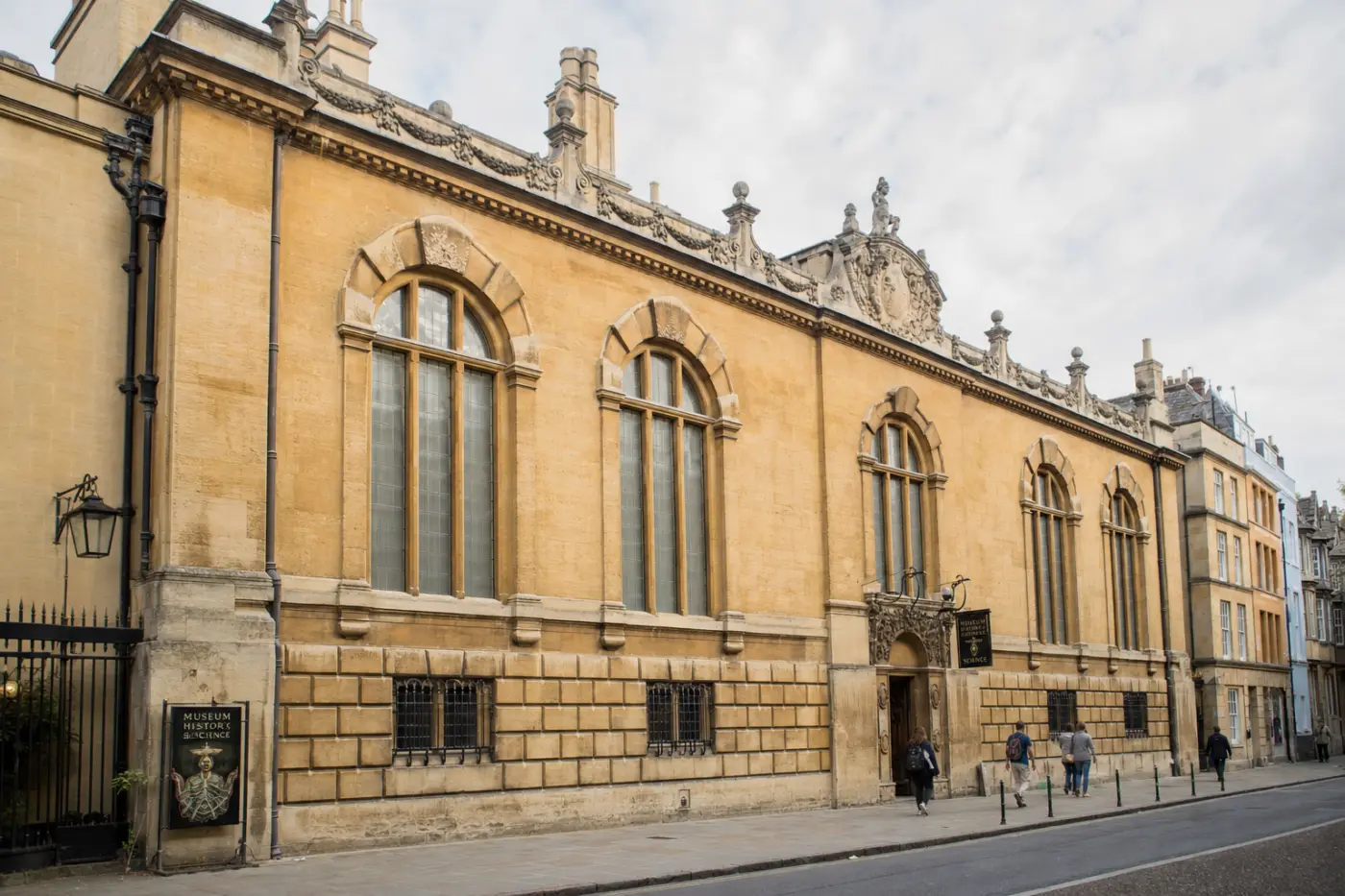
Tourist attraction
The History of Science Museum occupies the Old Ashmolean Building on Broad Street in Oxford — a structure completed in 1683 and widely recognised as the oldest surviving purpose-built museum building in the world. It was constructed to house the cabinet of curiosities donated by Elias Ashmole to the University of Oxford, making it the original home of what is now the Ashmolean Museum. When the Ashmolean's collections moved to their current Beaumont Street premises in 1894, the building was repurposed to house the university's growing collection of historic scientific instruments, formally reopening as the Museum of the History of Science in 1935. The building itself is a masterpiece of late 17th-century English baroque architecture, featuring a rusticated ground floor, tall arched windows, and a distinctive carved stone façade that has changed little in over three centuries.
The museum holds one of the finest and most comprehensive collections of historic scientific instruments in the world, spanning roughly 500 years of discovery. Among its most celebrated objects is the blackboard used by Albert Einstein during a lecture on the Theory of Relativity at Oxford in May 1931 — the equations and diagrams remain preserved exactly as he left them. The collection also includes Lewis Carroll's photographic equipment (Carroll, whose real name was Charles Dodgson, was a mathematics lecturer at Christ Church, Oxford), a large astrolabe collection recognised as among the most important globally, early microscopes and telescopes, Islamic mathematical instruments dating to the medieval period, and apparatus directly associated with the development of penicillin at Oxford in the 1940s. Over 15,000 objects are catalogued in the collections database, with hundreds on permanent display across three floors.
Visitors moving through the galleried interior encounter instruments arranged thematically and chronologically, from medieval Islamic astrolabes and Renaissance sundials to Victorian electrical apparatus and early 20th-century X-ray equipment. The ground-floor gallery focuses on astronomical and navigational instruments, while upper floors explore surveying, mathematics, medicine, and photography. The basement houses a dedicated display on alchemy and early chemistry. Unlike many large science museums, the History of Science Museum presents objects at close quarters in a relatively intimate space, allowing visitors to study the craftsmanship and inscription details of individual pieces in a way that larger institutions rarely permit.
Admission to the museum is free, and it is open Tuesday through Sunday (closed Mondays). It sits at the heart of Oxford's historic centre on Broad Street, directly opposite the Bodleian Library and a short walk from the Sheldonian Theatre and Radcliffe Camera — making it a natural stop on any walk through the university quarter. The building has no lift, so upper floors are accessible via stairs only; the ground floor and basement are step-free from the main entrance. Audio guides and family trail sheets are available at the front desk.
Private tours with a local guide, at your own pace.
London
London
London
London

London
London
London

London

London
We use a single cookie, to remember this choice. We do not use analytics or advertising cookies. Read our cookie policy.