3 hrs
London
Authentic British Food and Drink Private Tour in London- Local Taverns & Pubs
✓ Free cancellation Kids friendly
4.8(15 reviews)
From €206/ person
Book Now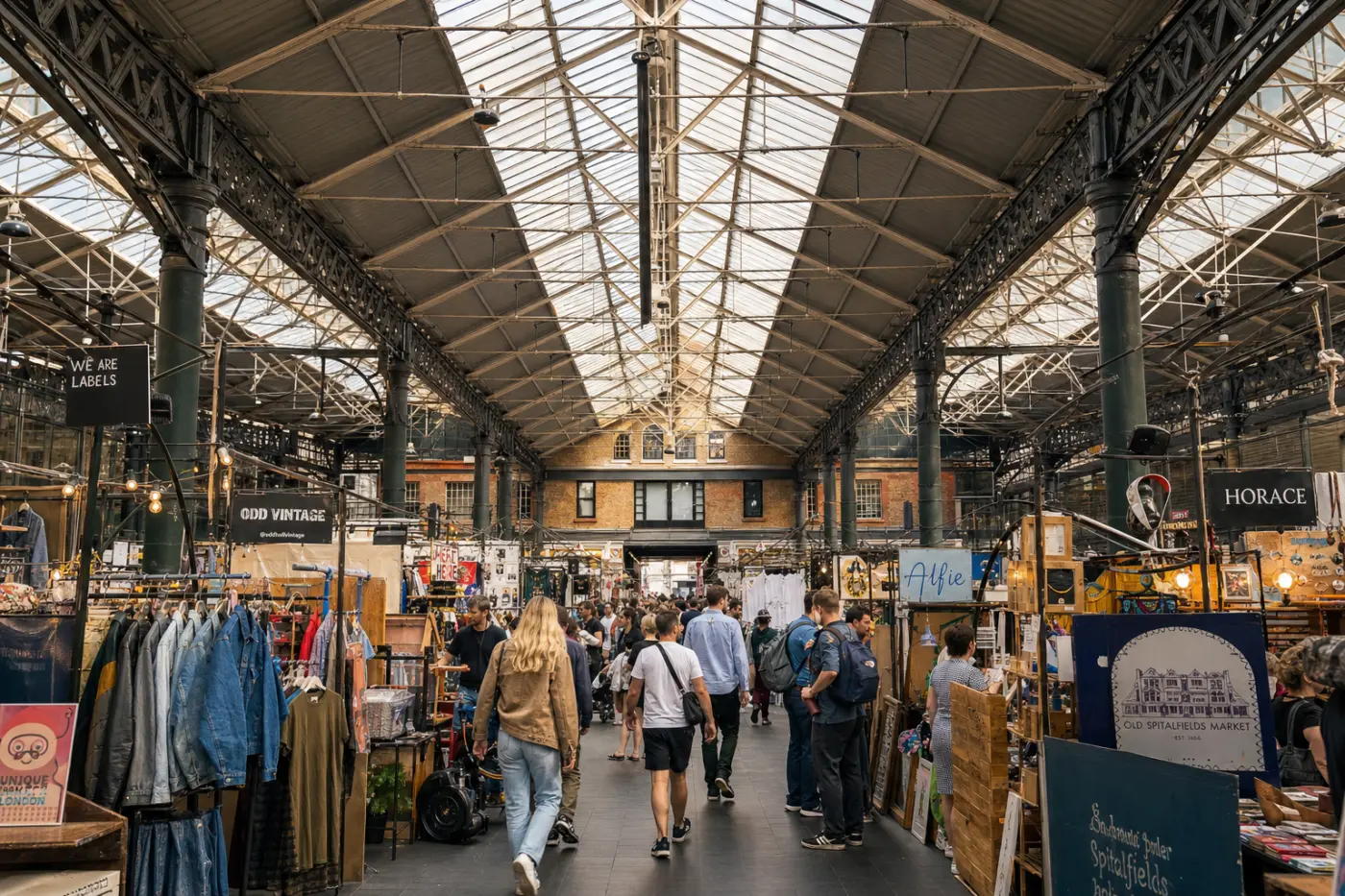
Tourist attraction
Old Spitalfields Market sits at the crossroads of London's East End history, occupying a site that has hosted trade continuously since 1638, when King Charles I licensed merchants to sell "flesh, fowl and roots" in Spital Fields. The market's formal establishment came in 1682, when King Charles II granted a Royal Charter to silk thrower John Balch, permitting trade every Thursday and Saturday. The name "Spitalfields" itself derives from the Augustinian priory and hospital of St Mary Spital, founded in 1197 on the outskirts of medieval London and demolished during Henry VIII's Dissolution of the Monasteries in 1539. Archaeological excavations carried out on the wider site between 1991 and 2007 uncovered cemeteries stretching back to Roman times, underlining how deeply layered this corner of the city truly is.
For the following two centuries, the market fed London's expanding population with fresh fruit and vegetables, eventually trading six days a week. Its commercial success drew successive waves of immigrants who left permanent marks on the neighbourhood. The most consequential were the French Huguenots — Protestant craftsmen outlawed in France by Louis XIV's revocation of the Edict of Nantes in October 1685 — who brought silk-weaving expertise that made "Spitalfields silk" a prized global commodity. By 1810, more than 10,000 silk looms were operating in the area. Their legacy endures in the grand Georgian terraces of Fournier Street's conservation area, still inhabited today by artists including Gilbert and George. The current market building was constructed in 1876 and extended in the late 1920s after the City of London acquired the site, its ornate Victorian ironwork roof and dated exterior brick plaques surviving as tangible records of that era.
In 1991, the wholesale fruit and vegetable operation relocated to a purpose-built facility in Leyton to accommodate further expansion, transforming the original Victorian hall into the mixed-use market visitors experience today. Open seven days a week, it now hosts over 60 shops and stalls selling independent fashion, vintage clothing, vinyl records, handmade crafts, and original artwork alongside a rotating cast of antiques dealers. The central "Kitchens" area concentrates a dense run of street food traders, while the surrounding permanent retail and restaurant units feature some of the UK and Europe's most acclaimed independent brands. The neighbourhood context adds further depth: Fournier Street's 18th-century townhouses, Christ Church Spitalfields (completed by Nicholas Hawksmoor in 1729), and the Ten Bells pub — all within a few minutes' walk — make the market a natural anchor for a full afternoon in E1.
The market operates daily from 10am to 8pm, with Thursday through Sunday seeing the heaviest concentration of independent traders and the liveliest atmosphere. The closest Underground stations are Liverpool Street (Central, Circle, Hammersmith & City, and Elizabeth lines) and Shoreditch High Street Overground, both under five minutes on foot. Entry is free. Visitors looking to understand the site's layered past need only look upward at the original Victorian iron-and-glass roof structure — one of the finest surviving examples of 19th-century market architecture in London — before stepping outside to trace the Huguenot silk weavers' story along Fournier Street and Elder Street.
Private tours with a local guide, at your own pace.
London

London
London

London

London

London
London

London

London
We use a single cookie, to remember this choice. We do not use analytics or advertising cookies. Read our cookie policy.