9 hrs
Rome
Orvieto Day Trip by Train with Duomo, Caves and Lunch
✓ Free cancellation Kids friendly
4.8(15 reviews)
From €554/ person
Book Now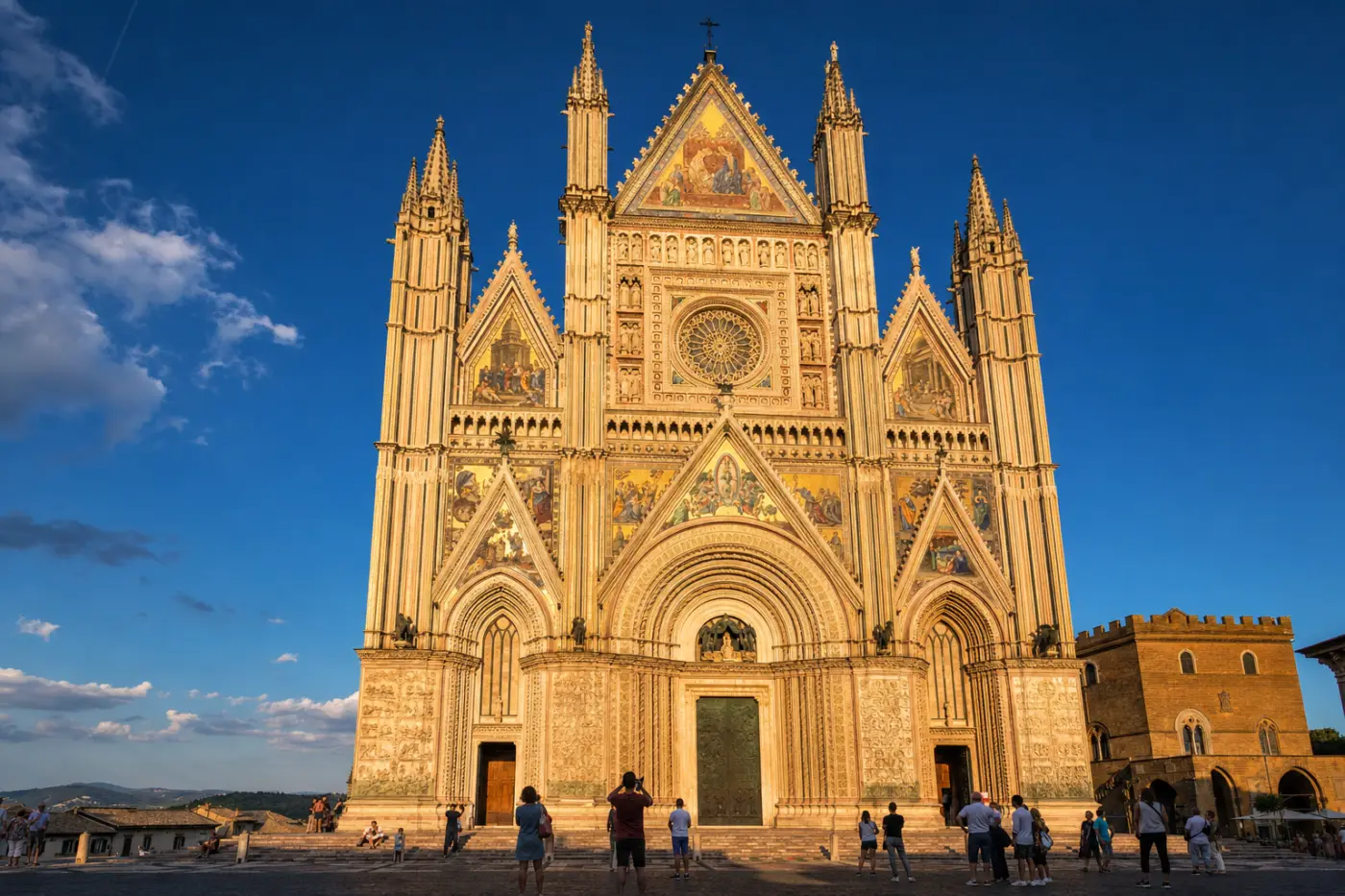
Tourist attraction
Orvieto Cathedral — the Duomo di Orvieto — stands on Piazza del Duomo in the hilltop city of Orvieto, Umbria, roughly 100 kilometres north of Rome. Pope Nicholas IV laid its foundation stone on November 13, 1290, commissioning it to celebrate the Miracle of Bolsena (1263), in which a Bohemian priest celebrating Mass at the nearby town of Bolsena witnessed blood seeping from the consecrated host onto the corporal cloth — an event that led Pope Urban IV to proclaim the feast of Corpus Christi. The cathedral was built to house that sacred relic, the Corporal of Bolsena, which remains in the Chapel of the Corporale to this day. Construction stretched across three centuries, drawing the greatest architectural minds of medieval Italy, including Fra Bevignate of Perugia, who drafted the original Romanesque plan, and Lorenzo Maitani of Siena, who from 1310 fundamentally redesigned the project, steering it decisively toward the Italian Gothic style.
The facade, largely the work of Lorenzo Maitani, is widely regarded as one of the supreme achievements of Gothic architecture in Italy. Its four marble pilasters are carved with extraordinary bas-reliefs depicting scenes from Genesis, the Tree of Jesse, the Life of Christ, and the Last Judgment — executed between roughly 1320 and 1330 with a narrative intensity that anticipates Renaissance humanism. Above these carvings, gold and vitreous mosaics glitter across the gable fields; though many were restored or replaced in later centuries, the overall chromatic effect — alternating bands of white Orvieto travertine and greenish-black basalt inside the nave — remains staggering. The rose window at the facade's centre was designed by Andrea Orcagna around 1354 and is encircled by statues of the Apostles and Evangelists.
The interior's greatest treasure is the Cappella di San Brizio (Chapel of San Brizio) in the right transept. Fra Angelico and Benozzo Gozzoli began its vault frescoes in 1447, completing only two bays before the commission lapsed. In 1499, Luca Signorelli was contracted to finish the cycle; working until 1504, he painted an overwhelming sequence depicting the Preaching of the Antichrist, the Resurrection of the Dead, the Damned Cast into Hell, and the Elect — a monumental program of some 50 figures that Michelangelo studied closely before beginning the Sistine Chapel ceiling in 1508. Art historians consistently identify Signorelli's athletic, foreshortened figures as a direct bridge between late Gothic painting and the High Renaissance.
Visitors approaching on foot from Orvieto's funicular station encounter the facade from across the piazza, where its full height of approximately 52 metres can be absorbed without obstruction. Entry to the cathedral is free; the Cappella di San Brizio requires a separate ticket, also valid for the adjacent Museo dell'Opera del Duomo. The cathedral is managed by the Opera del Duomo di Orvieto, which offers an official audio-guide app ("Opera del Duomo di Orvieto") for iOS and Android. Orvieto is reachable in about 75 minutes by direct train from Roma Termini, making it a practical and richly rewarding day trip from the capital.
Private tours with a local guide, at your own pace.
Rome
Rome
Rome

Rome

Rome
Rome
Rome
Rome

Rome
We use a single cookie, to remember this choice. We do not use analytics or advertising cookies. Read our cookie policy.