3 hrs
Rome
Rome Private Family Walking Tour with Games for Kids
✓ Free cancellation Kids friendly
4.7(32 reviews)
From €177/ person
Book Now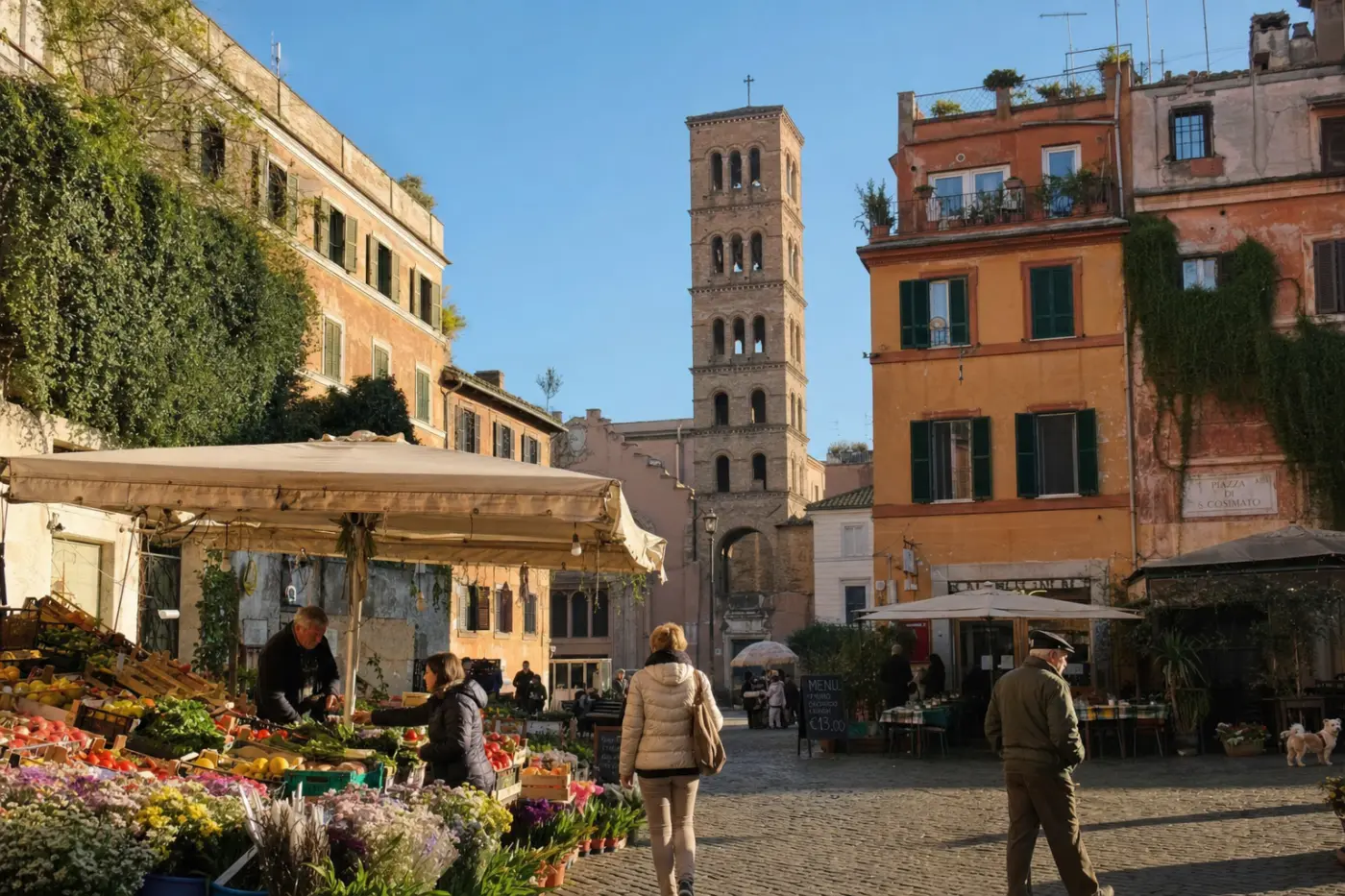
Tourist attraction
Piazza di San Cosimato is one of the most authentically Roman squares in Trastevere, the ancient working-class rione on the right bank of the Tiber that has been continuously inhabited since at least the 1st century BCE. The piazza takes its name from the adjacent Monastery of San Cosimato, a religious complex whose origins trace to the 10th century, when Benedictine monks established a small church here dedicated to the twin physician-saints Cosmas and Damian. In the 13th century the complex passed to the Franciscan Poor Clares, who expanded the monastery substantially and constructed two distinct cloisters — one Romanesque, dating to the 11th–12th century, and a second in the Gothic-Renaissance transitional style completed around the 15th century. Today the former monastery buildings serve as a municipal hospital, the Ospedale Nuovo Regina Margherita, though the cloisters remain among the most serene and least-visited medieval architectural survivors in Rome.
The square itself became a focal point of Trastevere's neighborhood life across the centuries, shaped as much by its proximity to the monastery as by the dense residential fabric of the rione surrounding it. By the 19th century it had consolidated its role as a local market square, a function it retains to this day. Every morning except Sunday, the piazza hosts a traditional open-air food market where vendors sell seasonal produce, cheeses, cured meats, and fresh-cut flowers — a scene that has changed in character far less than most of Rome's public spaces over the past 150 years. The ochre and terracotta facades of the surrounding palazzi, draped in climbing plants and punctuated by wrought-iron balconies, frame the market stalls with an atmosphere that feels structural rather than staged.
Visitors arriving at the piazza encounter layers of time stacked with unusual density. The Romanesque bell tower of the Church of San Cosimato rises above the roofline to the southwest, its simple biforate windows characteristic of the 11th-century Roman campanile tradition. The church interior, though modest in scale, preserves a Cosmatesque marble floor — the intricate geometric inlay work in colored stone and glass tesserae that Roman craftsmen of the Cosmati school produced from the 12th through the 14th centuries. The hospital courtyard, accessible through the main entrance on the piazza, allows occasional views of the older of the two cloisters, with its compact arcade of recycled ancient columns supporting rounded arches.
Piazza di San Cosimato rewards visitors who time their arrival for weekday mornings, when the market is in full operation and the square is at its most lived-in. The surrounding streets — particularly Via della Lungara and Vicolo del Cedro — are lined with neighborhood trattorias and wine bars that open from lunchtime onward, making the piazza a natural anchor for a half-day walk through southern Trastevere. The nearest major landmarks are the Basilica di Santa Maria in Trastevere, roughly 400 meters to the northeast, and the Orto Botanico di Roma immediately to the south along the Janiculum slope.
Private tours with a local guide, at your own pace.
Rome
Rome

Rome

Rome
Rome
Rome
Rome
Rome

Rome
We use a single cookie, to remember this choice. We do not use analytics or advertising cookies. Read our cookie policy.