4 hrs
London
Highlights of London Private Tour - Downtown, Notting Hill & Portobello Market
✓ Free cancellation Kids friendly
4.7(27 reviews)
From €188/ person
Book Now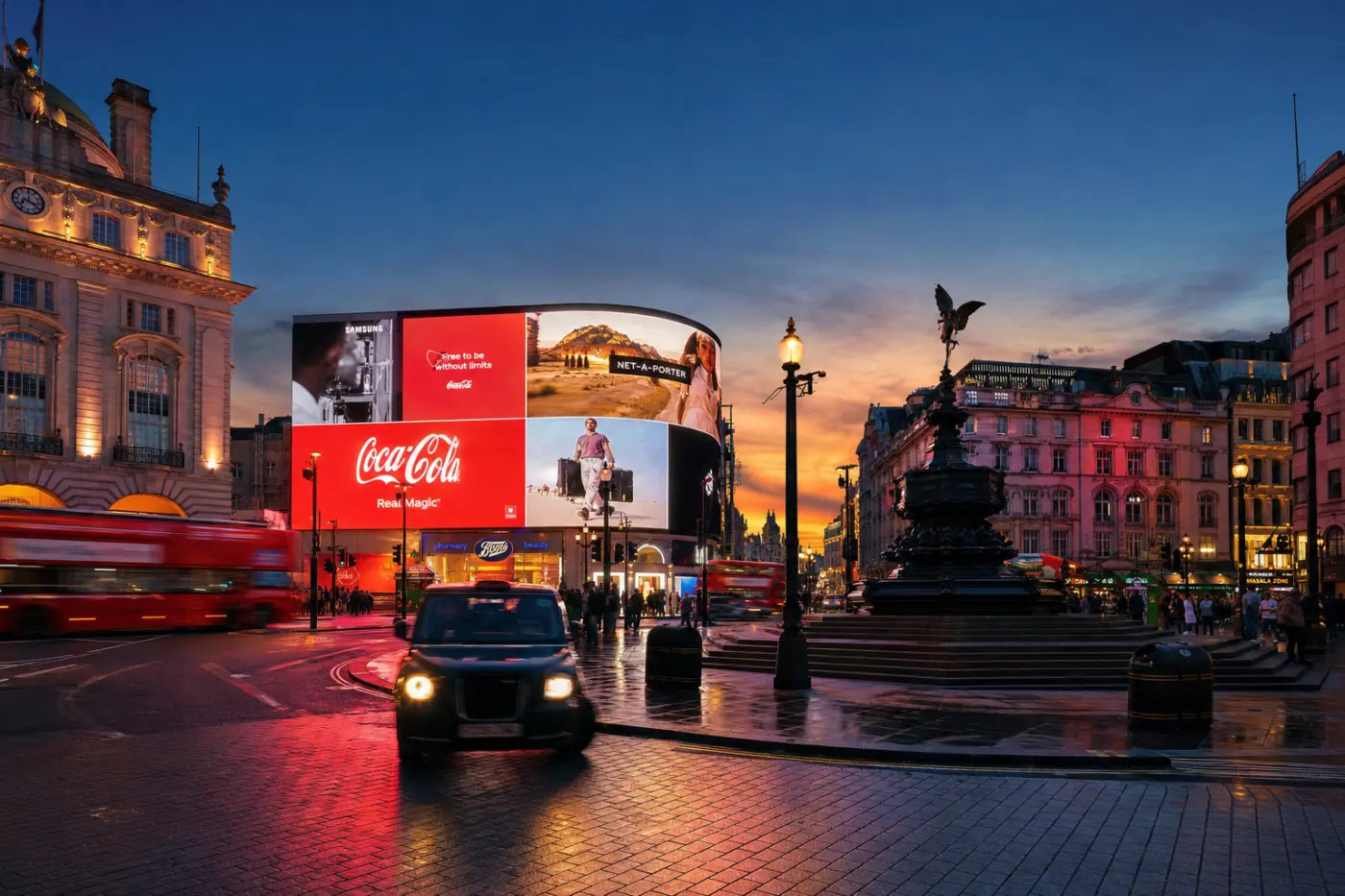
Tourist attraction
Piccadilly Circus is a public road junction and surrounding plaza in the City of Westminster, sitting at the convergence of five major streets: Piccadilly, Regent Street, Shaftesbury Avenue, Coventry Street, and Glasshouse Street. It was first laid out in 1819 as part of John Nash's grand urban design to connect the newly built Regent Street — constructed between 1812 and 1826 — with the older thoroughfare of Piccadilly. Nash envisioned Regent Street as a ceremonial route linking Carlton House to Regent's Park, and Piccadilly Circus was engineered as its southern anchor point. The word "circus" derives from the Latin for circle, reflecting the original round shape of the junction, which was later altered in 1886 when Shaftesbury Avenue was cut through, giving the space its current irregular geometry.
The junction's most iconic feature is the aluminum fountain statue formally titled the Angel of Christian Charity, erected in 1893 and almost universally known as "Eros." Sculpted by Alfred Gilbert, it was commissioned to honor Anthony Ashley-Cooper, the 7th Earl of Shaftesbury, the Victorian philanthropist and social reformer who championed the Mines Act of 1842 and the Ten Hours Act of 1847. The winged figure — cast in aluminum at a time when that metal was still considered novel and expensive — originally stood atop a layered stone plinth at the center of the circus before being repositioned after World War II to its current location on the southern side. The statue was removed for safekeeping during both World Wars, a testament to its cultural significance. Piccadilly Circus also gained an early place in transport history: the Piccadilly Circus Underground station opened in 1906 as part of the Great Northern, Piccadilly and Brompton Railway, and was dramatically rebuilt by architect Charles Holden in 1928 into the circular booking hall still in use today.
The illuminated advertising hoardings, known as the Piccadilly Lights, have defined the junction's visual character since the first electric advertisement appeared there in 1908. For most of the 20th century, brands such as Coca-Cola, Bovril, and Schweppes maintained permanent lit signs on the curved façade of the London Pavilion building — the same façade that now carries a single unified curved LED screen, installed in 2017, measuring 790 square meters and capable of displaying individual targeted content. At night, the glow of the screen and surrounding signage draws crowds that rival the daytime theatre rush in nearby Shaftesbury Avenue and Leicester Square, both less than a five-minute walk away.
Visitors arriving by Tube should use Piccadilly Circus station on the Piccadilly and Bakerloo lines. The statue of Eros remains a traditional meeting point and is freely accessible at all hours. The surrounding streets are dense with theatres, restaurants, and the flagship stores of Regent Street, making Piccadilly Circus an ideal starting point for exploring the West End on foot. The area is busiest on weekend evenings; those seeking a quieter experience of the architecture and lights should visit on a weekday morning, when the scale and detail of the Victorian and Edwardian buildings framing the circus are far easier to appreciate.
Private tours with a local guide, at your own pace.
London
London
London
London
London
London
London

London
We use a single cookie, to remember this choice. We do not use analytics or advertising cookies. Read our cookie policy.