3 to 4 hrs
London
Highlights & Secrets of London Private Tour - Camden Town, Downtown & Markets
✓ Free cancellation Kids friendly
4.9(19 reviews)
From €267/ person
Book Now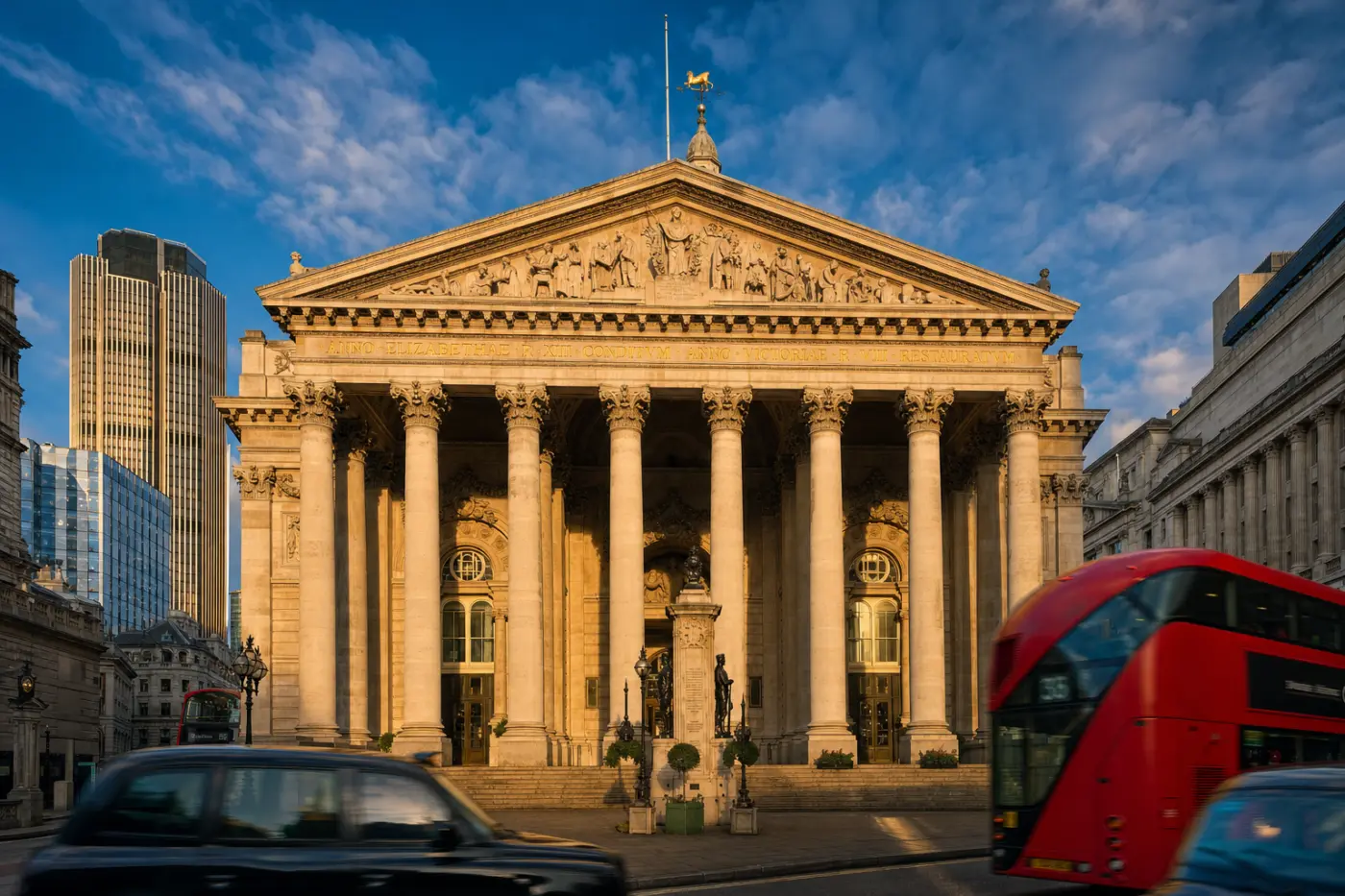
Tourist attraction
The Royal Exchange stands at the heart of the City of London, at the junction of Threadneedle Street and Cornhill, as one of the most historically loaded buildings in British commercial history. It was founded in 1566 by Sir Thomas Gresham — a wealthy merchant and royal financial agent known as the father of English banking — who modelled it on the Bourse in Antwerp, then the world's foremost financial exchange where Gresham had served as an agent for the Crown. Five years after its construction, in 1571, Queen Elizabeth I walked through its colonnaded courtyard, bestowed upon it a royal title, and granted it a licence to sell alcohol — a distinction that set it apart from every other trading house in England. Gresham later added two upper floors to the original trading floor to house retail businesses, making the Royal Exchange what many historians regard as Britain's first shopping mall.
The building that visitors see today is actually the third structure to occupy the site. The original Exchange was consumed by the Great Fire of London in 1666, which destroyed roughly one-third of the entire city. A second building, designed in Baroque style by City Surveyor Edward Jerman, opened in 1669 and thrived for nearly 170 years before being gutted by fire in 1838 — most likely started by an overheated stove in Lloyd's coffee house, which had operated from the building since the 1770s. An architectural competition for the third building was won by Sir William Tite, whose design retained the original courtyard layout but added an imposing eight-column Corinthian portico directly inspired by the Pantheon in Rome. Queen Victoria officially opened the current building in 1844. Its steps have served as a formal proclamation point for the British monarchy ever since, most notably on 23 January 1901, when the accession of King Edward VII was announced there just days after Queen Victoria's death.
The building survived the Second World War with partial damage from the Blitz in 1941, after which commodity traders gradually vacated the premises, leaving it dormant for several decades. In a remarkable reinvention, the Royal Exchange was transformed in 2001 into an upscale retail and dining destination, housing luxury jewellers, fashion boutiques, and restaurants within its Victorian courtyard. The original open-air trading floor is now a covered Grand Café, its high glazed ceiling flooding the stone-flagged courtyard with light while eight large historical murals by Lord Leighton and other Victorian painters look down from the surrounding gallery walls — a rare combination of living commerce and preserved public art.
Visitors today can walk freely into the courtyard, which requires no admission fee, and absorb a space where merchants once haggled over silk, spices, and insurance contracts. The building is a short walk from the Bank of England Museum and directly faces the Mansion House, making it the centrepiece of one of London's most architecturally concentrated intersections. For the best experience, visit on a weekday morning when the building is at its quietest, and look up at the carved Royal Coat of Arms above the portico and the gilded grasshopper weathervane — the personal symbol of Sir Thomas Gresham — perched on the rooftop since the sixteenth century.
Private tours with a local guide, at your own pace.
London
London
London
London
London
London
London
London
London
We use a single cookie, to remember this choice. We do not use analytics or advertising cookies. Read our cookie policy.