3.5 hrs
copenhagen
Copenhagen Alternative Private Tour: Vesterbro & Christianshavn
✓ Free cancellation Kids friendly
4.7(0 reviews)
From €311/ person
Book Now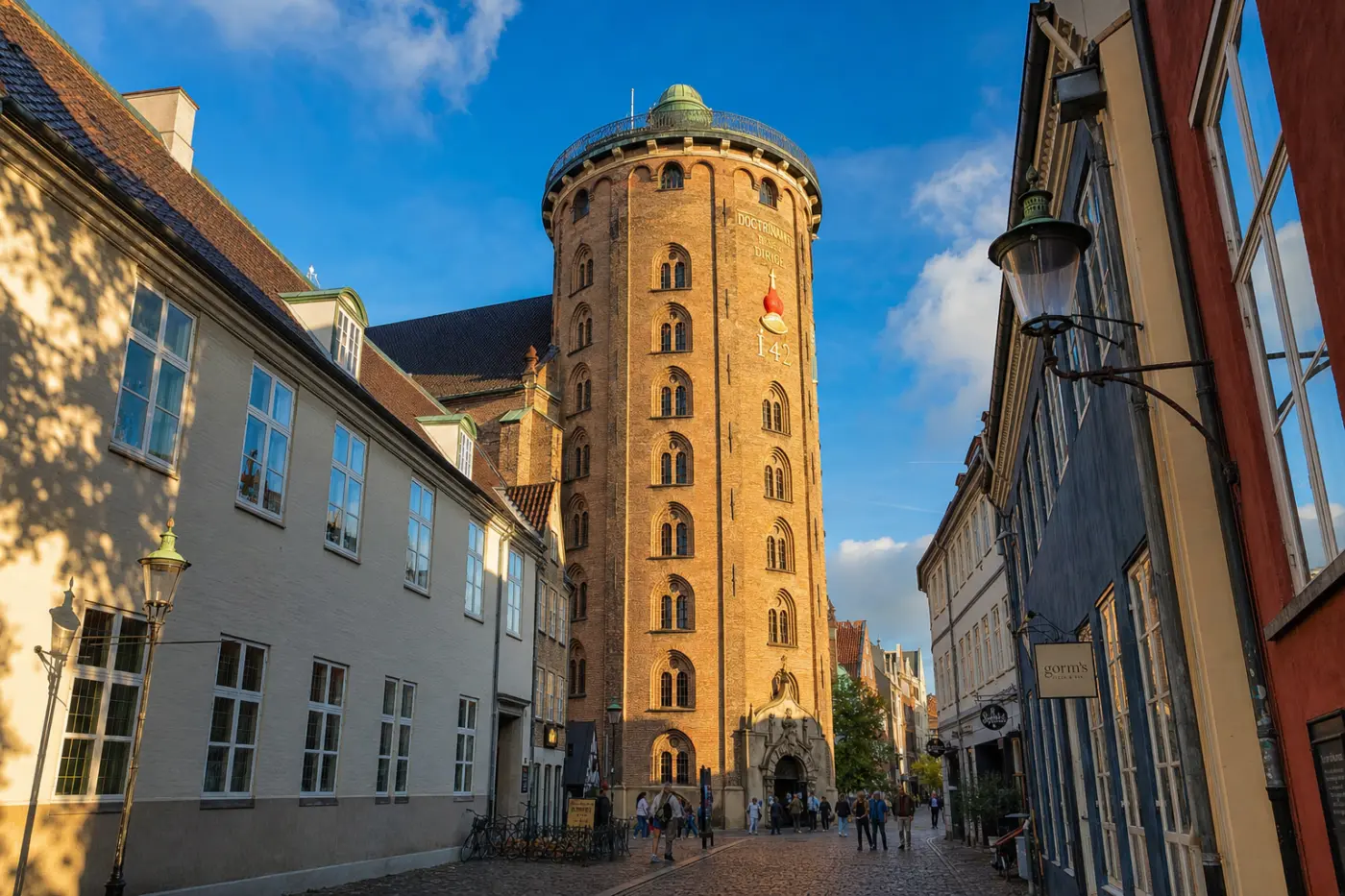
Tourist attraction
Rundetårn — Danish for "The Round Tower" — is a 34.8-metre cylindrical tower in the heart of Copenhagen's Latin Quarter, completed in 1642 under the orders of King Christian IV. It was conceived not as a lookout or fortification, but as a fully functioning astronomical observatory for the University of Copenhagen, making it Europe's oldest observatory still in operation. The tower was built as the centrepiece of a larger academic complex alongside the Trinitatis Church and a university library, an ambitious assertion of Denmark's place at the forefront of 17th-century scientific learning.
The tower's most remarkable architectural feature is its equestrian staircase: a wide, continuously sloping helical corridor that winds 7.5 times around a hollow brick core before opening onto the observation platform. There are no steps. This was a deliberate engineering solution — horses and carts needed to carry heavy telescopes, astronomical instruments, and thousands of books up to the library hall and observatory without the obstruction of a conventional staircase. The ramp's practicality earned it one of history's most memorable cameos: in 1716, Tsar Peter the Great of Russia rode to the top on horseback, followed by Tsarina Catherine I in a horse-drawn carriage. The hollow core itself also served a scientific purpose, housing a well that allowed astronomers to observe stars during daylight hours by looking upward through a narrow vertical shaft.
Visitors today walk the same 209-metre ramp that horses once climbed, passing through the restored Library Hall — an elegant 800-square-metre vaulted space that once held the university's book collection — before reaching the open-air platform at the top. From there, the view spans Copenhagen's copper-green spires, red-tiled rooftops, and on clear days, the strait of Øresund stretching toward Sweden. The tower's observatory remains active; on winter evenings, the public can observe the night sky through the telescope, a tradition dating back to the tower's original purpose. The exhibition spaces regularly host astronomy-themed shows, including the 2026 programme marking the 350th anniversary of Danish astronomer Ole Rømer's measurement of the speed of light — a discovery made in part through instruments used at this very site.
The tower is open 362 days a year and is located on Købmagergade, a five-minute walk from Strøget, Copenhagen's main pedestrian street. Admission is modest, and the climb takes around 10–15 minutes at a relaxed pace — the gentle gradient of the ramp makes it accessible to most visitors. Evening visits during observatory season (October to March) offer a particularly atmospheric experience. Arrive just before sunset for the rooftop view, then linger for the star-gazing session that follows.
Private tours with a local guide, at your own pace.
copenhagen
copenhagen
copenhagen

copenhagen

copenhagen