Rome
Rome Private Walking Tour with Highlights & Gelato Tasting
✓ Free cancellation Kids friendly
5.0(7 reviews)
From €118/ person
Book Now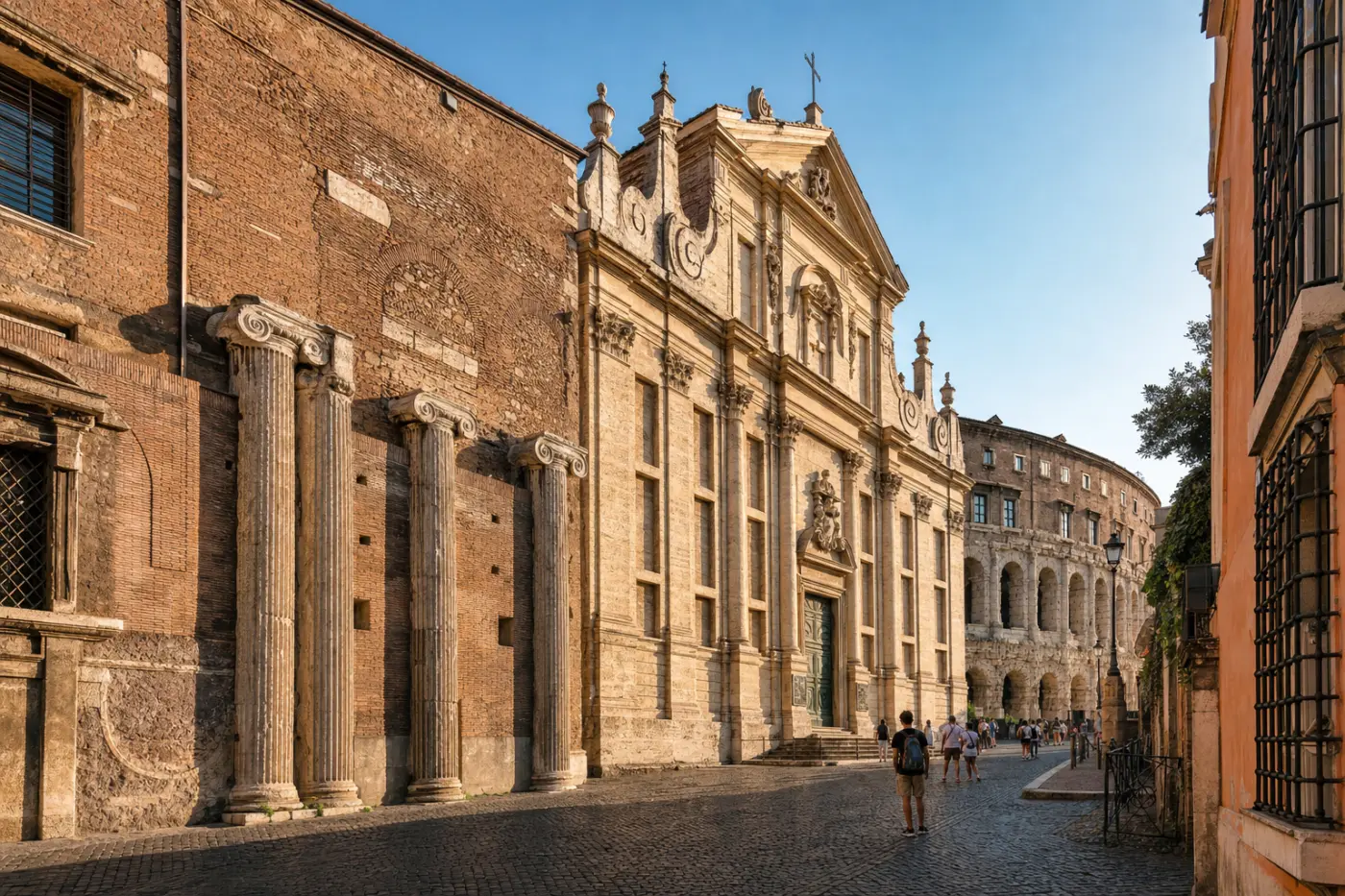
Tourist attraction
San Nicola in Carcere is a Roman Catholic basilica standing in the ancient Forum Holitorium — Rome's Republican-era vegetable and herb market — just steps from the Theatre of Marcellus in the Rione Sant'Angelo. The church's Latin name, meaning "Saint Nicholas in Prison," derives from a medieval legend that a jail once occupied the site, though the true explanation is far more remarkable: the building was constructed in the 11th century directly on top of, and incorporating the remains of, three side-by-side Roman temples dating to the 3rd and 2nd centuries BC. These temples were dedicated to Janus, Juno Sospita, and Spes (Hope), and their original tufa and travertine columns are still visibly embedded in the exterior walls of the church — some standing free, others half-absorbed into the masonry — creating one of the most striking examples of architectural palimpsest in Rome.
The church was first documented in the 10th century and rebuilt in its current Romanesque form around 1088 under Pope Urban II, who consecrated it in that year. The façade was remodelled in 1599 by the architect Giacomo della Porta, who gave it the restrained late-Renaissance appearance it retains today. Inside, the church follows a three-nave basilical plan with a raised presbytery beneath which lies a crypt that cuts directly through the podium of the ancient Temple of Janus. During restoration and archaeological campaigns carried out between the 19th and 20th centuries, excavations beneath the church floor revealed stretches of the original Republican-period street level and votive deposits, confirming the continuous sacred use of this corner of the city for over 2,300 years.
Visiting San Nicola in Carcere offers a genuinely rare experience: standing inside a functioning Christian church while touching columns that were already 300 years old when Julius Caesar was assassinated. The exterior walk around the building is essential — the north flank reveals the most intact ancient columns, their fluted shafts of the Ionic order rising cleanly from the medieval wall. The interior holds a 12th-century cosmateschi floor (geometric inlay work in coloured marble), fragments of medieval frescoes, and a gilded wooden ceiling added in the 17th century. Access to the underground archaeological area, which exposes the temple podiums and Republican-era street, is available on guided visits organized through the church.
San Nicola in Carcere sits on Via del Foro Olitorio, a short walk south from the Capitoline Hill and immediately adjacent to the Theatre of Marcellus, making it easy to combine with visits to that monument and the nearby Portico of Octavia. The church is free to enter and typically open on weekend mornings; the underground excavation requires a small fee and advance arrangement. Arrive early on a weekend to explore both levels without crowds. The surrounding neighbourhood, once the edge of the ancient Jewish Ghetto, retains its layered, unhurried atmosphere — a sharp contrast to the tourist-heavy Colosseum circuit a kilometre to the east.
Private tours with a local guide, at your own pace.
Rome
Rome

Rome

Rome

Rome
Rome
Rome
Rome
Rome
We use a single cookie, to remember this choice. We do not use analytics or advertising cookies. Read our cookie policy.