4 hrs
Rome
Rome Private Tour: Forum, Pantheon & Castel Sant’Angelo Tickets
✓ Free cancellation Kids friendly
5.0(14 reviews)
From €239/ person
Book Now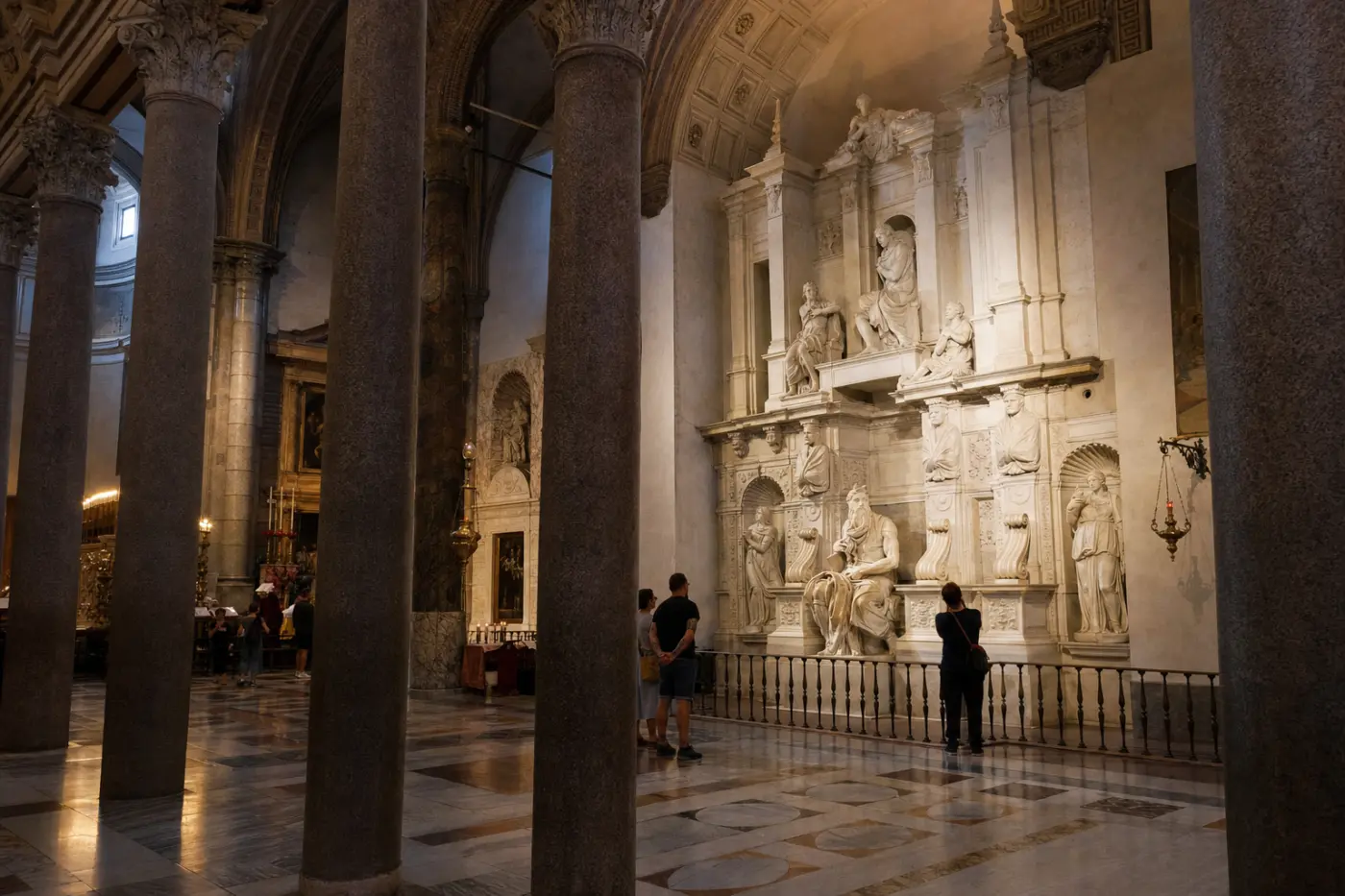
Tourist attraction
San Pietro in Vincoli — "Saint Peter in Chains" — is a titular basilica on the Esquiline Hill, steps from the Colosseum and the bohemian Monti district. Its origins trace to 432 AD, when Empress Eudoxia commissioned the church to enshrine a relic of extraordinary prestige: the iron chains (vincoli) said to have bound the Apostle Peter during his imprisonment in Jerusalem. Those links were later joined with a second set of chains from Peter's Roman captivity under Emperor Nero, and the fused relics are still displayed beneath the high altar in a golden reliquary. Pope Sixtus III consecrated the original structure, which was substantially rebuilt under Pope Sixtus IV between 1471 and 1484, giving the nave its current twenty granite columns — salvaged from ancient Roman buildings — and its cool, fortress-like elegance.
The basilica's global fame rests on Michelangelo's monumental tomb of Pope Julius II, located in the right transept. Julius II commissioned the tomb in 1505, envisioning a free-standing, three-tiered mausoleum with over forty large marble figures — a project so colossal that Michelangelo called it the "tragedy of the tomb," as it consumed 40 years of his life through repeated contractual revisions. What visitors see today is the final, reduced version completed in 1545: a two-story wall monument dominated by the seated figure of Moses at its center. Standing 2.35 meters tall and carved between 1513 and 1515, Moses is depicted at the moment he descends from Sinai, the Tablets of the Law tucked under one arm, his gaze burning with barely restrained fury. The famous horns on Moses's head stem from a medieval mistranslation of the Hebrew word "karan" (radiant) in the Vulgate Bible. Flanking Moses are the figures of Leah and Rachel, also carved by Michelangelo; the upper tier statues were largely executed by his assistants Raffaello da Montelupo and Giacomo del Duca.
Standing before Moses remains one of the most viscerally powerful encounters in all of Italian art. Sigmund Freud visited the church repeatedly between 1901 and 1913, sitting for hours in front of the statue and eventually publishing an anonymous essay in 1914 titled "The Moses of Michelangelo," analyzing the psychological tension the figure projects. The chains of Saint Peter, displayed in a glass-fronted reliquary below the altar, draw a steady stream of pilgrims — the relics are venerated each year on August 1st, the Feast of Saint Peter in Chains, when the church fills with ceremony and candlelight.
Admission to the basilica is free, but the church observes a lengthy midday closure from noon to 3:00 PM. Arriving before 10:00 AM or after 3:30 PM avoids the queues that form at reopening. A portable audio guide is available for €2 and can be shared between two visitors — it provides essential context for the tomb's long and contentious history. The church sits about a seven-minute walk uphill from the Colosseo metro station; the staircase approach through the medieval Borgia-era portico prepares you perfectly for the singular atmosphere within.
Private tours with a local guide, at your own pace.
Rome
Rome
Rome

Rome

Rome
Rome
Rome

Rome

Rome
We use a single cookie, to remember this choice. We do not use analytics or advertising cookies. Read our cookie policy.