4 hrs
London
Highlights of London Private Tour - Downtown, Notting Hill & Portobello Market
✓ Free cancellation Kids friendly
4.7(27 reviews)
From €188/ person
Book Now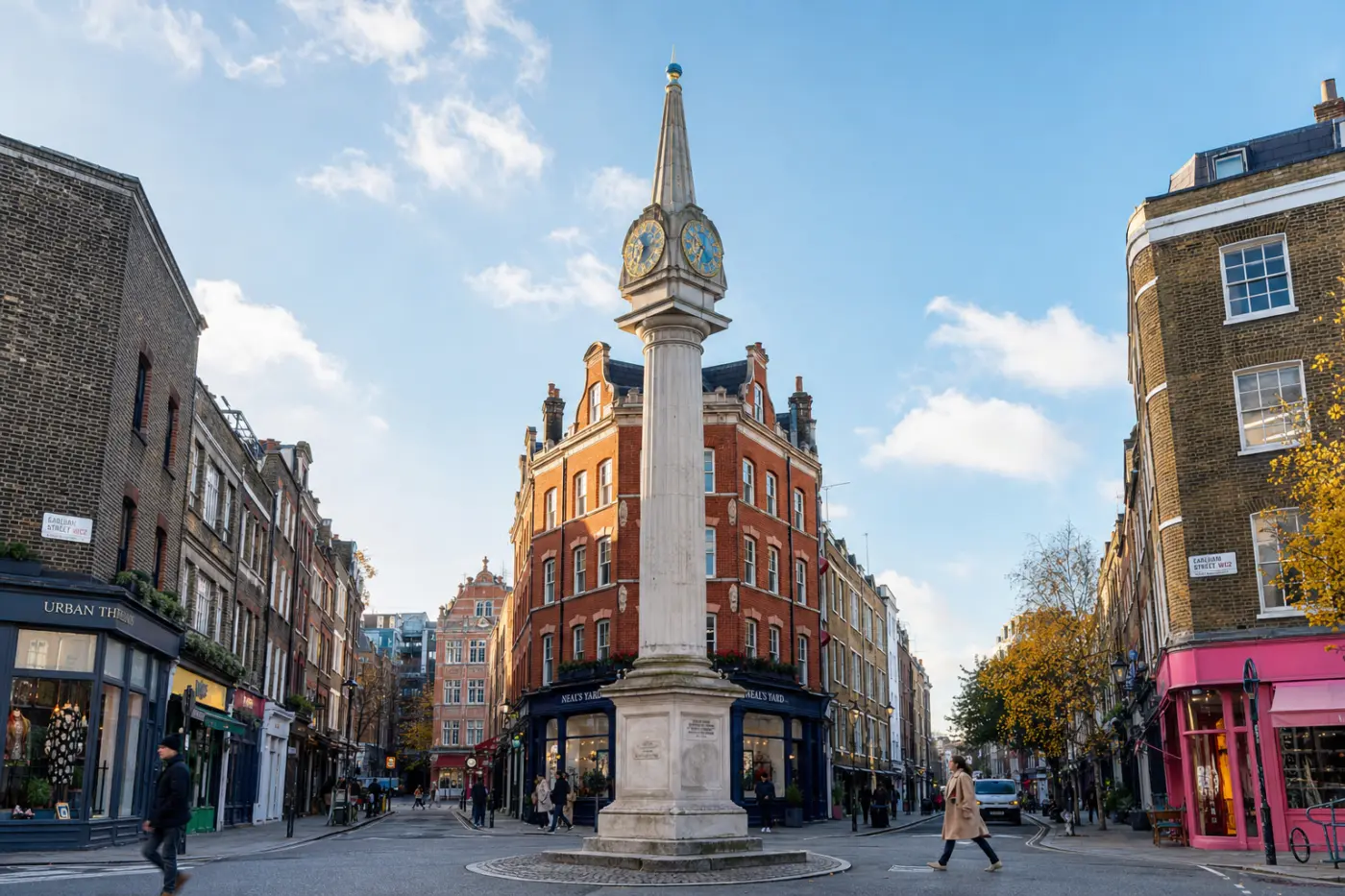
Tourist attraction
Seven Dials is the only quarter of London that survives largely intact from late Stuart England. Its defining feature — seven streets radiating from a single circular piazza — was not accidental. The developer Thomas Neale MP (1641–1699), known as "The Great Projector," obtained a Crown lease on the former Marshland Close in 1690 and converted it to freehold in 1692. His genius was geometric: by adopting a star-shaped plan rather than a conventional grid, Neale dramatically increased the total street frontage across the site, multiplying the number of leasable plots and maximising rental income, which was charged by frontage width. Construction began in March 1693, and most surviving building leases are dated 1694. Neale himself straddled three worlds of late Stuart England — the County, the Court, and the City — having served as Master of the Mint, Groom Porter to Charles II, James II, and William III, and a member of 62 Parliamentary committees. He also introduced lotteries "after the Venetian manner," the direct precursor to Britain's National Lottery.
At the heart of the junction stands a tall Doric column — the sundial pillar — designed by Edward Pierce (1630–1695), the foremost stonemason and sculptor of his generation and Master of the Painter Stainers Company in 1693. The diarist John Evelyn visited the site in October 1694 and recorded his inspection of Pierce's column in his diary. The original pillar was demolished in 1773 amid a local rumour that treasure was buried beneath it; a replica was finally restored to the junction in 1989 through the efforts of the Seven Dials Trust, returning the monument to the neighbourhood after more than two centuries. The column carries six sundial faces — one for each of the six streets visible from the pillar — while the seventh "dial" is the junction itself.
Seven Dials has a layered and often turbulent social history. After its construction it became a dense, impoverished district notorious for street ballads, broadsheet printing, and gin shops — the kind of neighbourhood Charles Dickens described in "Sketches by Boz" (1836) as a labyrinth of "squalid misery." For much of the 19th and early 20th centuries the area declined, its Georgian terraces subdivided and neglected. The turning point came in the 1970s and 1980s when the Seven Dials Trust, working in partnership with Westminster City Council and the London Borough of Camden, launched a sustained conservation effort that saved the streetscape from demolition and redevelopment. Today Seven Dials is a designated Conservation Area, its late-17th-century street layout protected and largely intact.
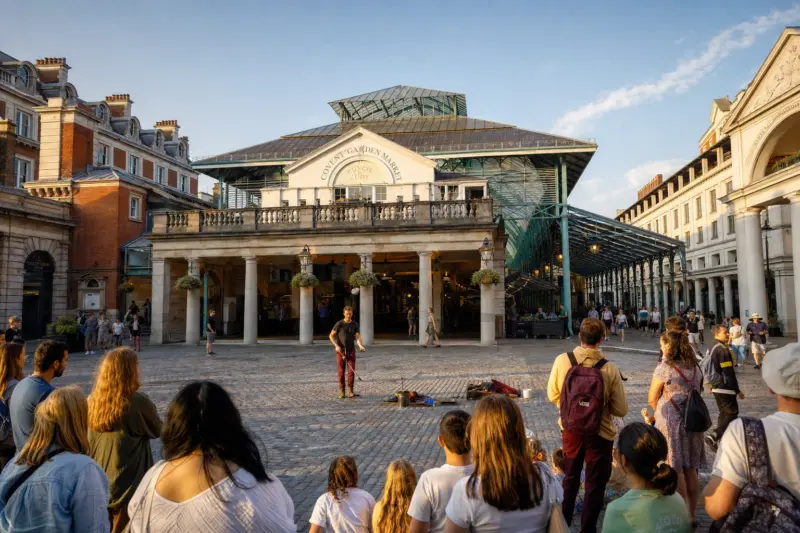
Visitors arriving at the junction encounter the restored sundial pillar surrounded by the converging mouths of Monmouth Street, Earlham Street, Shelton Street, Mercer Street, Short's Gardens, and Neal Street — each with its own character of independent shops, street food, and Victorian and Georgian shopfronts. The area sits immediately west of Covent Garden Market and north of the West End theatre district, making it easy to combine with both. The surrounding streets are pedestrian-friendly and best explored on foot; look out for the Trust's Street History Plaques fixed to buildings throughout the quarter, which document the specific trades, residents, and events associated with individual addresses.
Private tours with a local guide, at your own pace.
London

London
London

London

London

London
London
London

London
We use a single cookie, to remember this choice. We do not use analytics or advertising cookies. Read our cookie policy.