4 hrs
London
Highlights of London Private Tour - Downtown, Notting Hill & Portobello Market
✓ Free cancellation Kids friendly
4.7(27 reviews)
From €188/ person
Book Now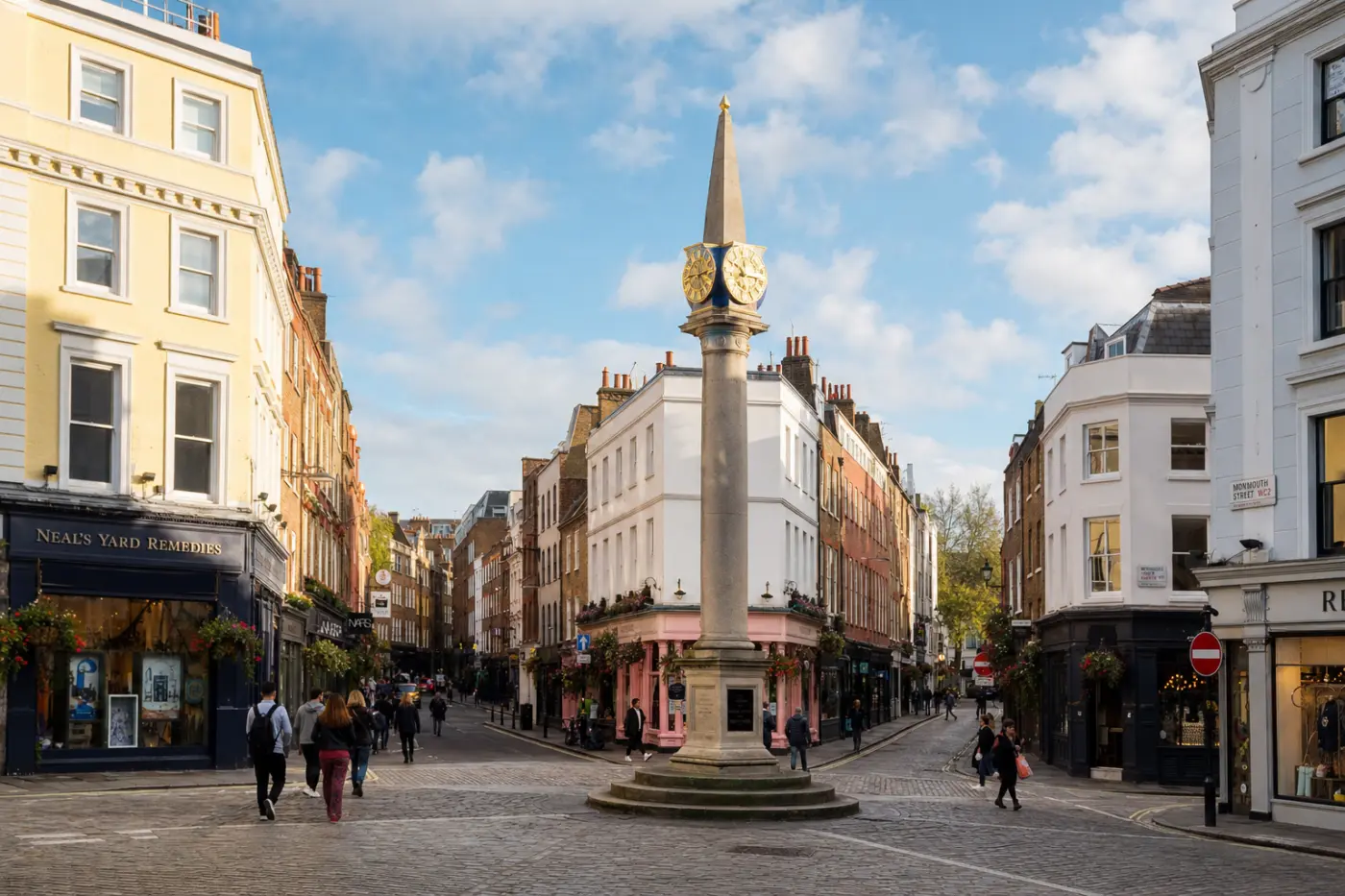
Tourist attraction
Seven Dials is a distinctive street junction in the London Borough of Camden, where seven narrow roads — Monmouth Street, Mercer Street, Shorts Gardens, Earlham Street, Shelton Street, Little Earl Street, and Earham Street's continuation — radiate from a central circus like the points of a star. The layout was conceived in the early 1690s by Thomas Neale (1641–1699), Master of the Royal Mint under Charles II and William III, who leased the land and commissioned the development as a speculative housing venture on fields north of Covent Garden. At the centre, the sculptor Edward Pierce (c.1630–1695) designed a tall Doric column capped with six sundial faces — one for each face of the hexagonal pillar — which, combined with the column itself acting as a seventh dial casting its own shadow, gave the junction its name. The original pillar was controversially removed in 1773 amid a rumour, almost certainly false, that treasure was buried beneath it; the crowd that gathered to watch the excavation grew so large it caused a riot.
Through the eighteenth and nineteenth centuries, Seven Dials acquired a notorious reputation as one of London's most overcrowded and impoverished slums, forming the southern edge of the St Giles Rookery. Charles Dickens described it in his 1836 Sketches by Boz as a place of "wild confusion," and John Keats singled it out as a byword for urban squalor. It was also the centre of London's broadsheet printing trade, where ballad sheets, political pamphlets, and sensational news prints were produced and hawked — a cheap media industry that thrived precisely because of the dense, literate-but-poor population. Agatha Christie drew on this lingering seedy reputation when she set her 1929 novel The Seven Dials Mystery partly in the district, depicting it as home to a clandestine gambling club.
The area's physical renaissance began in earnest with the founding of the Seven Dials Trust, which spent nearly four decades working alongside Westminster City Council and local landowners to restore the fabric of the streets and buildings. The centrepiece of this effort was the re-erection of the sundial pillar: a faithful recreation, carved in Portland stone and gilded, was installed in 1989. The new column contains a time capsule and was oriented with precision so that the sundial faces accurately tell the time. Today the junction is a designated Conservation Area, and its early 1690s star-shaped street plan — one of the few surviving examples of Baroque urban planning in London — remains essentially as Thomas Neale laid it out.
Visitors arriving at Seven Dials (nearest Tube: Covent Garden or Tottenham Court Road) find themselves at the junction of independent boutiques, vintage clothing shops, theatres, and cafés that have colonised the Georgian and Victorian terraces. The best vantage point for photographing the pillar is from any of the seven streets at mid-morning, when the stone catches the light cleanly. Street history plaques maintained by the Seven Dials Trust are fixed to buildings throughout the neighbourhood and reward a slow, on-foot exploration of each of the seven radiating streets.
Private tours with a local guide, at your own pace.
London

London
London
London

London
London
London
London

London
We use a single cookie, to remember this choice. We do not use analytics or advertising cookies. Read our cookie policy.