3 to 4 hrs
London
Highlights & Secrets of London Private Tour - Camden Town, Downtown & Markets
✓ Free cancellation Kids friendly
4.9(19 reviews)
From €267/ person
Book Now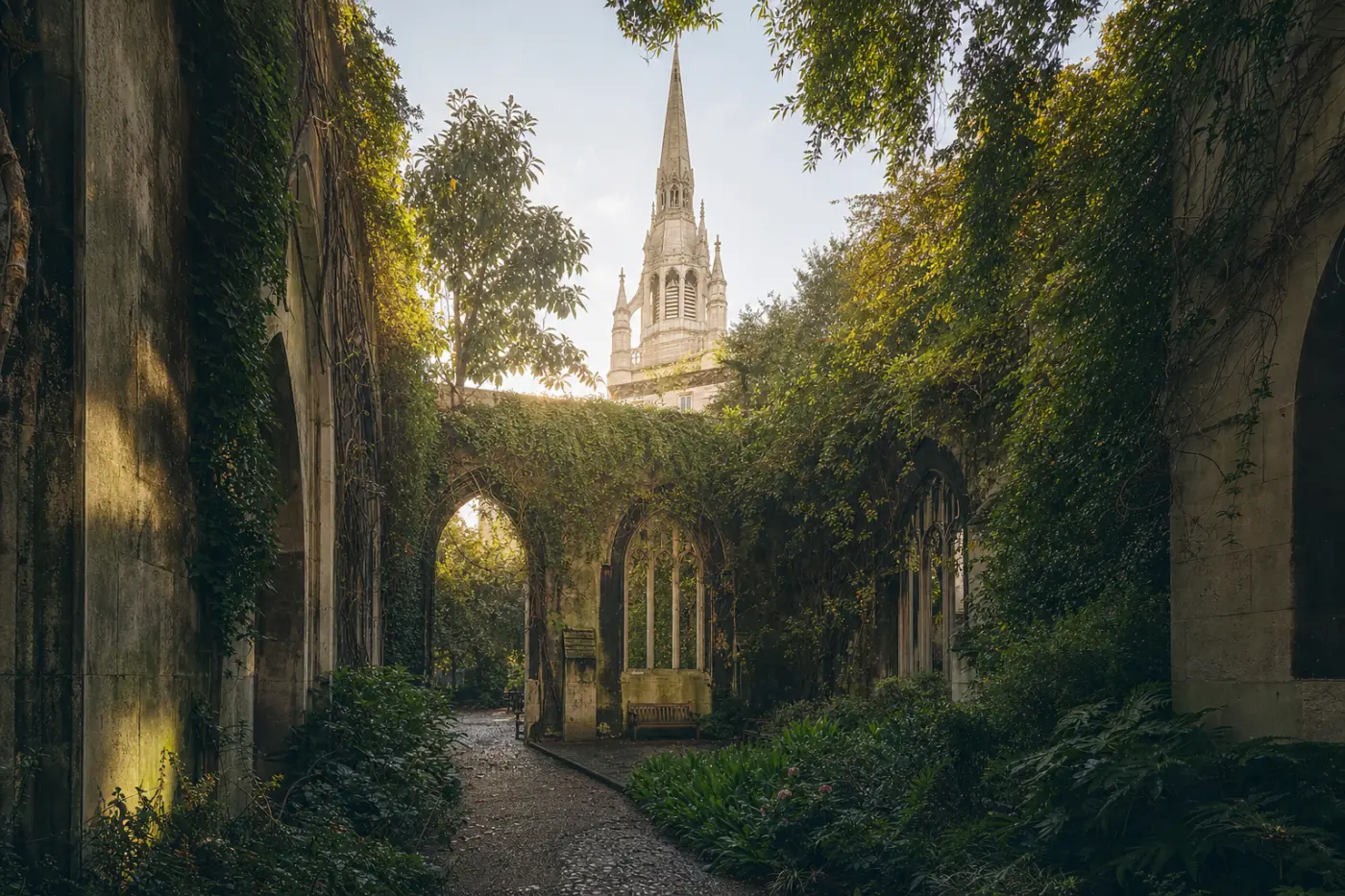
Tourist attraction
St. Dunstan in the East stands on St Dunstan's Hill in the City of London as one of the most quietly extraordinary sites in the capital — a medieval church tower, a Christopher Wren steeple, and a bombed-out nave, all swallowed by a lush public garden. The church takes its name from Dunstan of Glastonbury, born in 909 CE, who rose to become Archbishop of Canterbury in 960 and was the most venerated English saint until Thomas Becket's martyrdom in 1170 displaced him. At least two London churches were dedicated to him; this one, positioned close to the Tower of London, appears in records as early as the 12th century, serving a medieval city so dense — roughly 80,000 people packed within the Square Mile's walls — that its average parish covered no more than four football pitches.
The church survived the Great Fire of 1666 largely intact, one of only a handful of City churches to do so, though its tower required reinforcement shortly after. Sir Christopher Wren added his distinctive Gothic Revival-style steeple between 1695 and 1701 — a deliberately unusual choice for Wren, who favoured classical idioms in his 51 other City commissions. The steeple uses flying buttresses to carry its lantern tower, a form borrowed from medieval Gothic architecture and virtually unique among Wren's output. The nave was substantially rebuilt and enlarged in 1817 by architect David Laing. That rebuilding proved tragically temporary: German bombing raids in December 1940 gutted the nave entirely, leaving only the perimeter walls, the medieval tower at the west end, and Wren's steeple standing.
Rather than demolish the shell, the City of London Corporation made the inspired decision to convert it into a public garden, which opened in 1971. Today, climbing plants — wisteria, fig, ivy, and Virginia creeper — cling to the roofless Gothic window arches and crumbling stone walls, creating an atmosphere closer to a romantic folly than a war ruin. Benches are tucked into what were once side aisles, and the central path runs the length of the former nave beneath an open sky. On a weekday lunchtime the garden fills with office workers; on quiet mornings it can feel entirely private despite sitting just minutes from Monument and the Walkie-Talkie tower.
Entrance is free and the garden is generally open during daylight hours, though it is worth checking City of London Corporation notices for seasonal closures. The nearest Underground stations are Monument (Circle and District lines) and Tower Hill (Circle and District lines), each roughly a five-minute walk. The garden is small — plan 30 to 45 minutes — but pair it with a walk along the Thames foreshore at low tide or a visit to All Hallows by the Tower nearby, and you have a compelling half-day in this corner of historic London.
Private tours with a local guide, at your own pace.
London
London

London
London

London

London
London

London

London
We use a single cookie, to remember this choice. We do not use analytics or advertising cookies. Read our cookie policy.